
Main Page
Welcome to the ALB Wiki — a programming encyclopedia written by everyone, for everyone. Anyone can edit any page, create new pages, and file them in categories. Every edit is kept in the history forever.
AdaLogic BASIC
- AdaLogic BASIC — the language itself: what it is and what it's for
- Handbook — the official language reference on the main site
- Browser IDE — write and run ALB without installing anything
- Source on GitHub — the compiler and toolchain are Apache 2.0 open source
Featured article
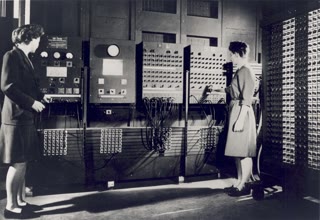
History of Programming — from punched cards on looms in 1801 to the AI-assisted editors of today: the complete tour of how telling machines what to do became its own craft. Nine public-domain photographs, the whole link web, and the reason AdaLogic BASIC exists — "programming belongs to everyone."
Latest from ALB
Original articles and announcements from the ALB Team.
- ALB Wiki Launches News — the wiki now supports news articles with full markup, datelines, and a chronological hub at Special:News.
See all articles: Special:News · Category:News
Explore the trails
Follow the links — every article connects to the next.
The dawn of programming
Jacquard Loom → Joseph-Marie Jacquard → Punched card → Charles Babbage → Analytical Engine → Ada Lovelace → Bernoulli numbers → Herman Hollerith → IBM
A loom's card chain becomes a census tabulator becomes the company that carried cards into the computer age.
The codebreaking war
Sir Hugh Sinclair → Bletchley Park → Alan Turing → Colossus
The admiral who bought a country estate with his own money; the mathematicians who filled it; the secret computer that helped win a war.
The first programmers
The first programmers — Kay McNulty · Betty Jennings · Betty Snyder · Marlyn Wescoff · Fran Bilas · Ruth Lichterman — then EDVAC report → John von Neumann → Manchester Baby → EDSAC
Six women who programmed ENIAC by rewiring it, and the stored-program machines that followed.
The age of languages
COBOL → Grace Hopper → FORTRAN → LISP → ALGOL
The committee language that won't die, the admiral who built the first compiler, and the three 1950s languages that set every convention since.
The living-room computer
Konrad Zuse → Z3 → Plankalkül
While governments funded computing projects, a civil engineer built the first working computer in his parents' apartment — then designed the first high-level programming language while hiding in an alpine barn.
Did you know?
- The first published computer program was written for a machine that didn't exist — Ada Lovelace's Bernoulli numbers method for the Analytical Engine, 1843.
- Bletchley Park was bought by the head of MI6 with his own money, when the government wouldn't fund it.
- "Debugging" comes from a moth taped into a logbook at Harvard in 1947 — see Grace Hopper.
- The chief of Britain's Secret Intelligence Service still signs papers "C" in green ink — a convention Sir Hugh Sinclair inherited and kept.
- A portrait of Joseph-Marie Jacquard was woven in silk by his own invention — about 24,000 punched cards of program.
- Plimpton 322, a Babylonian clay tablet from c. 1800 BCE, lists exact Pythagorean triples — a thousand years before Pythagoras. See History of Mathematics.
- The letter A is a 4,000-year-old ox — Egyptian hieroglyph ox-head → Semitic aleph → Greek alpha → A. See History of Language.
- The word electricity comes from the Greek for amber — fossilized tree sap was the first known generator. See History of Electricity.
- Alonzo Church's Princeton PhD students included Turing, Kleene, Rosser, Henkin, Davis, Rabin, Scott, and Smullyan — arguably the greatest advising record in the history of computing.
- Months before Donna Strickland won the 2018 Nobel Prize in Physics, a Wikipedia draft about her was declined for notability. Lesson: write the article anyway.
- The USSR's first machine-translation laboratory had no founding order: it came into existence the day its first lab assistant, Nina Leontyeva — a girl born above the Arctic Circle — was hired, 1 May 1959.
Inside the wiki
- Special:Statistics — page and edit counts
- Special:AllPages · Special:Categories · Special:Random
- Special:RecentChanges — every edit as it happens
- Special:LonelyPages · Special:DeadendPages — pages waiting for links
- Wiki Help — the full markup guide: links, images, infoboxes, redirects
Ground rules
- Be helpful and family-friendly.
- Write what you know; fix what you can.
- Summaries help everyone — leave one when you edit.