
Betty Jennings
Betty Jean Jennings Bartik — born Elizabeth Jean Jennings (27 December 1924 – 23 March 2011), who went by "Jean" on the ENIAC team — two Bettys was one too many — and took the name Bartik on her marriage — was an American mathematician and one of the six original programmers of ENIAC. Of the six, she went furthest: she became lead programmer on BINAC and UNIVAC I, the first American commercial computers, and is often described as the one who understood ENIAC most completely.
From the farm to Philadelphia
Jennings was born on a farm in Gentry County, Missouri — the seventh of eight children — and went to a one-room schoolhouse, reportedly riding there on horseback and skipping grades. She put herself through Northwest Missouri State Teachers College in Maryville and graduated in 1945 with a degree in mathematics — the school's only math major that year.
IBM interviewed her for a position and turned her down; the oft-told version says the interviewer found her too short. Instead she answered an Army advertisement for "human computers" — women hired to hand-calculate artillery firing tables — and took the train to the University of Pennsylvania's Moore School of Electrical Engineering in Philadelphia. IBM's rejection letter became, in hindsight, the luckiest piece of paper in computing.
ENIAC
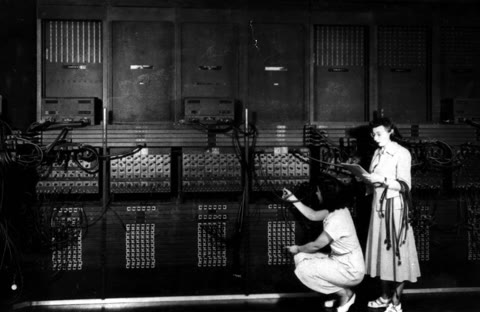
When ENIAC's six programmers were chosen, there were no manuals, no languages, and no teachers — the Army handed them wiring diagrams and access. Jennings learned the machine by studying its blueprints at night, and it showed: she became the one colleagues describe as understanding ENIAC whole — every accumulator, every function table, every cable.
Programming meant rewriting the problem physically: a shell's trajectory was decomposed into differential equations, mapped onto ENIAC's twenty accumulators, then realized by running cables between panels and setting thousands of switches. The women worked in pairs — Jennings with Betty Snyder — and invented the discipline as they went: flowcharts to plan the routing, subroutines to reuse it, and debugging when the machine disagreed.
The demonstration
Jennings was put in charge of the team that staged ENIAC's public unveiling on 15 February 1946. The machine computed a sixty-second artillery trajectory in about twenty seconds — faster than the shell's flight — while reporters watched. In the press coverage that followed, the six programmers were cropped, forgotten, or misidentified as models posing with the machine. The women who had made the demonstration possible weren't invited to the celebratory dinner.
Stored-program conversion
In 1948 Jennings co-led, with Richard Clippinger, the conversion of ENIAC to run its instructions from function tables — a primitive stored-program mode that made the machine dramatically easier to program and pointed directly at the EDVAC-era architecture that was coming. It was one of the first times an existing machine was reconfigured by reprogramming its own control, and Jennings was at its center.
BINAC and UNIVAC
When Eckert and Mauchly left Penn to found their own company, Jennings went with them — the only one of the six who would program all three of the era's pioneering machines. She became programming lead on BINAC (1949), the first true stored-program computer built in America, whose checkout period was so chaotic she reportedly kept it running by feel; and then on UNIVAC I, delivered to the Census Bureau in 1951, where she led the programming group and wrote code for the machine's acceptance tests.
She liked to say she was the only person alive who had programmed all three of the era's pioneering machines — ENIAC, BINAC, and UNIVAC. She was probably right.
After the machines
Jennings married William Bartik in December 1946 and left the industry in 1951 to raise their children — just as the field she had helped invent began to boom. She returned to computing in the 1960s as a technical editor at Auerbach Publishers, documenting and standardizing the industry she had helped create, and later worked at Data Decisions.
In 1986, Harvard undergraduate Kathy Kleiman tracked down the women in the uncaptioned ENIAC photographs and began the work of restoring them to the record. Jennings embraced the role of witness — she gave talks, taught herself email, and spent her last decades making sure the story was told straight. Her memoir, Pioneer Programmer, appeared in 2013 — the fullest first-person account of the six.
Legacy
- Inducted into the Women in Technology International Hall of Fame in 1997 with the other five ENIAC programmers
- IEEE Computer Pioneer Award (2008) and Computer History Museum Fellow (2008)
- Honorary doctorate from Northwest Missouri State, which renamed a museum and a fellowship for her
- Her memoir remains the primary source for how ENIAC was actually programmed — the technique, the teamwork, and the erasure
She died in Poughkeepsie, New York, on 23 March 2011 — having lived long enough to be transformed in public memory from an anonymous "refrigerator lady" to a founding programmer of the computer age.
See also
- The first programmers — the six together
- Kay McNulty · Betty Snyder · Marlyn Wescoff · Fran Bilas · Ruth Lichterman
- Bletchley Park · Grace Hopper
- History of Programming
References
- Kleiman, Kathy. Proving Ground: The Untold Story of the Six Women Who Programmed the World's First Modern Computer (Grand Central, 2022).
- Haigh, Thomas, Mark Priestley, and Crispin Rope. ENIAC in Action: Making and Remaking the Modern Computer (MIT Press, 2016).
- Evans, Claire L. Broad Band: The Untold Story of the Women Who Made the Internet (Portfolio, 2018).
- Honeywell v. Sperry Rand, 180 U.S.P.Q. 673 (D. Minn. 1973) — the ENIAC patent trial.