
Charles Babbage
Charles Babbage (26 December 1791 – 18 October 1871) was an English mathematician, inventor, and — a century early — the designer of the first general-purpose computer. He never saw one built: his Difference Engine died of cost overruns and feuds, and his Analytical Engine existed only as thousands of drawings. Yet his machine's architecture — memory, processor, program cards, output — is the architecture computers still have.
The Difference Engine
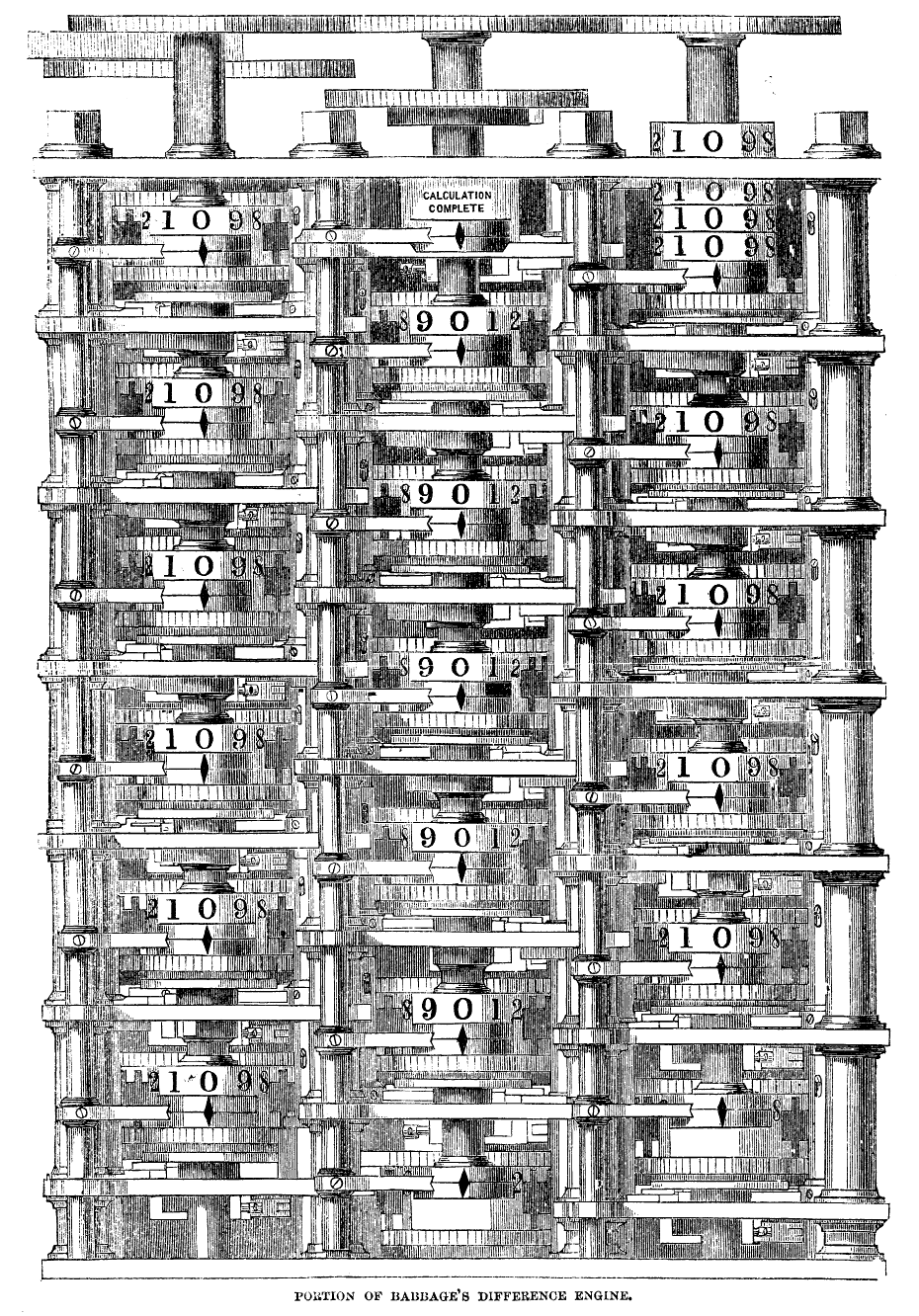
Babbage's first great project was a machine to compute and print mathematical tables automatically, ending the era of error-ridden hand-calculated tables that cost lives at sea — navigational tables with mistakes were a documented cause of shipwrecks, and Babbage had personally found errors in official tables. Begun around 1822 with generous British government funding — ultimately some £17,000, roughly the cost of a warship — the Difference Engine ground gears to produce polynomial tables by the method of finite differences: if you know the first few values of a polynomial, every later value falls out of repeated addition, and addition is something brass wheels do well.
It was never finished. Disputes with his engineer Joseph Clement — who legally owned the specialized machine tools — spiraling costs, a move of the workshop that stalled progress for a year, and Babbage's own uncompromising temperament burned through the money and the government's patience. A completed Difference Engine No. 2, built from his plans by the Science Museum in London in 1991, worked exactly as designed — vindication 120 years late.
The Analytical Engine
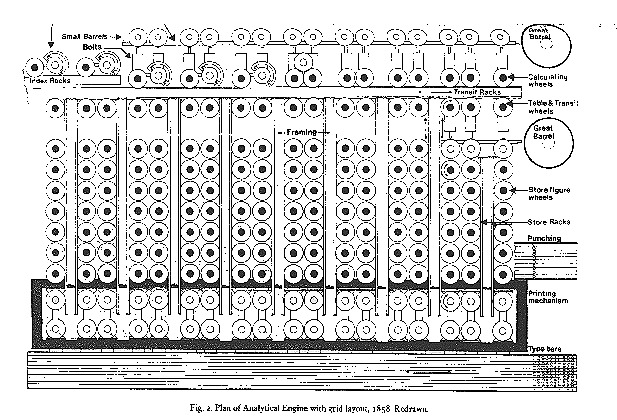
Abandoning the single-purpose Difference Engine, Babbage designed something far greater: the Analytical Engine, a general-purpose machine controlled by the punched cards of the Jacquard loom. With a memory store, an arithmetic "mill," conditional branching, and printed output, it was a computer in every modern sense — designed before the light bulb.
It was for this machine that Ada Lovelace wrote her famous notes in 1843, and it was Babbage's failure to build it that left her program — and his design — waiting nearly a century for hardware that could run them.
Babbage kept refining it to the end of his life — he produced thousands of pages of drawings and dozens of notational systems to describe mechanisms that did not yet exist. His son Henry assembled a small piece of the mill in 1888 and showed it could compute; a full engine was never attempted. Modern engineers studying the plans keep reaching the same verdict: the design is sound, and the 1991 Difference Engine proved the nineteenth century could have machined it.
The man
Babbage held the Lucasian Chair of Mathematics at Cambridge — Newton's chair — for eleven years (and never once lectured). He founded the Astronomical Society, helped found the Royal Statistical Society, worked on cryptography — he cracked the supposedly unbreakable Vigenère cipher in the 1850s and never published it — pioneered operational economics with On the Economy of Machinery and Manufactures (1832), and designed railway recorders, lighthouse signaling, and an ophthalmoscope.
He was brilliant, combative, and famously unable to suffer fools: he waged a documented war on London's street musicians, who responded by serenading his house — sometimes a hundred players at once. He died in 1871 with the Analytical Engine unbuilt; half his preserved brain rests at the Science Museum.
Legacy
- The template of store + mill + program + output is today's memory + CPU + code + I/O — he drew it in 1837.
- His lineage runs through Ada Lovelace to the Ada language and onward to AdaLogic BASIC, which carries her name's inspiration into a modern BASIC.
- "Babbage's complaint" — "I wish to God these calculations had been executed by steam" (1821) — is the founding gripe of all automation.
See also
- Analytical Engine
- Ada Lovelace · Bernoulli numbers
- Jacquard Loom · Punched card
- Herman Hollerith · Alan Turing
- History of Programming
References
- Menabrea, Luigi Federico (tr. Ada Lovelace). "Sketch of the Analytical Engine invented by Charles Babbage." Taylor's Scientific Memoirs 3 (1843) — includes Lovelace's Notes A–G.
- Babbage, Charles. Passages from the Life of a Philosopher (Longman, 1864).
- Swade, Doron. The Cogwheel Brain: Charles Babbage and the Quest to Build the First Computer (Little, Brown, 2000).