
Biological Computing
Somewhere in a Melbourne laboratory, on a silicon chip the size of a postage stamp, there is a small civilization of human neurons. They were once ordinary blood cells, donated by adults, reprogrammed backwards into stem cells, and then coaxed forward into brain cells. Now they live in a nutrient bath, kept warm and oxygenated, their chatter picked up by a grid of electrodes — and they are working. They play games. They respond to patterns. If you are a paying customer of Cortical Labs, they may even run your code.
This is biological computing — or wetware, in the field's own slang — and it has quietly crossed from laboratory curiosity to commercial product. In March 2025 a machine called the CL1 went on sale for $35,000: the world's first commercially available biological computer, carrying ~800,000 living human neurons on a silicon chip, programmable through a Python SDK, rentable by the week over the internet.[1] In Switzerland, a company called FinalSpark rents access to brain organoids — millimetre-scale balls of neural tissue — for $500 a month. At Johns Hopkins, a consortium has published a formal roadmap for organoid intelligence, arguing that biocomputers could eventually outperform silicon "in speed, processing power, data efficiency, and storage."[2]
The pitch is not science fiction. It is arithmetic. A human brain performs on the order of 10¹⁶ operations per second — comparable to an exascale supercomputer — while running on about 20 watts, roughly a light bulb. The machine in this article's own category, the exascale Frontier supercomputer, draws about 22 megawatts — a million times more, to do a similar amount of work. Evolution spent four billion years optimizing wet, squishy, extremely efficient computation. Silicon, by comparison, is sixty years old and enormously wasteful. The question the field is asking is whether we can borrow what biology already knows.
This is the story of how a neuron became a computer — from the drawings of a Spanish anatomist to a dish of brain cells learning Pong — and of what might happen when the computers are alive.
The discovery of the neuron
Physics began, arguably, with a man and a bathtub. Biological computing begins with two men who hated each other sharing a Nobel Prize.
In the 1870s Camillo Golgi invented a staining technique — the reazione nera, "black reaction" — that could dye a few whole neurons at random in a slice of brain tissue, rendering them visible under a microscope for the first time. Santiago Ramón y Cajal took Golgi's stain, improved it, and spent years drawing what he saw: not a continuous web, as Golgi believed, but separate cells, each touching others across tiny gaps, each apparently a one-way device taking in signals at one end and passing them out the other. Cajal's drawings — of Purkinje cells like elaborate corals, of pyramidal neurons like root systems — established the neuron doctrine: the brain is made of discrete cells, and information flows through them in a direction.[3]
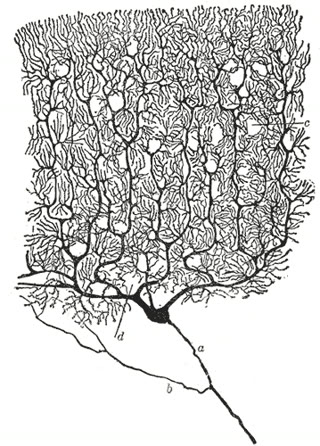
If a neuron is a one-way switch, then a brain is a machine — 86 billion switches wired together — and the question of whether neurons could compute becomes a matter of engineering rather than philosophy. Everything in this article follows from Cajal's ink.
The equation of the spike
What kind of signal does a neuron actually send? In the 1930s two Cambridge physiologists, Alan Hodgkin and Andrew Huxley, found the ideal experimental animal: the squid, whose motor neurons include a giant axon a full millimetre thick — thick enough to thread electrodes inside. By the early 1950s they had measured exactly how the neuron's membrane lets sodium and potassium ions rush in and out in sequence, generating the electrical spike — the action potential — that travels down the axon to the next cell.
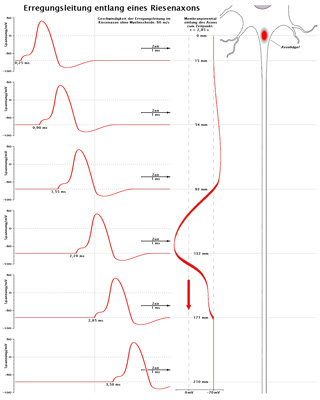
Their model — four coupled differential equations — reproduced the spike so precisely it is still taught unchanged today, and won them the 1963 Nobel Prize.[4] The Hodgkin–Huxley equations did something deeper than explain a squid: they showed that a cell's behavior could be written as mathematics. The neuron was now computable — which meant, in principle, you could compute with neurons.
Life on the wire
By the 1970s, researchers could keep neurons alive outside a body — cultured in a dish, on nutrient medium — and the neurons did something remarkable without any instruction: they grew axons and dendrites, found each other, and formed networks. By the 1990s engineers could grow those cultures directly on multi-electrode arrays (MEAs) — chips patterned with dozens or hundreds of tiny electrodes — and for the first time read and write the traffic of a living network in real time.
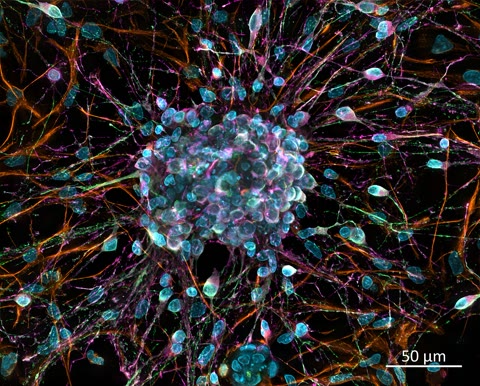
And the traffic was strange. A culture of cortical neurons does not sit quietly waiting for input like a circuit waiting for instructions. Left alone, it produces synchronized bursts — waves of spikes that sweep the whole culture at once, then silence, then another wave. The bursts are not random noise. In 2003, John Beggs and Dietmar Plenz showed that the sizes of these neuronal avalanches follow a power law — the signature of a network poised at criticality, the knife-edge between rigid order and explosive chaos, the same mathematical state sandpiles sit at before they slide.[5]
Criticality turned out to be the answer to "why is a brain so good at learning?" — a network at the edge of chaos has maximum dynamic range, maximum information capacity, and maximum sensitivity to small changes. The chaos is not a bug in the dish. The chaos is the substrate. Everything biological computing does depends on it.
The robot with a rat brain
The first proof that a dish of neurons could do something came from Steve Potter's lab at Georgia Tech around 2001. Potter plated ~50,000 rat cortical neurons on an MEA, wired the chip to a robot arm, and closed the loop: the culture's firing patterns moved the arm; sensors fed information back into the culture as electrical stimulation. The neurons — which had never been in a body, had never "intended" anything — began controlling the robot, and their firing patterns changed as they adapted to the task. Potter called it a hybrot: a hybrid of living tissue and machine.[6]
The Australian art collective SymbioticA took the idea further and stranger: MEART — The Semi Living Artist (2003–2007) grew rat neurons on an MEA in Atlanta and connected them, over the internet, to a robotic drawing arm exhibited in Perth. A dish of brain cells in Georgia made drawings in Australia. It was art, but it was also a working demonstration: cultured neurons + electrodes + a closed loop = a device that learns to act in the world.
The other biocomputer
Neurons are not the only living hardware. In 1994, computer scientist Leonard Adleman — the "A" in RSA encryption — did something no one had tried: he solved a real math problem with DNA. He encoded a seven-city routing puzzle (a directed Hamiltonian path problem) into strands of DNA, mixed them in a test tube, let them self-assemble into every possible route through the graph at once, and then used standard biochemistry to fish out the strands that satisfied all the constraints. The answer came out of the tube.[7]
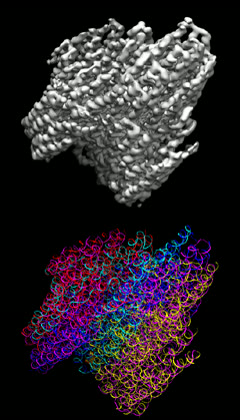
DNA computing never became practical for general-purpose work — the molecules are slow, error-prone, and single-use — but it founded molecular computing as a real discipline, gave us DNA origami (folding DNA into programmable nanostructures), and pointed to DNA's actual superpower: storage. A gram of DNA can theoretically hold ~455 exabytes — more than every data center on Earth, in a test tube. Microsoft and others have already stored files this way. The molecule that stores genomes can store anything.
DishBrain: the dish that learned Pong
In October 2022, a small Melbourne startup called Cortical Labs, working with UCL's Karl Friston — the most-cited neuroscientist alive and architect of the free energy principle — published a paper that made the field real. They had built DishBrain: ~800,000 neurons, grown from human stem cells (and, in separate cultures, mouse brains), plated on a high-density MEA and connected to a computer running Pong.
The setup was elegant. The electrodes told the neurons where the ball was — stimulation frequency encoding distance. When the culture fired in the right motor regions, the paddle moved; when it hit the ball back, the system gave the neurons a predictable, ordered electrical pattern. When it missed, it got unpredictable noise. Within five minutes of real-time play, the cultures had reorganized their firing to play better — longer rallies, fewer misses — and control cultures given random feedback did not learn at all.[8]
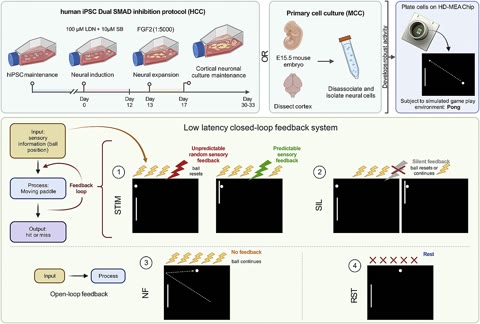
The paper's title used the word sentience — deliberately, in a narrow technical sense meaning "responsive to sensory input in a goal-directed way," not consciousness — and it set off a firestorm of coverage anyway. The authors spent months clarifying that the dish was not a mind; it was a system that learned, which is a different and already extraordinary claim. But the word got out, and the question it raised — how would we know? — turned out to be the field's defining problem. (See The question nobody can answer, below.)
The chaotic heart — why you can't program a dish
This is the part of the technology that makes every other kind of computing look tame, and it is worth understanding precisely.
A silicon neural network is a set of numbers. To train it, an algorithm — backpropagation — walks backward through the numbers and nudges each weight by a calculated amount. You always know exactly what changed and why. A biological neural network (BNN) has no weights to adjust. It has ~800,000 living cells, each making thousands of synapses, each synapse continuously strengthening or weakening according to local rules the cells evolved on their own.
The local rules are the deep part:
- Hebbian plasticity — "cells that fire together, wire together." If neuron A reliably helps fire neuron B, the synapse between them strengthens. The network literally carves the patterns it repeats into physical structure.
- Spike-timing-dependent plasticity (STDP) — the timing matters to milliseconds. If A fires just before B, the link strengthens (A predicted B); if A fires just after, it weakens. A dish of neurons is constantly, automatically learning causality.
- Criticality — as Beggs and Plenz showed, the network self-organizes to the edge of chaos. Too ordered and it can only repeat; too chaotic and nothing propagates. Living networks hold the knife-edge where information flows best — and they hold it on their own.
So a wetware "programmer" does not program. The FinalSpark Neuroplatform paper puts it flatly: "unlike ANNs, where updating digital tensors can instantly modify network responses, entirely new methods must be developed for neural networks using biological neurons."[9] What you shape is the environment — the statistics of the stimulation. DishBrain's closed loop was the first working example: not a program, a world. The neurons, doing what neurons have done for half a billion years, minimized their surprise by getting better at the game.
CL1 — the product
In March 2025, at Mobile World Congress in Barcelona, Cortical Labs launched the CL1 — the first commercial biological computer. The machine is shoebox-sized and self-contained: a chip carrying ~800,000 human neurons reprogrammed from adult donor blood or skin cells, a life-support system that feeds them, removes waste and keeps them alive for up to six months, a touchscreen, and no external computer required.[10]
The price: $35,000 per unit, or $20,000 each in 30-unit racks drawing ~850–1,000 watts — roughly a space heater for a rack of living brains. For labs that don't want to own one, Cortical Labs offers Wetware-as-a-Service at about $300 per unit per week, and in 2025 opened Cortical Cloud — a hosted fleet of CL1 nodes accessible through a public Python SDK, so any researcher with an API key can run experiments on living neurons from anywhere.[11]
The software layer is what makes it a computer rather than a biology experiment. Cortical Labs' biOS — Biological Intelligence Operating System — runs the simulated world the neurons inhabit, sends their environment in as stimulation, and reads their responses back as computation. You write Python; the biOS translates it into the language of spikes. "Deploy code directly to the real neurons," the company's documentation puts it — "self-programming, infinitely flexible, and the result of four billion years of evolution."[12]
Karl Friston — who co-authored the DishBrain paper — offered the field's most quoted assessment: the CL1 "could be regarded as the first commercially available biomimetic computer, the ultimate in neuromorphic computing that uses real neurons… However, the real gift of this technology is not to computer science. Rather, it's an enabling technology that allows scientists to perform experiments on a little synthetic brain."[13]
The Swiss rent-a-brain
Meanwhile, in Vevey, Switzerland, FinalSpark took the organoid route and put it on the internet first. Its Neuroplatform, opened to researchers in 2024 and to paying academic customers since, hosts brain organoids — 3D spheres of neural tissue about half a millimetre wide — on electrode arrays, four organoids per processing unit, accessible 24/7 from a browser. The price for academia: $500 per user per month, or free for selected projects.[14]
The details are genuinely strange. The organoids live over 100 days in automated microfluidic incubators that feed them without human intervention; researchers stimulate and record through an eight-electrode interface per organoid; and FinalSpark's training trick is chemical — neurons are bathed in dopamine when they produce the desired response, mimicking the brain's own reward system. Over three years the platform has hosted more than 1,000 organoids and collected 18 terabytes of neural data. Co-founder Fred Jordan states the goal plainly: "artificial intelligence for 100,000 times less energy."[15]
Organoid intelligence
The most ambitious plan belongs to Johns Hopkins' Thomas Hartung and a multidisciplinary consortium, who in February 2023 published a formal roadmap for organoid intelligence (OI) — biocomputers built on 3D brain organoids rather than flat cultures.[16] Their argument: organoids can model the architecture, myelination and learning circuitry of real brains better than 2D cultures ever could, and the field should aim to scale today's ~50,000-cell organoids toward 10 million cells — with the interfaces, microfluidics and ethics frameworks built alongside, not after.
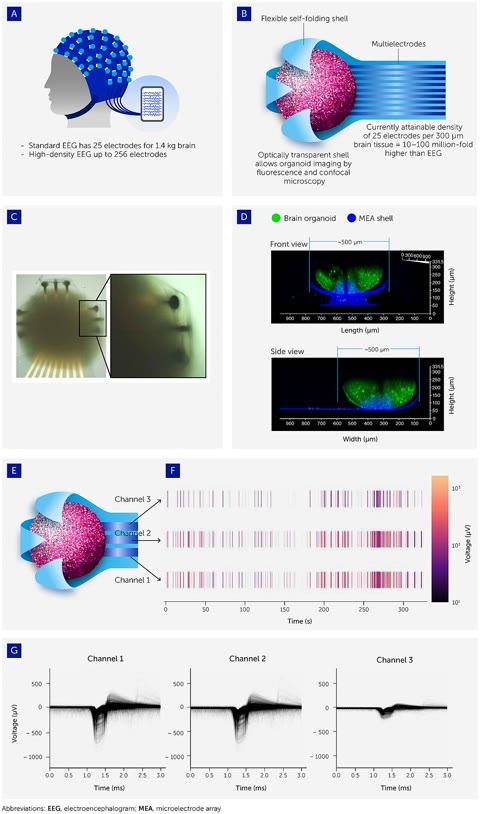
Hartung's team already built the prototype of that interface — a flexible shell densely covered in electrodes that wraps around an organoid like, in his words, "a kind of an EEG cap for organoids." The roadmap is explicit that the goal is not a brain in a vat but a computational substrate: organoids as biological hardware, trained by biofeedback and big data, connected to real-world sensors — and, eventually, to each other.
What has already happened
Wetware is not a proposal; it has a track record. In rough order of what the dishes have already done:
- Learned a game in five minutes — DishBrain's Pong result, with human and mouse cultures, closed-loop only, controls confirming it was the structured feedback doing the work
- Controlled a robot — Potter's hybrot, two decades before the commercial era
- Made art across an ocean — MEART's Atlanta neurons drawing in Perth
- Survived as a product — the CL1 shipping at $35k with an SDK and a cloud service
- Been rented by the month — FinalSpark's platform, 1,000+ organoids, 18TB of data
- Published an ethics framework — the OI field's own roadmap includes the governance questions before the technology outruns them
What might happen
Here the honest flag: everything below this line is extrapolation, and the field itself marks the difference carefully.
Near-term (real roadmaps): drug screening on human neurons instead of animals — the CL1's first pitch is "animal-free testing" with more relevant data; disease modeling for epilepsy, Parkinson's and autism on patient-derived neurons; robotics with wetware that adapts faster than any trained network; edge computing where milliwatts matter.
Medium-term (extrapolation): hybrid systems where organoids handle the messy, adaptive parts of a problem and silicon handles the bookkeeping; organoid brains learning in silico before being transplanted; the Johns Hopkins scaling goal of 10 million cells per unit; wetware data centers that grow their own processors.
The arithmetic nobody can ignore: if biological computing reaches even a fraction of its theoretical efficiency, the economics of computation change. A million-fold improvement in joules per operation is the difference between a megawatt data center and a light bulb — and between AI as a planetary energy drain and AI as a living process that costs less than the food it eats.
And the uncomfortable one: if these systems ever cross some threshold of complexity — the organoids keep getting bigger, the loops keep getting richer, the training keeps getting better — at some point we may have to ask whether the dish is not just computing but experiencing. Nobody currently knows where that line is. The DishBrain authors said "sentience" in a narrow sense and spent a year explaining they meant it; the field has not stopped using the word carefully since.
The question nobody can answer
The ethics are not hypothetical; the field itself wrote them down. The OI roadmap's own ethics framework — embedded ethics, not bolted-on — identifies the core problems: at what point does a network of human neurons become capable of suffering? Does a 10-million-cell organoid deserve protection a 50,000-cell one doesn't? Who owns the cells when they come from a donor's blood? And who regulates a product that is legally neither animal, machine, nor person?[17]
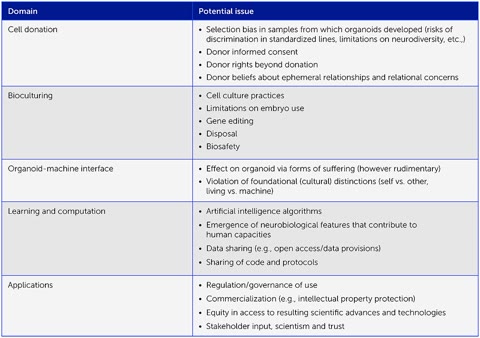
The DishBrain team's own position, and the field's emerging consensus, is that a dish of neurons is not currently a mind — but that the question deserves the same rigor as the engineering, because the engineering is moving faster than the answer. Insoo Hyun and colleagues argued in Nature that brain organoids demand proactive oversight precisely because we can't say when they might cross a threshold we can't currently define.[18]
The deeper problem is the one that makes this the strangest technology in the world: we do not have a test for what a dish of neurons is. Consciousness has no meter. We can measure spikes, and bursts, and learning — but whether there is anything it is like to be 800,000 cells in a nutrient bath is, for now, a question without an instrument. The dishes keep learning. The question keeps waiting.
Quiz
- 1 — Who drew the neuron doctrine, and what prize did he share (with a man who disagreed with him)?
- 2 — What two-part system — predictable reward vs. unpredictable noise — taught DishBrain's neurons to play Pong?
- 3 — Roughly how many watts does a rack of CL1s draw, vs. the megawatts of an exascale computer?
- 4 — What does FinalSpark use as the "reward" that trains its organoids?
- 5 — What mathematical state — between order and chaos — do living neural cultures self-organize to?
Show answers — click to check yourself
1 — Santiago Ramón y Cajal, who shared the 1906 Nobel with Golgi — who argued against the neuron doctrine in his own lecture. 2 — The free energy principle — predictable stimulation as reward, chaotic noise as punishment; the neurons minimize surprise by learning. 3 — ~850–1,000 watts a rack — vs. ~22 megawatts for Frontier. A million-fold difference in joules per operation, roughly. 4 — Dopamine — the brain's own reward chemical, bathed over the organoids when they respond correctly. 5 — Criticality — the edge-of-chaos state where avalanches follow a power law; Beggs & Plenz measured it in 2003.
Notes
- The word sentience in the DishBrain paper's title is used in the narrow technical sense — responsive to sensory input — not consciousness; the authors spent a year clarifying it, and it's flagged here deliberately.
- All CL1 specifications are Cortical Labs' published figures (price, neuron count, power, 6-month viability, biOS, SDK) — reported as the company's claims.
- The "million times more efficient" figure is a field-level extrapolation comparing training energy, not a benchmark of deployed systems.
- The DishBrain paper's rodent data used mouse cultures; the human-iPSC cultures were separate experiments within the same paper.
- Adleman's DNA computation solved a seven-node Hamiltonian path — correct but small; it founded a field rather than solved a practical problem.
- The energy comparison (brain ~20W vs Frontier ~22MW) is rough and deliberately so — the honest range is the order of magnitude, not the decimal.
References
- Kagan, B. J. et al., "In vitro neurons learn and exhibit sentience when embodied in a simulated game-world", Neuron 110 (2022) — the DishBrain paper.
- Smirnova, L., Caffo, B. S., Hartung, T. et al., "Organoid intelligence (OI): the new frontier in biocomputing and intelligence-in-a-dish", Frontiers in Science (2023) — the OI roadmap and ethics framework.
- Jordan, F. et al., "Open and remotely accessible Neuroplatform for research in wetware computing", Frontiers in Artificial Intelligence 7 (2024) — the FinalSpark platform.
- Beggs, J. & Plenz, D., "Neuronal avalanches in neocortical circuits", Journal of Neuroscience 23 (2003).
- Adleman, L., "Molecular computation of solutions to combinatorial problems", Science 266 (1994).
- Hodgkin & Huxley, "A quantitative description of membrane current…," J. Physiol. 117 (1952).
- DeMarse, T. et al., "The neurally controlled animat", Autonomous Robots 11 (2001).
- Hyun, I. et al., "Ethical issues related to brain organoid research", Brain Research 1732 (2020).
- Cortical Labs CL1 launch coverage — ABC Science, IEEE Spectrum, DCD (March 2025); FinalSpark Neuroplatform — finalspark.com/neuroplatform.
Footnotes
- ↑ IEEE Spectrum, "Biological Computer for Sale", June 2025; Cortical Labs CL1 launch at MWC Barcelona
- ↑ Smirnova, L., Caffo, B. S., Hartung, T. et al., "Organoid intelligence (OI): the new frontier in biocomputing and intelligence-in-a-dish", Frontiers in Science (2023)
- ↑ Cajal won the 1906 Nobel Prize in Physiology or Medicine with Golgi — who used his own Nobel lecture to argue against Cajal's conclusion. Golgi was wrong.
- ↑ Hodgkin & Huxley, "A quantitative description of membrane current and its application to conduction and excitation in nerve", J. Physiol. 117 (1952)
- ↑ Beggs, J. & Plenz, D., "Neuronal avalanches in neocortical circuits", Journal of Neuroscience 23 (2003)
- ↑ DeMarse, T., Wagenaar, D., Blau, A. & Potter, S., "The neurally controlled animat", Autonomous Robots 11 (2001)
- ↑ Adleman, L., "Molecular computation of solutions to combinatorial problems", Science 266 (1994)
- ↑ Kagan, B. J. et al., "In vitro neurons learn and exhibit sentience when embodied in a simulated game-world", Neuron 110 (2022)
- ↑ Jordan, F. et al., "Open and remotely accessible Neuroplatform for research in wetware computing", Frontiers in Artificial Intelligence 7 (2024)
- ↑ Cortical Labs CL1 launch, MWC Barcelona, March 2025; ABC Science; IEEE Spectrum
- ↑ Cortical Labs, Cortical Cloud launch — Python SDK access to CL1 nodes (2025)
- ↑ Cortical Labs CL1 product documentation — biOS, corticallabs.com/cl1
- ↑ Karl Friston, quoted in IEEE Spectrum, March 2025
- ↑ FinalSpark Neuroplatform; Tom's Hardware, May 2024
- ↑ Jordan, F. et al., Frontiers in Artificial Intelligence 7 (2024); FinalSpark statements
- ↑ Smirnova, Caffo, Hartung et al., Frontiers in Science (2023); the "Baltimore Declaration", same issue
- ↑ Smirnova, Caffo, Hartung et al., "Preliminary framework of ethical considerations in organoid intelligence research", Frontiers in Science (2023)
- ↑ Hyun, I. et al., "Ethical issues related to brain organoid research", Brain Research 1732 (2020)