
History of Physics
Physics is the science of the least possible question. Not "what is this flower?" but "what is everything?" Not "how does this machine work?" but "what are the rules all machines must obey?" Strip every other science down far enough — a chemist's bonds, a biologist's cells, a geologist's strata — and at the bottom you find a physicist's handful of stubborn ideas: things fall, light travels, energy is conserved, matter is made of pieces, and the universe does not care what you call its pieces.
Its history is the story of how those ideas were dragged into the light. It begins with a man shouting eureka in a bathtub, passes through a one-eyed telescope pointed at Jupiter, a falling apple that probably never fell, a bookbinder's apprentice who could not do calculus, a patent clerk nobody would hire, and a conference where Einstein and Bohr argued so hard the future had to pick a side. It ends — for now — with a photograph of a black hole and machines that compute in superposition. The characters change; the method stays the same. Ask nature a yes-or-no question, and accept the answer even when it is absurd.
The first physicist
The story begins in Syracuse, Sicily, around 250 BCE, with Archimedes — the man who, by every later account, was doing physics before the word existed. He gave us the law of the lever, proved it mathematically, and immediately understood what it meant: "Give me a place to stand, and I will move the Earth." It is still the most physics thing anyone has ever said — a claim about the whole universe derived from a plank and a pivot.
Archimedes measured the principle of buoyancy so precisely he could tell a gold crown had been debased with silver — the story that gave us the eureka legend. He built war machines, calculated pi to two decimal places, and died, the story goes, absorbed in a diagram drawn in the sand, telling a Roman soldier: "Don't disturb my circles." The soldier disturbed them permanently.
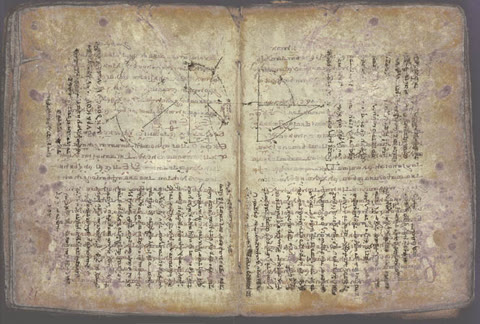
Then comes the strange part — and a warning about how fragile knowledge is. The single oldest surviving copy of Archimedes' deepest mathematical work is a palimpsest: a medieval prayer book whose parchment was scraped clean and overwritten with hymns in 1229. For seven centuries, the only copy of The Method — where Archimedes used an early form of actual infinity and mechanical reasoning to find volumes — sat hidden under prayers in a Constantinople library. Around the turn of the millennium, conservators shone X-rays through the pages, read the iron in the faded ink, and got him back.[1] Physics almost lost its founder, saved at last by physics.
The Greeks gave the discipline its name — physis, nature — and its central wager: the world runs on rules, and the rules can be written in mathematics. Aristotle guessed wrong about nearly everything (heavier things fall faster, vacuums are impossible), but the Greeks invented the deeper idea that survives every wrong answer: nature is legible. You can argue with it, and win, if you argue carefully enough.
The light of Baghdad
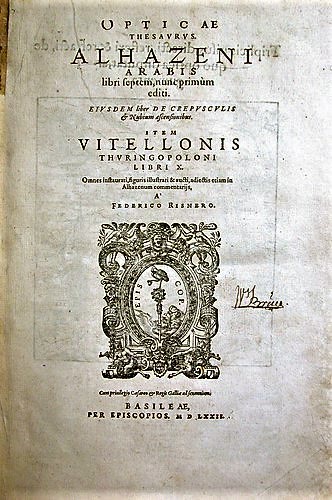
Then for a thousand years, the torch moved. While Europe copied manuscripts it barely understood, the Abbasid Caliphate's House of Wisdom in Baghdad turned science into an institution. And it was here — not in Florence, not in Newton's Cambridge — that a man named Ibn al-Haytham (Alhazen, to later Latin readers) did something no Greek had quite managed: he made experiment the judge.
Around 1021, under house arrest in Cairo — having told the caliph he could regulate the Nile's flooding, then discovering he could not — Ibn al-Haytham wrote the Book of Optics. He built a camera obscura dark room, measured how light bends through water, proved that light travels in straight lines and enters the eye from outside (the Greeks had it backwards, believing the eye emitted rays), and — this is the revolutionary part — tested every claim. "If learning the truth is the scientist's goal," he wrote, "then he must make himself the enemy of all that he reads."[2]
That sentence is the scientific method, five hundred years before anyone gave it a name. And he was not alone in that century — the Indian mathematician Āryabhaṭa had argued for a rotating Earth around 500 CE; Chinese natural philosophers had described magnetic compasses by the 1040s, and the polymath Shen Kuo wrote of true north, fossils, and falling stars with a physicist's instincts. The standard story, in which physics sleeps from Archimedes to Galileo, is a European editorial choice — the real torch never went out. It just moved east, and came back translated into Latin.
The telescope turns
The revolution, when it arrived in Europe, arrived through a tube. In 1609, hearing that a Dutchman had patented a device that made distant things look near, Galileo Galilei built his own — and rather than selling it to the navy, pointed it at the night sky. What he saw broke the ancient cosmos in a single season: mountains on the Moon (it was supposed to be a perfect sphere), sunspots (the Sun, blemished!), four moons circling Jupiter (something orbits a body that is not the Earth), and the phases of Venus, which only make sense if Venus goes around the Sun.[3]
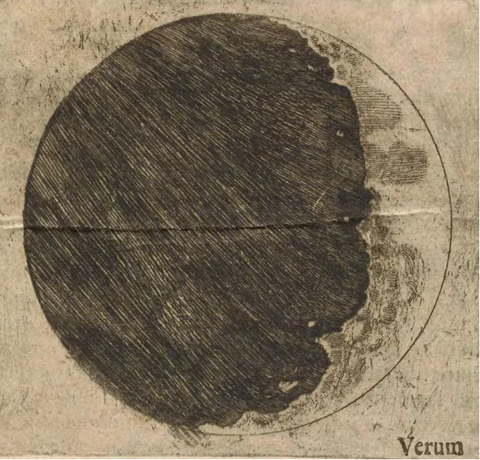
His more dangerous achievement was quieter. Rolling balls down ramps and dropping things off (probably not) the Leaning Tower, Galileo argued that falling objects accelerate uniformly regardless of their mass — Aristotle, dead for two millennia, was wrong, and could be tested. His defense of Copernicus got him hauled before the Inquisition in 1633, shown the instruments, and sentenced to house arrest for life. The legend that he muttered "Eppur si muove" — "and yet it moves" — under his breath is almost certainly not true, which is a pity, because it should be.[4]
What he actually left behind was the template: measure, mathematize, and let the experiment vote. That, and the most consequential sentence in the history of science — that the universe is "written in the language of mathematics."
Heaven and earth, one law
Isaac Newton was born on Christmas Day, 1642 — the year Galileo died, as the storybook versions like to note. In the plague years of 1665–66, sent home from Cambridge while the university closed, the 23-year-old effectively invented the modern world in a Lincolnshire farmhouse: the foundations of calculus, the decomposition of white light into colors, and — so the story goes, watching an apple — the realization that the same pull that drops fruit holds the Moon in its orbit.
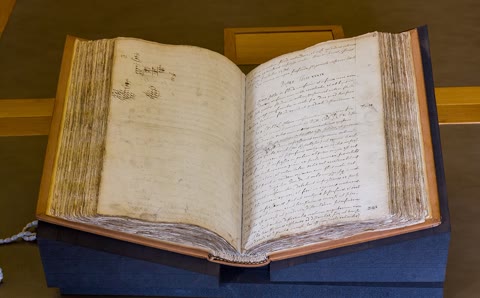
The idea took him twenty years to publish, in the Principia (1687) — arguably the most important book ever written in the sciences. Its astonishing claim: one law, everywhere. The same inverse-square gravitation governs a falling apple, the Moon's orbit, the tides, and the comet Halley — which Edmond Halley, using Newton's own math, correctly predicted would return in 1758. For the first time in human history, heaven and earth obeyed a single equation.[5]
Newton also gave physics its first great feud. Gottfried Leibniz, the German philosopher, had independently invented calculus — with better notation, the d/dx and ∫ we still use — and each man spent years waging a priority war through proxies and anonymous pamphlets. Newton, as president of the Royal Society, appointed an "impartial" committee to settle who invented calculus first; the committee found for Newton, and its report was secretly written by Newton.[6] The fight split European mathematics into two camps for a century — the one time in this history that being right was arguably worse than being wrong.
And for all his genius, Newton kept a private second career no biographer could explain away: he spent more words on alchemy and biblical chronology than on optics and gravity combined. "Newton was not the first of the age of reason," John Maynard Keynes wrote after reading the secret papers. "He was the last of the magicians."
The invisible fluids
The eighteenth century made physics a profession, and the nineteenth made it an industry — powered, literally, by steam. Steam engines were already draining mines when a French engineer named Nicolas Carnot asked the purely theoretical question in 1824: what is the best possible engine? His answer — that efficiency depends only on the temperature difference, and no engine can ever be perfect — founded thermodynamics, the physics of heat, work, and time's arrow.
Thermodynamics gave the universe a bank account and a tax. James Joule showed that heat is just another form of work — you can raise water's temperature by stirring it — and Hermann von Helmholtz generalized that into the first great conservation law: energy is never created or destroyed, only converted. The second law is the bleaker one: entropy always increases. Everything runs downhill. The universe is slowly, inexorably going lukewarm, and there is no loophole, ever. "The second law of thermodynamics," Arthur Eddington wrote, "holds the supreme position among the laws of Nature." If your theory disagrees with it, the theory loses — no appeal.[7]
This was also the era of the invisible fluids — phlogiston, caloric, luminiferous aether — substances invented to explain what couldn't be seen, then abandoned one by one as experiments found nothing there. It's a pattern worth remembering: physics advances not only by discovering what exists, but by evicting what doesn't.
The field
Michael Faraday was a bookbinder's apprentice with no mathematics — and the greatest experimentalist who ever lived. Hired at the Royal Institution in 1813 as a bottle-washer's assistant, he spent forty years at a bench in the basement and emerged having invented the electric motor, the generator, the transformer, and the concept that would swallow physics whole: the field.
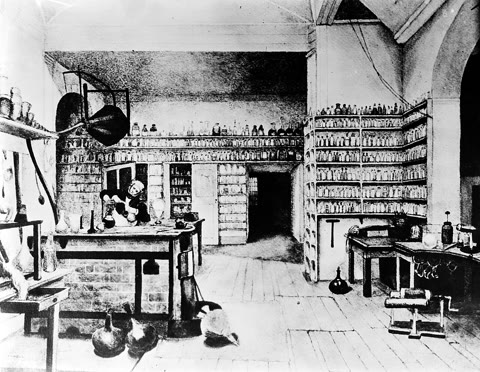
Everyone before Faraday imagined electricity and magnetism as forces acting at a distance, mysteriously, through empty space. Faraday looked at iron filings and saw something real there — lines of force, a tension in the space itself. He could not prove it mathematically; he could barely do algebra. But in 1831 he found that moving a magnet through a coil makes electricity — electromagnetic induction — the principle inside every generator, turbine, and power grid on Earth. The modern world is Faraday's basement, scaled up.
The math he lacked arrived with James Clerk Maxwell, a Scottish polymath who took Faraday's physical intuition and wrote it as four equations. In 1865 they made a prediction that still stands as the most beautiful in all of physics: electricity and magnetism are one thing — an electromagnetic field — and a disturbance in it ripples outward at exactly the speed of light. Light is an electromagnetic wave. Optics, electricity, and magnetism — three whole sciences — turned out to be one subject wearing three hats.[8]
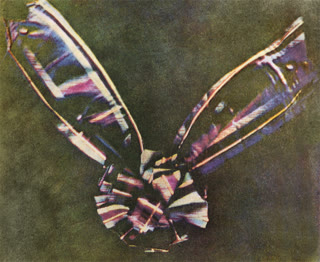
Maxwell demonstrated the practical magic of his theory in 1861 with a party trick that was a century ahead of its time: he took three black-and-white photographs of a tartan ribbon through red, green and blue filters, projected them back through the same filters, and produced the world's first permanent color photograph — proving trichromatic vision with physics.[9]
The current war
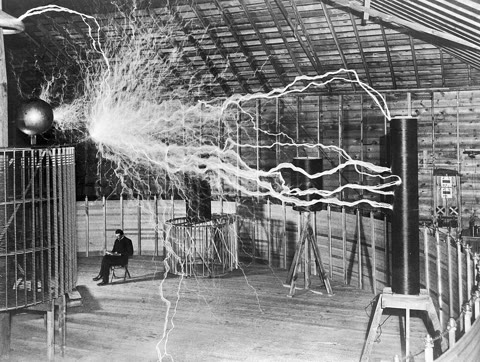
Fields became fortunes almost immediately — and physics acquired its second great feud. Thomas Edison had built America's first power system on direct current; Nikola Tesla, the Serbian inventor who arrived in New York in 1884 with four cents and a head full of alternating current, went to work for him. When Edison allegedly brushed off Tesla's promised bonus as "American humor," Tesla quit and took his AC motor patents to George Westinghouse. What followed was the War of the Currents — Edison electrocuting animals at publicity events to brand AC as the executioner's current, Tesla demonstrating his coils by letting thousands of volts dance over his body.
AC won — it's how the grid still works — but Tesla won and lost at once. His polyphase system lit the 1893 Chicago World's Fair and powered Niagara Falls; his grander dream, wireless power broadcast to everyone for free, died when the money ran out. He died alone in a New York hotel room in 1943, feeding pigeons, nearly broke — a man who had held the future and let the business of it slip away. The double-exposure photograph of him reading calmly beneath the discharges of his own magnifying transmitter remains physics' most theatrical portrait.[10]
Rays from nowhere
The 1890s detonated. In three years physics found three things nobody had predicted: X-rays (Röntgen, 1895 — he photographed his wife's hand, bones and all, and she declared "I have seen my death"), radioactivity (Becquerel, 1896 — uranium fogging photographic plates in a drawer), and the electron (J. J. Thomson, 1897 — a particle smaller than the atom it was supposed to be indivisible from). The atom had been the bottom of the world since Democritus. Now the bottom had a basement.
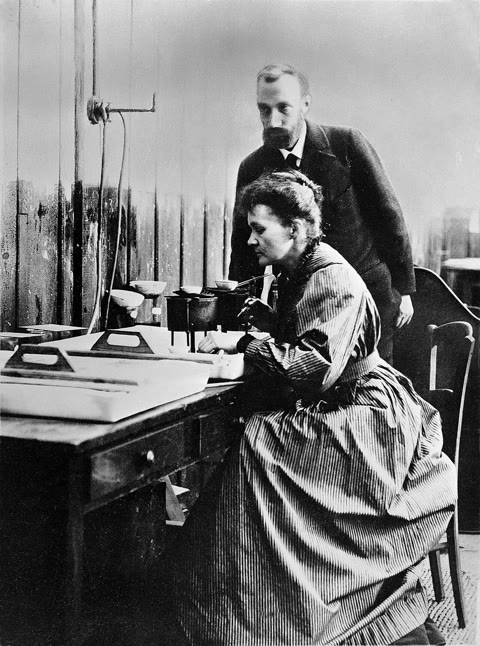
Radioactivity's story belongs to Marie Skłodowska Curie, who came from Warsaw to Paris, and with her husband Pierre processed tons of pitchblende ore by hand in a leaky shed to isolate two new elements — polonium, named for the Poland that officially did not exist, and radium. Pierre died in a street accident in 1906; Marie kept working, won a second Nobel — in chemistry this time, making her the only person to win in two sciences — and died in 1934 of the radiation nobody yet understood. Her laboratory notebooks are still too radioactive to handle without protection.[11]
What the Curies had found without knowing it: atoms are not permanent. They decay, transmute, and release energy from a storehouse so deep that a single gram of radium — a sliver of metal glowing faintly blue — outshone a hundred steam engines' worth of chemical energy. The world was about to learn exactly how deep that storehouse went.
The patent clerk's year
In 1905, a 26-year-old technical expert third class at the Bern patent office — rejected for academic jobs, unable to get a decent letter of reference — published four papers in his spare time. Any one of them would have made a career; together they remade physics. Albert Einstein explained Brownian motion (settling whether atoms are real), explained the photoelectric effect with light quanta (the seed of quantum theory), derived special relativity (space and time are not the stage; they are actors, stretching and shrinking with your speed), and wrote down the most famous equation ever scratched on paper:[12]
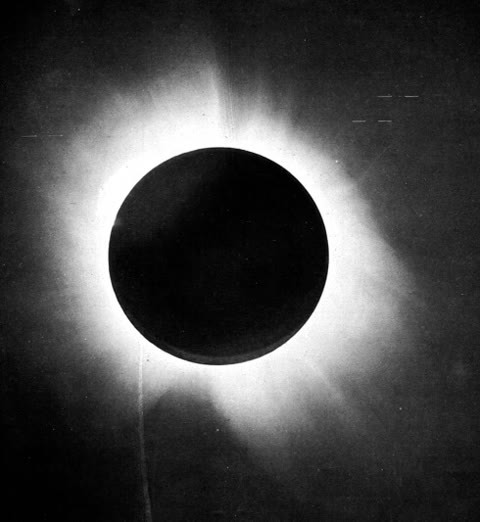
Relativity said the strangest true thing anyone had ever claimed: moving clocks run slow; gravity is geometry. In 1915 Einstein generalized it — gravity is not a force pulling you down but spacetime itself curving around mass. The theory made a falsifiable bet: starlight passing the Sun should bend by a precise, measurable angle. In May 1919, Arthur Eddington sailed to the island of Príncipe off West Africa, photographed an eclipse, and measured the stars' positions shifted by almost exactly the amount Einstein predicted. Overnight — confirmed by a photograph on a glass plate — Einstein became the most famous scientist who ever lived.[13]
The quantum quarrel
While Einstein was bending spacetime, an even stranger revolution was boiling underneath. Light came in packets; electrons lived in fixed orbits and jumped between them without crossing the space between; particles behaved as waves and waves as particles. By the mid-1920s Heisenberg, Schrödinger, Dirac and Pauli had built quantum mechanics — a theory in which you can predict probabilities with stunning precision and certainty not at all.
Einstein hated it — "God does not play dice" — and the argument came to a head at the 1927 Solvay Conference in Brussels, the photograph at the top of this article. Every morning Einstein presented a thought experiment designed to break quantum mechanics; every evening Niels Bohr found the flaw. The duel lasted years and Einstein lost every round — but his final shot, the 1935 EPR paradox, asked whether quantum theory could possibly be complete. In 1964 John Bell turned that philosophical jab into a testable prediction, and in the 1980s–2020s experiments proved nature really is nonlocal — entangled particles correlate instantly across any distance, defying common sense but matching quantum predictions exactly.[14] Einstein's attempt to disprove the theory ended up revealing its weirdest, most useful feature — the entanglement that now powers quantum computers.
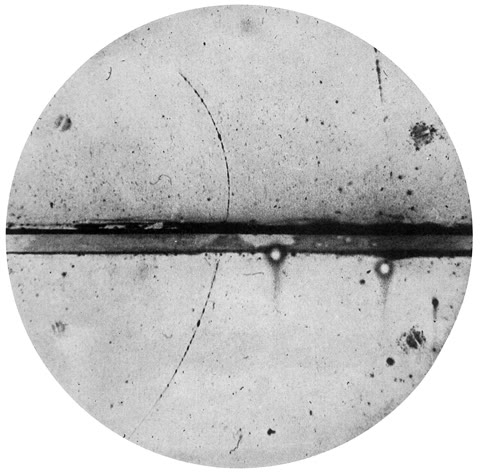
Meanwhile quantum mechanics was paying for dinner. In 1928 Paul Dirac wrote down an equation for the electron so elegant it made a prediction nobody asked for: antimatter. In 1932 Carl Anderson found it — a particle curving the wrong way in a cloud chamber photograph, the first positron, antimatter caught on film.[15]
The physicists' sin
In December 1938, in Berlin, Otto Hahn and Fritz Strassmann split the uranium atom. Lise Meitner, their longtime collaborator who had fled the Nazis to Sweden, understood first what the results meant — and she named it: fission. Each splitting released two hundred million electron-volts of energy — E = mc² doing arithmetic with a vengeance. The physics community understood instantly, and the physicists who understood it best were the most frightened. Many were refugees from the fascism their own discovery was about to arm.
In 1939 Leó Szilárd, who had conceived the chain reaction years earlier while waiting at a London traffic light, persuaded Einstein to sign a letter to President Roosevelt warning that Germany might build a bomb. The letter started the Manhattan Project — a two-billion-dollar secret city employing 130,000 people, directed by J. Robert Oppenheimer, a theorist who quoted Sanskrit and read French poetry. On 16 July 1945, at 5:29 a.m. in the New Mexico desert, the Gadget — a plutonium sphere on top of a tower — turned night into morning. The light was visible a hundred miles away.[16]
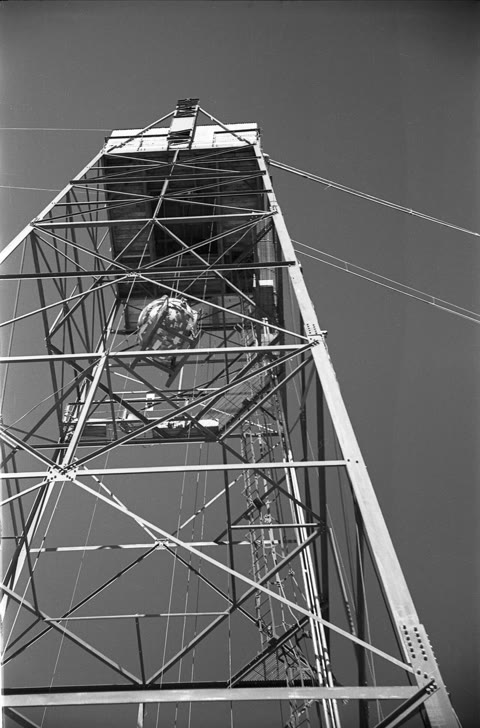
Oppenheimer watched the fireball and later said he remembered the Bhagavad Gita: "Now I am become Death, the destroyer of worlds." Twenty days later, Hiroshima; three days after that, Nagasaki — one hundred and fifty to two hundred and fifty thousand people dead, most of them civilians, most of them from a physics equation written by a man who had fled Germany because of who he was. Einstein, whose letter had started it and whose equation had powered it — but who had never worked on the bomb — said the one mistake of his life was signing Szilárd's letter. The physicists' community has never fully reckoned with 1945; it remains the discipline's original sin — the moment the search for truth produced the means to end the search, permanently, for everyone.[17]
The new wilderness
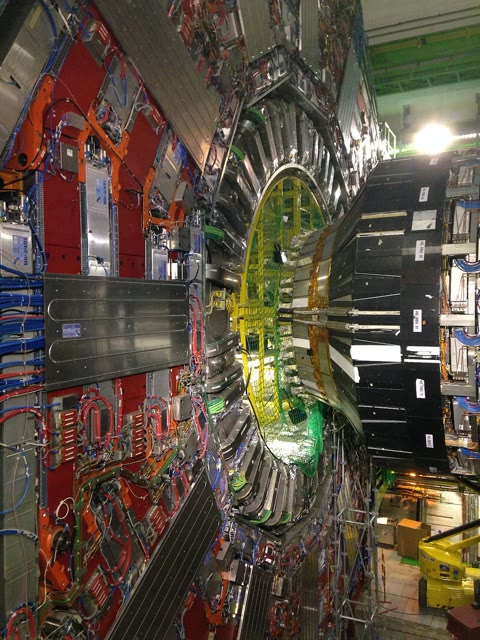
The physicists who walked out of Los Alamos built a different bomb of knowledge. Over thirty years, accelerators smashed particles to dust and found the zoo underneath — quarks, leptons, bosons — organized finally into the Standard Model: every atom, every force except gravity, reducible to fields and their exchanges. In 2012, after decades and a machine 27 kilometers in circumference, the Higgs boson was found at CERN — the last missing piece, the field that gives particles mass.[18]
Then physics started hearing the cosmos itself. In September 2015 LIGO — two laser observatories four kilometers long, built to detect wobbles a thousandth the width of a proton — heard two black holes colliding 1.3 billion light-years away, exactly as Einstein's equations described. Gravitational waves, predicted in 1916, arrived on schedule a century late.[19]
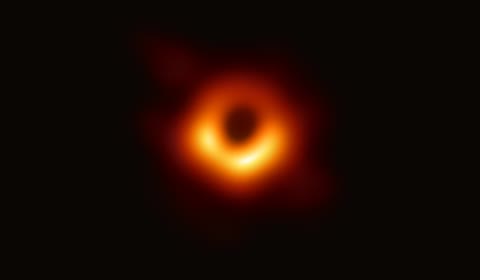
And in April 2019 the Event Horizon Telescope — eight radio dishes synced across four continents into a virtual telescope the size of Earth — released the first photograph of a black hole: the glowing ring of gas around M87's monster, fifty-five million light-years away, the same orange donut relativity said it had to be. A theory from 1915, proved on a photograph a hundred years later by a telescope the size of a planet.[20]
What we still don't know
Here's the honest epilogue: we are far from finished, and the unfinished parts are huge. Ordinary matter — all the atoms, stars, you — is about 5% of the universe. The rest is dark matter (27%, invisible, detected only by its gravity) and dark energy (68%, the name for the fact that the expansion is accelerating and nobody knows why). The two great theories — general relativity for the very large, quantum mechanics for the very small — still refuse to combine; quantum gravity remains the holy grail that string theory, loop quantum gravity and a dozen rivals are fighting over. And the deepest question of all — why is there something rather than nothing? — is still wide open.
The story isn't done. The next Archimedes, the next patent clerk, the next person pointing a new kind of telescope at an old sky — they're out there now, probably being underestimated.
Quiz
- 1 — Who wrote the Book of Optics and arguably invented the experimental method, a thousand years ago in Baghdad?
- 2 — What did Newton's Principia unify?
- 3 — What did Maxwell's equations turn out to be — three sciences as one?
- 4 — What photograph made Einstein world-famous in 1919?
- 5 — What particle was discovered "curving the wrong way" in a cloud chamber — the first antimatter ever seen?
Show answers — click to check yourself
1 — Ibn al-Haytham — five centuries before it was named, he made experiment the judge. 2 — One law for heaven and earth — the same gravity pulls the apple and holds the Moon. 3 — Light — it's an electromagnetic wave; Maxwell's equations predicted the speed of light. 4 — Eddington's 1919 eclipse plates — the starlight bent by the amount relativity predicted. 5 — The positron — Dirac's equation predicted it; Anderson photographed it in a cloud chamber in 1932.
Notes
- The eureka and apple stories are later traditions — Plutarch for the bath, Voltaire and William Stukeley for the apple — and are told as legend, not established fact.
- Newton's Principia manuscript page photographed at the Royal Society; the calculus-priority feud is well documented.
- Galileo's "Eppur si muove" is almost certainly apocryphal — first appearing in print over a century after the trial — and is flagged as such in the text.
- The Einstein–Bohr debate is real and extensively documented; Einstein's "God does not play dice" quote is a paraphrase of his letters to Max Born.
- The Manhattan Project material is included at the user's direction — soberly, with the physicists' reckoning, not celebratory.
- Solvay 1927 photograph attribution: taken by Benjamin Couprie; the "most intelligent photograph" framing is a popular claim, kept rhetorical.
References
- Newton, I., Philosophiæ Naturalis Principia Mathematica (1687) — Royal Society manuscript.
- Maxwell, J. C., "A Dynamical Theory of the Electromagnetic Field," Phil. Trans. R. Soc. (1865).
- Einstein, A., Annus Mirabilis papers, Annalen der Physik (1905).
- Dyson, Eddington & Davidson, "A Determination of the Deflection of Light by the Sun's Gravitational Field," Phil. Trans. R. Soc. A 220 (1920).
- Anderson, C. D., "The Positive Electron", Physical Review 43 (1933).
- LIGO/Virgo Collaboration, Phys. Rev. Lett. 116 (2016).
- Event Horizon Telescope Collaboration, ApJL 875 (2019).
- Rhodes, R., The Making of the Atomic Bomb (1986).
- Netz, R. & Noel, W., The Archimedes Codex (2007).
- Carlson, W. B., Tesla: Inventor of the Electrical Age (2013).
Footnotes
- ↑ Netz, R. & Noel, W., The Archimedes Codex (2007) — the palimpsest recovered The Method and Stomachion
- ↑ Ibn al-Haytham, Kitāb al-Manāẓir (Book of Optics), c. 1021 — seven volumes on light, vision, and experimental method
- ↑ Galileo, Sidereus Nuncius (Starry Messenger), 1610 — the first published account of telescopic astronomy
- ↑ The phrase first appears in print in the 1750s, a century after the trial — probably legend, flagged honestly
- ↑ Newton, Philosophiæ Naturalis Principia Mathematica (1687) — the Royal Society's surviving manuscript pages
- ↑ Hall, A. R., Philosophers at War: The Quarrel between Newton and Leibniz (1980)
- ↑ Eddington, A., The Nature of the Physical World (1928)
- ↑ Maxwell, J. C., "A Dynamical Theory of the Electromagnetic Field", Phil. Trans. R. Soc. 155 (1865)
- ↑ Maxwell, J. C., "On the Theory of Three Primary Colours" — the Sutton photographic process, 1861
- ↑ Carlson, W. B., Tesla: Inventor of the Electrical Age (2013)
- ↑ Curie, E., Madame Curie (1937); her papers remain stored in lead-lined boxes at the Bibliothèque nationale de France
- ↑ The Annus Mirabilis papers, Annalen der Physik (1905)
- ↑ Dyson, Eddington & Davidson, "A Determination of the Deflection of Light by the Sun's Gravitational Field", Phil. Trans. R. Soc. A 220 (1920)
- ↑ Aspect, Clauser & Zeilinger — the 2022 Nobel Prize for the entanglement experiments that settled the EPR debate in quantum theory's favor
- ↑ Anderson, C. D., "The Positive Electron", Physical Review 43 (1933)
- ↑ Rhodes, R., The Making of the Atomic Bomb (1986)
- ↑ The Einstein–Szilárd letter is in the U.S. National Archives; Einstein's regret reported by Linus Pauling and others
- ↑ ATLAS and CMS Collaborations, Physics Letters B 716 (2012)
- ↑ LIGO/Virgo, "Observation of Gravitational Waves from a Binary Black Hole Merger", Phys. Rev. Lett. 116 (2016)
- ↑ Event Horizon Telescope Collaboration, Astrophysical Journal Letters 875 (2019)