
Ada Lovelace
Ada Lovelace — born Augusta Ada Byron (10 December 1815 – 27 November 1852), later Countess of Lovelace — was an English mathematician whose 1843 notes on the Analytical Engine contain what is often called the first published computer program, and the first clear statement of what programming could mean. She is the namesake of the Ada programming language and an inspiration for AdaLogic BASIC.
The poet's daughter, raised on mathematics
Ada was the only legitimate child of the poet Lord Byron, who left England weeks after her birth; she never knew him. Fearing poetry's contagion, her mother Annabella steered her toward mathematics and logic — a rigorous education rare for anyone, extraordinary for a woman of her era, with tutors including Mary Somerville and later Augustus De Morgan. Ada came to call her own style "poetical science": she refused to choose between imagination and rigor, and it shows in everything she wrote.
At twelve she designed a flying machine — studying birds' anatomy, writing a book of Flyology illustrated with her own diagrams, and concluding that steam power was the answer. The instinct to meet imagination with engineering never left her.
The notes
Introduced to Charles Babbage at seventeen — she saw the Difference Engine demonstration and understood it immediately — Ada followed the Analytical Engine for years through a long, lively correspondence with Babbage, who called her the "Enchantress of Numbers." When she translated Luigi Menabrea's French account of the machine in 1843, her added notes A through G tripled the paper's length — and Note G laid out a step-by-step method for the engine to compute Bernoulli numbers: the first algorithm published as intended for a machine.
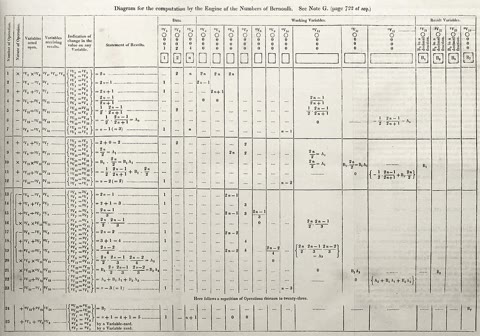
The table itself is the remarkable artifact: columns listing the engine's operations, the variables each acts on, and the results — the direct ancestor of every source listing, trace, and state table since. It even contains one of history's first bugs: an index error she and Babbage later corrected by letter.
The notes reach further than code. She wrote that the engine "might act upon other things besides number" — that if objects' relations could be expressed symbolically, the machine might compose "elaborate and scientific pieces of music." Where others saw a calculator, Lovelace saw the computer as we now understand it. She was also the first to write down a bug risk plainly — her own Bernoulli table contains an error — and to insist a machine has no power to originate anything: the "Lovelace objection," still argued wherever machine intelligence is debated. Alan Turing engaged it directly a century later.
She died of uterine cancer at thirty-six, the same age as her father, and was buried beside him — the poet she never knew.
Legacy
- The Ada language — designed for the US Department of Defense and standardized in 1980 for safety-critical systems — was named for her and assigned the reference MIL-STD-1815, her birth year.
- Ada Lovelace Day (second Tuesday of October) celebrates women in science and engineering.
- Whether she was "the first programmer" is debated — Babbage drafted earlier engine programs — but hers was the first published, the most sophisticated, and the only one wrapped in a vision of what such machines could become. AdaLogic BASIC honors the same inheritance: a language named in her spirit, built for clarity and real work.
See also
- Charles Babbage · Analytical Engine
- Bernoulli numbers
- Jacquard Loom · Punched card
- Alan Turing
- AdaLogic BASIC
- History of Programming
- JoAnn H. Morgan — first female engineer at Kennedy Space Center
- Ada Lovelace Day — the international October observance named for her
References
- Menabrea, Luigi Federico (tr. Ada Lovelace). "Sketch of the Analytical Engine invented by Charles Babbage." Taylor's Scientific Memoirs 3 (1843) — includes Lovelace's Notes A–G.
- Babbage, Charles. Passages from the Life of a Philosopher (Longman, 1864).
- Swade, Doron. The Cogwheel Brain: Charles Babbage and the Quest to Build the First Computer (Little, Brown, 2000).