
Z3
The Z3 — the third of Zuse's machines, after the mechanical Z1 and the relay-hybrid Z2 — was the machine Konrad Zuse demonstrated in Berlin on 12 May 1941 — and the machine that quietly answers the question "when was the computer invented?" Built from roughly 2,600 discarded telephone relays in a Kreuzberg living room, it was binary, programmable, floating-point, and fully automatic: punch the program onto film, press start, and the relays clicked through the work alone. It predates Colossus by two years and ENIAC by four. Most histories give the Z3 the title it earned: the first working, programmable, fully automatic digital computer.
What was inside
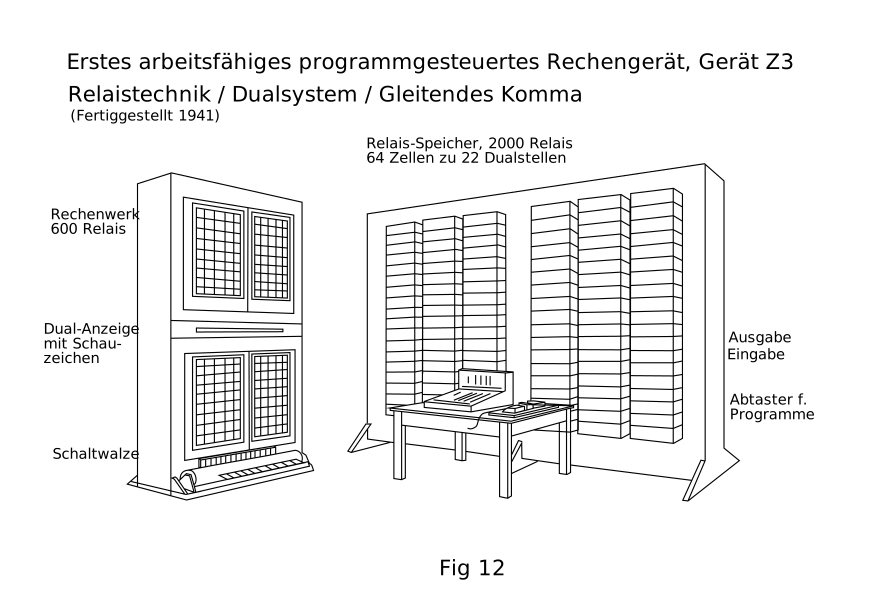
The Z3 was not a calculator wired to repeat; it was a real architecture, divided the way computers are still divided:
- The memory — about 2,000 relays holding 64 words of 22 bits each, addressable and random-access. Numbers were binary floating-point: a sign bit, a 7-bit exponent, and a 14-bit mantissa (15 effective bits, the leading 1 implied). Special values for zero and infinity were built in — the machine could report "this overflowed" instead of lying.
- The arithmetic unit — about 600 relays, a two-stage floating-point engine doing add, subtract, multiply, divide, and square root, plus automatic conversion between the operator's decimal and the machine's binary.
- The program reader — instructions punched as holes in recycled 35 mm film stock, eight operations encoded per line, read sequentially. To loop a program, you literally glued the film into a loop.
- The console — a small keyboard for decimal input and a lamp panel for decimal output: the human spoke decimal, the machine thought binary, and the hardware translated both ways.
What it could do — and what it couldn't
In operation the Z3 was honest arithmetic at relay speed: an addition in well under a second, a multiplication in about three seconds, the whole clock ticking at somewhere between five and ten hertz. It worked real problems — wing-flutter and structural calculations for aviation researchers, the very statics Zuse had been too lazy to keep doing by hand.
Its limitation was fundamental and simple: it could not decide. The film program ran straight through, instruction after instruction, with no conditional branch — the machine could loop only if its tape was glued into a circle, and it could not alter its course based on a result. Every program was one fixed sequence.
Three years, then fire
The Z3 did its wartime work in obscurity. The Reich's institutions never grasped what they had — Zuse's requests for serious funding were dismissed, in his account, by officials who believed the war could be won without computers. The machine clicked away at aerodynamic matrices while the country that owned it decided not to want it.
In December 1943, Allied bombs destroyed the Methfesselstraße workshop, and the Z3 with it — two and a half years after switching on, the first working computer became scrap. Its successor, the Z4, survived only because Zuse evacuated it south, eventually to a barn in the Allgäu, where it waited out the end of the war.
Afterlife
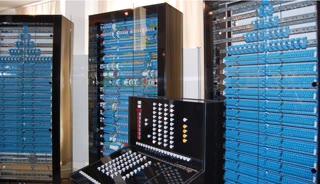
- 1960 — Zuse KG built a working replica of the Z3 for the Deutsches Museum in Munich, where it still stands — and has been demonstrated, clicking through real programs.
- 1987–89 — a nearly eighty-year-old Zuse personally supervised the reconstruction of his earlier Z1 in Berlin.
- 1998 — Rojas's Turing-completeness proof settled the theoretical question the skeptics had left open.
- The original film programs and fragments of documentation survive; the Z3 is reconstructed in scholarship, in replicas, and in the architecture of every machine since.
Where it sits in the line
The Z3 was electromechanical where ENIAC would be electronic, sequential where the Baby would be stored-program — but it ran first, and it ran alone. Between Babbage's unfinished dream and the electronic machines of 1945, the bridge was a film tape and 2,600 relays in an apartment that no longer exists.
See also
- Konrad Zuse — the man in the living room
- Plankalkül — the language he designed while the machine burned
- Analytical Engine · Charles Babbage — the design Zuse unknowingly reinvented
- Colossus · ENIAC six · Manchester Baby · EDSAC · EDVAC report
- Alan Turing · History of Programming
- History of Electricity — the relay's story
References
- Zuse, Konrad. The Computer — My Life (Springer, 1993, tr. of Der Computer – Mein Lebenswerk, 1970/1984).
- Rojas, Raúl. "Konrad Zuse's Legacy: The Architecture of the Z1 and Z3." IEEE Annals of the History of Computing 19(2), 1997.
- Rojas, Raúl, and Ulf Hashagen, eds. The First Computers: History and Architectures (MIT Press, 2000).