
Prehistory
Prehistory is the name we give to everything that happened before anyone thought to write it down — and that turns out to be almost everything. From the first stone tool struck in Kenya to the first wedge pressed into Mesopotamian clay, the span covered here is three and a third million years. Written history, the whole of it, occupies the last five and a half thousand. If the human story were a book of a thousand pages, the first nine hundred and ninety-seven would have no letters at all — only pictures we must read from stone, bone, and ash.
That reading is harder, and more honest, than the written kind. Nobody in prehistory tells you their side of the story. You have to infer it: a butchered bone, a footprint in volcanic ash, a bead worn around a child's neck fifty thousand years after the child wore it. This article is the full arc — the parent story that our Neolithic Period article ends inside.
How to read a million years
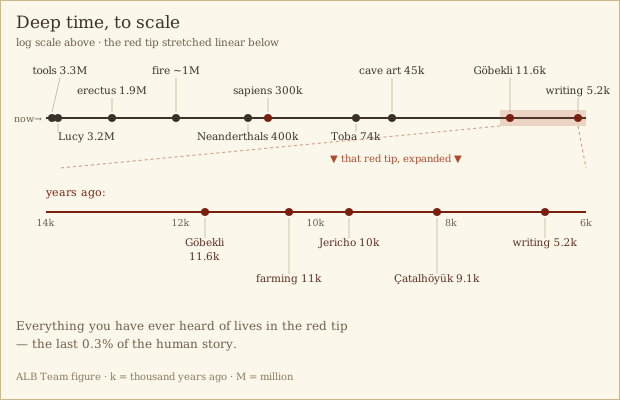
Dates this deep resist ordinary intuition, so a device helps: imagine the entire age of stone tools compressed into a single day. The first tool is struck at one second past midnight. Lucy walks at about 00:01. Homo erectus arrives near dawn; fire is tamed around mid-morning; our own species, Homo sapiens, appears at roughly 9 p.m. The first cave painting happens around 11:45 p.m., agriculture at 11:56, and the first written word at 11:59:52 — eight seconds before midnight. Your whole life, so far, is the last few hundredths of a second.
Two rules for the numbers that follow. First, they are ranges, not facts — radiometric dates carry error margins, and "about a million years ago" is honest where a false precision wouldn't be. Second, newer is not always better: the deepest tools were made by brains nothing like ours, on a planet we would not recognize. The timeline above keeps both ideas honest.
The first technology
Somewhere on the shore of Lake Turkana, Kenya, 3.3 million years ago, someone picked up a rock and hit another rock with it — deliberately, with intent to sharpen. The Lomekwi 3 site, reported in 2015, pushed back the oldest known stone tools by seven hundred thousand years and predates our own genus, Homo.[1] The tools were made by a smaller-brained ancestor, probably an australopithecine — which means technology is older than us.
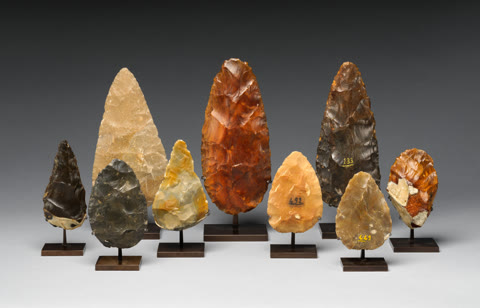
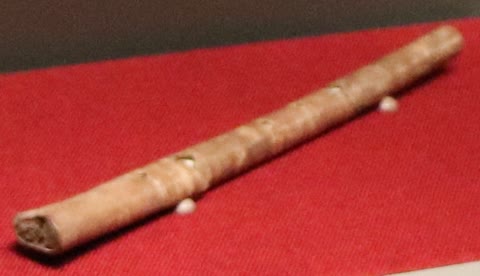
The Oldowan tradition followed (~2.6 Mya) — sharp flakes struck from cores, crude but effective. Then came the greatest tool of the entire Stone Age: the Acheulean handaxe, a teardrop-shaped biface appearing about 1.7 million years ago and made, essentially unchanged, for nearly 1.5 million years.[2] No other technology in human history has lasted so long. Smartphones will have to survive until roughly the year 1.5 million CE to match it.
The family album
For most of prehistory, we were not alone — several human species walked the Earth at once, sharing the genus Homo and often the landscape. The family album is a crowded one.
The earliest candidate hominin yet found is Sahelanthropus tchadensis, a skull from Chad dated to roughly 7 million years ago — near the split between our line and the chimpanzee line. Whether it stood upright is still argued.[3] Far less controversial is Australopithecus afarensis: in 1974, Donald Johanson's team found a partial skeleton at Hadar, Ethiopia — about forty percent complete — nicknamed Lucy after the Beatles song playing at the celebration that night.[4] She was 3.2 million years old, stood about a meter tall, and proved our ancestors walked upright long before they were clever.
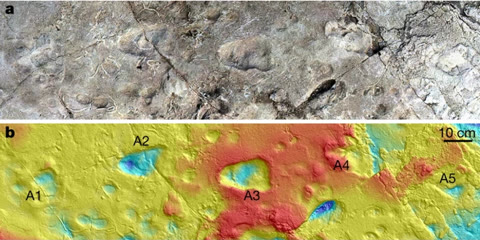
Four years later, in 1978, Mary Leakey's team found proof that needed no interpretation: the Laetoli footprints in Tanzania — a 27-meter trail of hominin footprints pressed into fresh volcanic ash 3.66 million years ago, then sealed by more ash. Two individuals, walking upright, side by side, on a rainy day in the Pliocene.[5] No fossil could say it plainer: they walked like us before they thought like us.
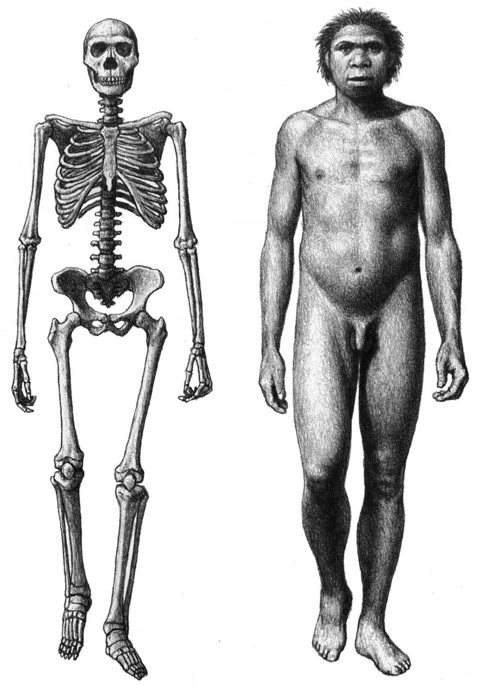
From there the line thickens: Homo habilis ("handy man," ~2.4 Mya) with slightly bigger brains and the first recognized tools; Homo erectus (~1.9 Mya), tall, efficient, the first to leave Africa — surviving for nearly two million years across Africa and Asia, the most successful hominin ever. The best-known fossil is the Turkana Boy (or Nariokotome Boy), an ~8-year-old erectus found in Kenya in 1984, almost complete — our best single look at an ancestor's body.[6]
Fire
Nobody can date the moment fire was tamed — flames leave no fossils. But at Wonderwerk Cave in South Africa, ash and burnt bone fragments found deep inside the cave show hominins were using fire about one million years ago — the earliest secure evidence yet.[7]
Fire changed everything that mattered. It cooked food — and cooked food is pre-digested food, unlocking more calories for less work, which primatologist Richard Wrangham argues is what made our big, expensive brains affordable in the first place.[8] It warmed camps, scared predators, and — maybe most importantly — it gathered people. The campfire is the original hearth, the first television, the first social network: a fixed point of light around which the whole group circled, every night, for a million years. Every story humans tell started being told there.
Out of Africa — twice
The map of prehistory is a story of leaving. Homo erectus left Africa perhaps 1.8 million years ago (Dmanisi, Georgia). But Homo sapiens — us — is younger: the oldest securely dated sapiens fossils are ~300,000 years old, from Jebel Irhoud, Morocco — discovered not in East Africa's rift, as the textbook story went, but on the far side of the continent.[9]
The great dispersal came far later. One lineage, possibly more, left Africa around 60,000–70,000 years ago and became everyone outside Africa. They reached Australia by ~65,000 years ago — an open-sea crossing that implies boats and planning;[10] Europe by ~45,000; the Americas by ~15,000–20,000 (or earlier — the evidence keeps pushing back). By the time farming arrived, humans had settled essentially every habitable land on Earth — on foot.
The other humans
We tend to imagine Homo sapiens stepping onto an empty stage. In fact, when our ancestors left Africa, the world already had people in it — other humans, older than us in their home ranges, whom we met, outlasted, and occasionally loved.
The Neanderthals held Europe and western Asia for ~400,000 years. Stockier than us, with brains at least our size, they made tools, controlled fire, buried their dead — see Neolithic Period for the Shanidar story — and may have painted before we arrived: a hand-stencil in Spain has been dated to ~64,000 years ago, before sapiens reached Iberia.[11] The proof that we knew them intimately is in your own cells: most non-African humans carry 1–4% Neanderthal DNA — we didn't just meet them. We met them.[12]
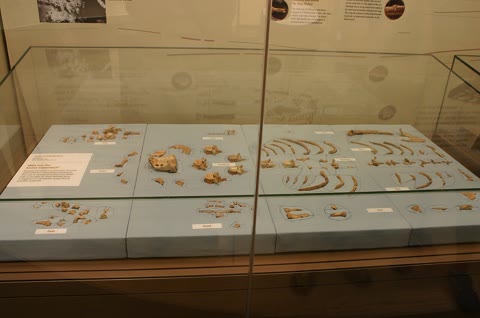
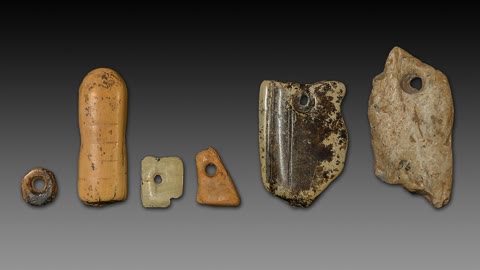
The Denisovans we know almost entirely from a cave in the Altai Mountains — a finger bone, a few teeth, a jawbone from Tibet — and the beads and pendants they left behind. Found in 2008 and sequenced in 2010, they were a third distinct human lineage nobody knew existed until DNA said so — and their genes survive today, especially in Melanesians, Tibetans, and indigenous Australians (the Tibetan high-altitude adaptation is a Denisovan gift).[13]
And there were more: the Hobbit of Flores (Homo floresiensis, a meter-tall island hominin surviving to ~50,000 BCE), the tiny-brained Homo naledi of Rising Star — and others still being named. Why we're alone now is the open question. The honest answer is probably all of them — climate, competition, absorption by interbreeding — and the last one means they never entirely left.
The bottleneck
Around 74,000 years ago, the Toba supervolcano in Sumatra exploded in the largest eruption of the last two million years — a VEI-8 event that threw thousands of cubic kilometers of ash into the sky and dimmed the sun for years.[14]
For scale: the 1816 eruption of Tambora — the one that caused the famous 'Year Without a Summer,' when it snowed in New England in June and famine swept Europe — ejected about 50 km³ of material. Toba's Youngest Toba Tuff ejected roughly 2,800 km³ of dense rock — somewhere between fifty and a hundred Tamboras, in a single event.[15] It was Toba's fourth and largest eruption; the caldera had been building toward it for over a million years.
What it did to the sky
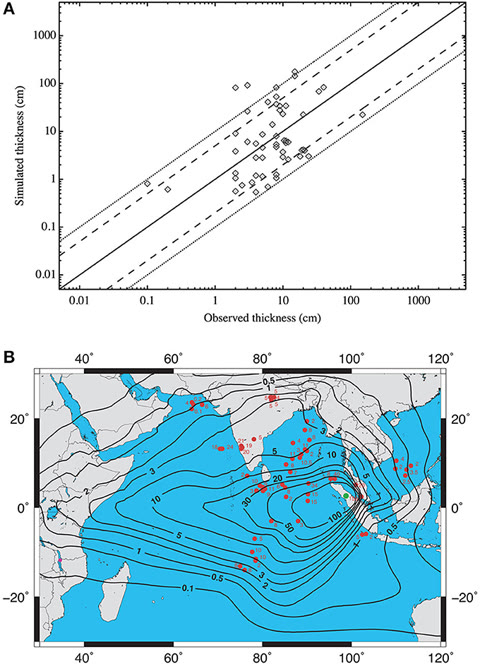
The ash did not stay in Sumatra. Youngest Toba Tuff deposits have been identified across South Asia, the Arabian Sea, and as far as Lake Malawi in East Africa and the Greenland ice sheet — a single layer of ash, thinner than a fingernail in places, laid down over a sixth of the planet and visible today in sediment cores as a global marker horizon.[16] In parts of India the ash lies meters thick; even at thousands of kilometers' distance it fell centimeters deep.
Then came the chemistry. The eruption threw sulfur compounds high into the stratosphere, where they formed a reflective aerosol veil around the whole planet. Climate models of a Toba-scale event estimate 3–5 °C of global cooling for six to ten years — with sharper drops regionally — followed by a thousand-year cold period that the ice cores record starting almost exactly at the ash layer.[17] To the humans watching it, the sun simply went weak and the world went cold, for years.
How close it came
Here is the reason Toba is more than a geology lesson. Our species' genetic diversity is strangely thin — two humans from opposite sides of the planet are more alike, genetically, than two chimps from the same forest. When geneticists run the math backward, the diversity points to a population bottleneck around the same era — possibly as few as 1,000 to 10,000 breeding individuals left standing.[18] Stanley Ambrose put the pieces together in 1998: Toba's winter, Ambrose argued, is what nearly killed us — a humanity reduced to scattered refuges, one bad decade from joining the australopithecines.
The case against
And here is where honesty requires a second act. The 'nearly extinct' story has been under sustained assault for a decade. At Jwalapuram in India's Middle Son Valley, stone tools continue right through the ash layer — the people there did not vanish;[19] at Shinfa-Metema 1 in Ethiopia, excavations published in 2024 found humans thriving through the eruption window, hunting fish and game as usual;[20] and newer genetics suggests the bottleneck may have come earlier, or been shallower, than Ambrose proposed. The eruption was real and enormous. The near-extinction is a hypothesis — a good one, but a hypothesis.
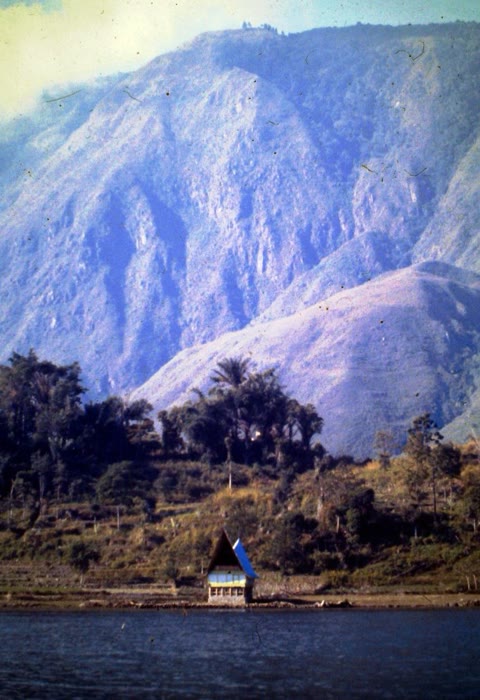
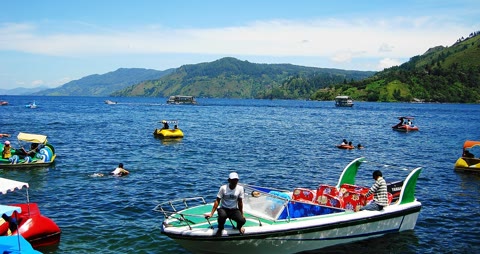
And the volcano is not finished with us. Lake Toba — the hundred-kilometre lake filling the crater — holds Samosir Island, a landmass nearly the size of Singapore that is not really an island at all but the caldera's resurgent dome: the roof of the magma chamber, still slowly rising. Toba sleeps, but it has not gone extinct — unlike, almost, us. Every human being alive descends from the population that outlasted that winter — whichever side of the argument you take, the scar in our genome says we only just made it.
Becoming symbolic
Somewhere between 100,000 and 40,000 years ago, humans started making things that meant things. At Blombos Cave on South Africa's southern coast, ochre blocks were engraved with deliberate cross-hatch patterns ~75,000 years ago — the earliest known abstract marks; shell beads were strung ~75–100,000 years ago — the earliest known jewelry.[21]
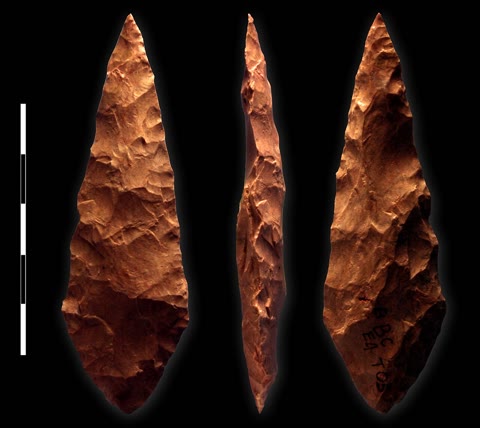
Music may be older than painting: a bone flute found at Jiahu, China, playable and tuned to a scale, is ~9,000 years old — and flutes from Germany's Hohle Fels, made of vulture wing-bone, reach back ~40,000 years.[22]
Cave art, Venus figurines, and the painted dark belong to the Neolithic Period article — which treats them at length. Here the point is simpler: before the New Stone Age, the symbolic human — the one who paints, buries, sings, and adorns — was already fully formed.
The impossible question: language
The single most consequential invention of prehistory left no fossil at all. When did we start talking?
Anatomy offers clues: a low larynx for vowels, a modern hyoid bone (Neanderthals had one — they could probably speak), and the FOXP2 gene, whose two human-specific mutations are shared with Neanderthals — suggesting the capacity for complex language predates our split.[23] Estimates for full language range from 50,000 to 2,000,000 years — a forty-fold spread that tells you how honestly nobody knows.
What we can say: it existed before the great dispersal (all living languages share a deep structure), and once it existed, it changed the unit of evolution — a human could now inherit knowledge without experiencing it. Every word you've ever read, including this one, descends from something nobody wrote down.
The last chapter
By 10,000 BCE the stage was set: modern humans on every continent, dogs at the fire, art on the walls, memory in the soil. What happened next — the temple before the farm, the first towns, the mammoths' last stand, the invention of agriculture eleven separate times — is its own story, and it's a good one.
Continue reading: Neolithic Period — the New Stone Age, where this story ends and the one we call civilization begins.
Epilogue: history starts here
Prehistory ends not with a war or a flood but with a document. Around 3,200 BCE in the Sumerian city of Uruk, temple accountants began pressing wedge-shaped marks into clay — inventory, rations, barley tallies. The marks became cuneiform, the tablets became archives, and for the first time, memory could outlive the person who held it.[24]
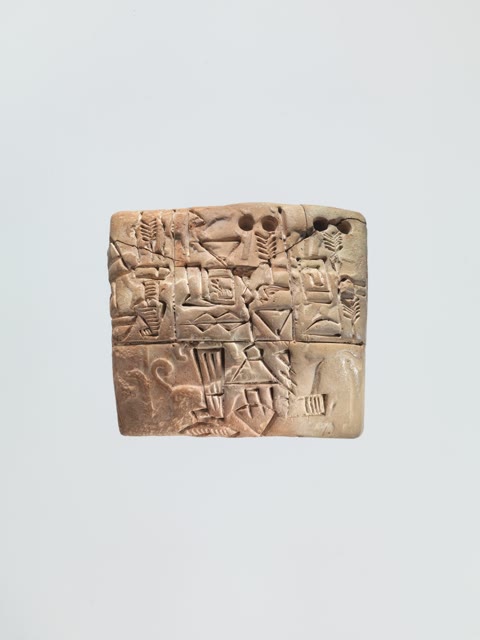
This tablet is a barley receipt. It says nothing profound — and that is precisely the point. History begins not with an epic but with paperwork. The three-million-year prologue was over; from now on, we'd write it all down.
Quiz: were you paying attention?
- Which species predates our own genus Homo — and yet used the oldest stone tools known (~3.3 million years)?
- What did the Laetoli footprints prove before anyone found a skeleton to match them?
- Name two other human species that coexisted with early Homo sapiens — and what their DNA still does inside us.
- What supervolcano nearly ended humanity ~74,000 years ago — and where is its caldera today?
- What invention ended prehistory — and what was the oldest document actually about?
Show answers
1 — probably an australopithecine (the Lomekwi 3 tools predate Homo) · 2 — that hominins walked upright 3.66 million years ago, side by side, long before big brains · 3 — Neanderthals and Denisovans (also naledi, floresiensis) — most non-African people carry 1–4% Neanderthal DNA · 4 — Toba, Sumatra — its caldera is now Lake Toba · 5 — writing, c. 3,200 BCE in Uruk — the oldest documents are barley accounts, not epics.
Notes
- On Lucy: "Lucy" is the nickname of specimen AL 288-1; the Hadar team's celebration played "Lucy in the Sky with Diamonds." Her species' upright gait is corroborated by the Laetoli tracks.
- On fire: a million-year date is the earliest secure claim (Wonderwerk). Claims of fire use at 1.5–1.7 Mya exist but remain disputed; the text uses the conservative figure.
- On Toba: the eruption's date (~74,000 ya) is solid; the causal link to the human population bottleneck is contested. The bottleneck itself — our thin genetic diversity — is not.
- On naledi: the deliberate-burial claim is still disputed; see the full story in Neolithic Period.
- On language: no fossil evidence exists; dates cited are anatomical/genetic inference, which is why the range spans forty-fold.
- On dates: all deep-time figures are radiometric estimates with error margins; "Mya" = million years ago, "k ya" = thousand years ago.
References
- Harmand, S. et al., Nature 521 (2015) — the Lomekwi tools, predating Homo
- Johanson, D. et al. (1978); Leakey & Hay, Nature 278 (1979) — Lucy and the Laetoli tracks
- Berna, F. et al., PNAS 109 (2012) — Wonderwerk fire
- Hublin, J.-J. et al., Nature 546 (2017) — Jebel Irhoud and the pan-African sapiens origin
- Green, R. E. et al., Science 328 (2010); Reich, D. et al., Nature 468 (2010) — Neanderthal and Denisovan genomes
- Rampino & Self, Nature 359 (1992); Ambrose, J. Hum. Evol. 34 (1998) — Toba and the bottleneck
- Henshilwood, C. et al., Science 295 (2002) — Blombos engraved ochre
- Zhang, J. et al., Nature 401 (1999) — the Jiahu bone flutes
- Englund, R. K. (1994) — the archaic Uruk tablets
- Metropolitan Museum of Art Open Access (CC0); Smithsonian; eLife; Nature; PNAS; Wikimedia Commons contributors — images
See also
- Neolithic Period — the final chapter this article hands off to
- History of Education · History of Learning · History of Science · History of Mathematics
- The ALB handbook · Examples — the species that learned to write, now learning to program
Footnotes
- ↑ Harmand, S. et al., "3.3-million-year-old stone tools from Lomekwi 3, West Turkana, Kenya", Nature 521 (2015)
- ↑ Gowlett, J., "The longest transition — the Acheulean and the human career," Journal of the Royal Anthropological Institute (2016)
- ↑ Brunet, M. et al., "A new hominid from the Upper Miocene of Chad, Central Africa", Nature 418 (2002)
- ↑ Johanson, D. C. et al., "A new species of the genus Australopithecus…," Kirtlandia 28 (1978)
- ↑ Leakey, M. D. & Hay, R. L., "Pliocene footprints in the Laetolil Beds at Laetoli, northern Tanzania", Nature 278 (1979)
- ↑ Walker, A. & Leakey, R., The Nariokotome Homo erectus Skeleton (1993)
- ↑ Berna, F. et al., "Microstratigraphic evidence of in situ fire in the Acheulean strata of Wonderwerk Cave", PNAS 109:20 (2012)
- ↑ Wrangham, R., Catching Fire: How Cooking Made Us Human (2009)
- ↑ Hublin, J.-J. et al., "New fossils from Jebel Irhoud, Morocco and the pan-African origin of Homo sapiens", Nature 546 (2017)
- ↑ Clarkson, C. et al., "Human occupation of northern Australia by 65,000 years ago", Nature 547 (2017)
- ↑ Hoffmann, D. L. et al., "U-Th dating of carbonate crusts reveals Neandertal origin of Iberian cave art", Science 359 (2018)
- ↑ Green, R. E. et al., "A draft sequence of the Neandertal genome", Science 328 (2010)
- ↑ Reich, D. et al., "Genetic history of an archaic hominin group from Denisova Cave in Siberia", Nature 468 (2010); Meyer, M. et al., Science 338 (2012)
- ↑ Rampino, M. R. & Self, S., "Volcanic winter and accelerated glaciation following the Toba super-eruption", Nature 359 (1992)
- ↑ Self, S., "The effects and consequences of very large explosive volcanic eruptions", Phil. Trans. R. Soc. A 364 (2006)
- ↑ Smith, V. C. et al., 'Humans thriving in South Asia through the Toba super-eruption' — ash distribution studies, Science/Nature Communications (2018–2020)
- ↑ Rampino & Self (1992); Zielinski, G. A. et al., "Potential atmospheric impact of the Toba mega-eruption", Geophysical Research Letters 23 (1996)
- ↑ Ambrose, S. H., "Late Pleistocene human population bottlenecks, volcanic winter, and differentiation of modern humans", Journal of Human Evolution 34 (1998)
- ↑ Petraglia, M. et al., "Middle Paleolithic assemblages from the Indian subcontinent before and after the Toba super-eruption", Science 317 (2007)
- ↑ Kappelman, J. et al., "Adaptive foraging behaviours in the Horn of Africa during Toba supereruption", Nature (2024)
- ↑ Henshilwood, C. et al., "Emergence of modern human behaviour: Middle Stone Age engravings from South Africa", Science 295 (2002); d'Errico, F. et al., Journal of Human Evolution (2005)
- ↑ Zhang, J. et al., "Oldest playable musical instruments found at Jiahu early Neolithic site, China", Nature 401 (1999); Conard, N. J. et al., Nature 460 (2009)
- ↑ Enard, W. et al., "Molecular evolution of FOXP2, a gene involved in speech and language", Nature 418 (2002); Krause, J. et al., Current Biology (2007)
- ↑ Englund, R. K., Archaic Administrative Texts from Uruk (1994); Englund & Nissen, Die lexikalischen Listen der archaischen Texte aus Uruk (1993)