
Kay McNulty
Kathleen Rita McNulty (February 12, 1921 – April 20, 2006) — known to history as Kay McNulty, and in later life as Kay Mauchly and then Kay Antonelli — was an Irish-born American mathematician and one of the six original programmers of ENIAC, the first general-purpose electronic computer. Of the famous six, she was the only one born outside the United States — an emigrant who arrived in Philadelphia as a toddler in 1924 and, two decades later, helped invent the profession of programming on the machine that needed it invented.[1][2]
Her particular fingerprints on computing are structural: she is remembered among the six for her work on the machine's program structure — the emerging idea of subroutines, reusable blocks of wiring-and-switch logic — for debugging practice on a machine with a vacuum tube failing every few days, and later for teaching programming to the next generation at her own kitchen table while raising five children.[3]
Creeslough, 1921
McNulty was born in Creeslough, a village in County Donegal in the northwest of Ireland, in the middle of the Irish War of Independence. Her father, James McNulty, had been a member of the Irish Republican Army and had spent time in British custody for it; the family's emigration was never quite separable from the politics of those years. She was baptized on the night of February 12, 1921 — and by family legend the household left for America so soon after that the christening and the departure became one story, retold for eighty years. The McNultys sailed in 1924 and settled in Philadelphia, in the Irish neighborhood of Chestnut Hill — a coincidence she later enjoyed: she would graduate from Chestnut Hill College, named for the very neighborhood that had received the family.[4]
Raised in a household that was Irish before anything else, she attended J. W. Hallahan Catholic Girls High School, where the nuns discovered she was something of a mathematical prodigy. At Chestnut Hill College she took every mathematics course the school offered — and still only assembled a handful of classmates in the major. She graduated in 1942, into a country at war and suddenly short of men who could do mathematics.[5]
The human computers
The Army's Ballistic Research Laboratory needed what the war could not wait for: firing tables. Every gun, every shell type, every charge and elevation angle required a computed trajectory — and each trajectory was a calculus problem that took a trained person hours to days to complete by hand. The work was done by a corps of roughly eighty women at the University of Pennsylvania's Moore School of Electrical Engineering, armed with Monroe desk calculators and, for the ambitious, a room-sized analog device called the differential analyzer. Their job title was, literally, computer.
McNulty answered the Army's advertisement in the summer of 1942 and became one of them — a GS-4 "computer" grinding out trajectories. She was very fast, and she was very bored; years later she was blunt about how stultifying the work felt to someone who had spent four years learning real mathematics. But the corps taught her the thing that mattered: what it actually takes to decompose a physical problem into steps a machine — human or electronic — can execute.[6]
Six volunteers
In the spring of 1945 a notice went around the corps: the Army wanted six volunteers for a secret project. Volunteers would not be told what the machine was or what it did. McNulty put her name down. So did Betty Jennings, Betty Snyder, Marlyn Wescoff, Fran Bilas, and Ruth Lichterman — the group history remembers as the ENIAC six, the first programmers.[4]
The machine was ENIAC — Electronic Numerical Integrator and Computer — thirty tons of steel, eighteen thousand vacuum tubes, and not a single line of anything that could be called software. Programming it meant physically reconfiguring it: routing signals through plugboards with hundreds of patch cables, setting thousands of switches, and arranging its twenty accumulators into a plan of execution. There was no programming language to learn because nobody had invented one. There was no manual. There were block diagrams.
The six taught themselves the machine off the paper first — they were initially not even permitted into the room where ENIAC stood — and then taught the machine. Out of sheer necessity they produced the apparatus of the profession: flowcharts to plan the logic before a cable was touched, careful state-tracking across the accumulators, hand-simulation to verify a wiring plan before committing to it, and the hard-won discipline of debugging — finding which of ten thousand possible connections, settings, or marginal tubes was the one producing garbage.[7]
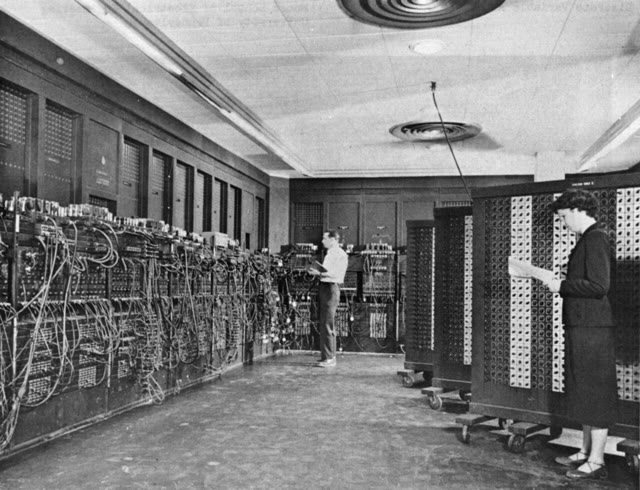
What she built
Every member of the six left a different mark on the machine, and McNulty's was architectural. She became deeply involved in ENIAC's master programmer — the central control unit that let one part of a computation invoke another — and in the practice that grew around it: the idea that a block of the machine's configuration could be treated as a subroutine, invoked and reused as a unit rather than rewired from scratch each time. It is the oldest ancestor of the function call, and the ENIAC six's working notes show it being invented in real time.[8]
Her other specialty was the unglamorous half of programming that never makes the photographs: verification. ENIAC failed physically on a rhythm measured in days — a dying tube here, a marginal connection there — and its failures were silent: a drifted signal produced confidently wrong numbers. McNulty became one of the people the others relied on to read a bad run and find the fault — whether it lived in the wiring plan, the settings, or the hardware itself. On a machine that could not be trusted, knowing how to check was the whole job.[9]
She was still at the machine when the Army finally showed it to the world. On February 14–15, 1946, ENIAC was unveiled to the press in Philadelphia — the first time the public learned that an electronic general-purpose computer existed. Its showpiece was a ballistic trajectory computed faster than the shell would have flown it. Photographers documented the room extensively; the women who had programmed it were either cropped out of the story or mislabeled in captions — in some accounts introduced to reporters as models. The machine's designers, Eckert and Mauchly, became famous. The programmers' names were not recorded.[10]
Mauchly
In 1948, Kay McNulty married John Mauchly — ENIAC's co-inventor — becoming the second Mrs. Mauchly. The marriage connected the two halves of ENIAC's story in one household: the man who had conceived the machine and the woman who had made it compute. They had five children.
She kept programming. At the Eckert–Mauchly Computer Corporation — through BINAC and then UNIVAC, the first commercial computer in the United States — she worked on software in the years when "software" was still a new word, and became the person who taught it to others: newly hired programmers were trained, famously, at Kay Mauchly's kitchen table, in the hours the children allowed. She contributed to UNIVAC's documentation and training while working part-time across the company's turbulent sale to Remington Rand — and remained, by every account, one of the most experienced programmers alive at a moment when the profession was only a decade old.[11]
After John Mauchly died in 1980, she married the Italian-American photographer Severo Antonelli in 1995 — her third name, and the one under which she spent her last decade.
Recognition, at last
The correction arrived late and then all at once. In 1997, fifty-one years after the unveiling, the six ENIAC programmers were inducted into the Women in Technology International Hall of Fame — the first major institutional recognition that the first programmers were not the two men on the patent, but six mathematicians who had invented the job. McNulty lived to see the reversal: she gave interviews to historians and appeared on camera for Kathy Kleiman's documentary The Computers, telling the story in her own voice.[12]
Ireland claimed her back, too. In her homeland's northwest — the county she had left as a toddler — a computing centre at the institute in Letterkenny, County Donegal, was named in her honor: the girl from Creeslough became a namesake for Irish students learning the field she had helped create.[13]
She died in Wyndmoor, Pennsylvania, on April 20, 2006 — eighty-five years old, three names deep into one life, and finally famous for the right thing.
Legacy
McNulty's career is the argument at the heart of this encyclopedia's history pages: that the "technical" work of early computing was not done instead of mathematics but because of it. The six were hired for their mathematics degrees, then asked to do something no one on Earth had done. McNulty's own contribution — program structure, subroutines, verification, and the patient transfer of hard-won knowledge to the next generation — reads today like a description of the profession's best habits, written fifty years early.[7]
See also
- The first programmers — the story of all six
- Fran Bilas · Betty Jennings · Betty Snyder · Marlyn Wescoff · Ruth Lichterman — the other five
- UNIVAC I — the commercial machine she helped teach the world to use
- History of Programming
- JoAnn H. Morgan — the woman who followed them into the launch room, a generation later
References
- Kleiman, Kathy. Proving Ground: The Untold Story of the Six Women Who Programmed the World's First Modern Computer (Grand Central, 2022).
- Haigh, Thomas, Mark Priestley, and Crispin Rope. ENIAC in Action: Making and Remaking the Modern Computer (MIT Press, 2016).
- Evans, Claire L. Broad Band: The Untold Story of the Women Who Made the Internet (Portfolio, 2018).
- Chestnut Hill College — alumni profile, Kathleen McNulty Antonelli, class of 1942.
- Women in Technology International Hall of Fame — 1997 induction of the ENIAC programmers.
- Kleiman, Kathy (dir.). The Computers — documentary featuring interviews with McNulty and the surviving ENIAC six (2014).
Footnotes
- ↑ Kleiman, Proving Ground (2022), chapter on McNulty's early life
- ↑ Chestnut Hill College alumni records, class of 1942
- ↑ Haigh, Priestley & Rope, ENIAC in Action (MIT Press, 2016)
- ↑ Kleiman, Proving Ground (2022)
- ↑ Chestnut Hill College, "Kay McNulty Antonelli" alumni profile
- ↑ McNulty oral history, quoted in Evans, Broad Band (2018)
- ↑ Haigh, Priestley & Rope, ENIAC in Action (2016)
- ↑ ENIAC in Action (2016), on the master programmer and early subroutine practice
- ↑ Kleiman interviews with McNulty, as cited in Proving Ground (2022)
- ↑ Kleiman, Proving Ground (2022); contemporary press coverage of the unveiling
- ↑ Evans, Broad Band (2018); Kleiman, Proving Ground (2022)
- ↑ WITI Hall of Fame, 1997 inductees; Kleiman, The Computers (documentary, 2014)
- ↑ Donegal County / LYIT commemoration of Kathleen McNulty