
Joseph-Marie Jacquard
Joseph-Marie Jacquard (7 July 1752 – 7 August 1834) was a French weaver and inventor from Lyon whose punched-card loom changed two industries at once: textiles, which he automated, and — a century later — computing, which inherited his idea that a machine could follow a stored deck of instructions.
Life
The weaver's son
Jacquard was born into a Lyon weaving family — his father was a master weaver, his mother a pattern reader — and he was sent to work at the loom as a child in place of much schooling; he reportedly learned to read as a teenager from his brother-in-law. After his father's death in 1772 he inherited the workshop and two looms, drifted through trades — bookbinding, typefounding, cutlery, a failed plaster venture — lost most of the inheritance, and by the late 1780s was back in Lyon doing journeyman weaving work. He knew the loom's drudgery firsthand, and in particular the figure-weaving bottleneck: the draw boy who had to lift the right warp threads by hand for every pass.
Revolution and the invention
He was experimenting with loom automation by 1790, but the French Revolution interrupted everything — Jacquard fought on the Republican side during the siege of Lyon in 1793, lost his only son Jean Marie to the fighting, and fled with the retreating army. Returning to Lyon after the amnesty, he resumed work and produced his key device around 1800–1801: an attachment that read a pattern from punched cards, building on earlier punched-paper mechanisms by Basile Bouchon (1725), Jean-Baptiste Falcon (1728), and Jacques de Vaucanson (1745). Jacquard's contribution was making it practical — needles and hooks instead of fragile paper rolls, cards chained so a pattern could run indefinitely.
Demonstrated in Paris in 1801 — where a simpler net-making machine of his had already earned a bronze medal — the loom was patented in 1804. In 1805 Napoleon inspected it personally in Lyon; the reward was not riches but a pension of 3,000 francs, a royalty of 50 francs per loom sold, a medal — and the design declared effectively public property of French industry, which is precisely why it spread so fast.
The riots and the comeback
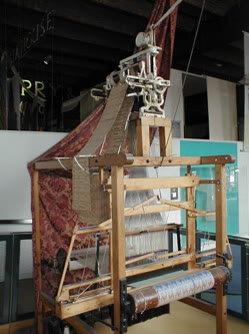
Lyon's weavers saw their livelihoods encoded onto cards and responded with fury. Early looms were smashed, Jacquard was attacked in the street — the famous story has him thrown into the Rhône — and the unrest became one of the earliest documented fights between labor and automation. The adoption curve won regardless: by 1812 roughly 11,000 Jacquard looms were working in France, and the city's silk output exploded even as the draw-boy trade vanished.
Jacquard spent his later years honored but modest, improving the mechanism until the end. He died in Oullins, just south of Lyon, on 7 August 1834, aged 82 — the man thrown in the river by weavers had outlived the riots to be celebrated as the savior of the city's industry.
The portrait that proved the point
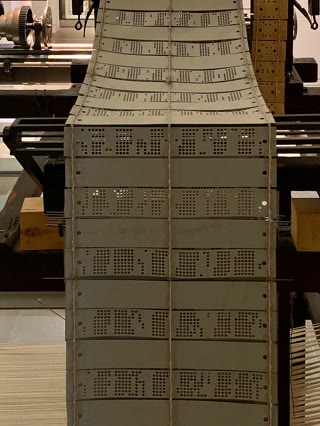
Around 1839–1840, a few years after his death, the Lyon firm Didier, Petit et Cie produced a portrait of Jacquard woven entirely in silk on a Jacquard loom — some 24,000 punched cards encoding a near-photographic image. Weavers at the time described it as woven "in imitation of an engraving." Charles Babbage owned one and displayed it proudly — it is the earliest surviving artifact of a complex stored program, and you can still see the weave in its detail today.
Legacy
- In textiles, "jacquard" is still the everyday word for figured woven fabric — his name is woven into the material itself.
- In computing, his card mechanism is the direct ancestor of the program deck: Babbage borrowed the cards for the Analytical Engine, Hollerith carried them into data processing, and IBM's punched-card standard kept the idea alive into the computer age.
- His story is the quiet start of the history of programming: before any computer existed, there was a machine that obeyed a deck of instructions — and a person who imagined it.