
Jacquard Loom
The Jacquard loom is a weaving machine invented by Joseph-Marie Jacquard of Lyon, France, first demonstrated in 1801 and patented in 1804. It wove complex figured patterns automatically by reading instructions from chains of punched cards — making it the first practical machine controlled by a stored pattern of instructions, and the ancestor of every idea of a "program" that followed.
Before Jacquard: the long road
Jacquard's breakthrough was the last step of an eighty-year effort to mechanize pattern weaving:
- 1725 — Basile Bouchon replaced the draw boy's cord-pulling with a perforated paper roll that pressed against needles — the first automatic selection, but the paper tore too easily for real use.
- 1728 — Jean-Baptiste Falcon, Bouchon's assistant, swapped the roll for individual punched cards chained in a loop — the right idea, still too delicate.
- 1745–1750 — Jacques de Vaucanson, the famous automaton-maker, tried a punched metal cylinder — precise, expensive, and never adopted by the trade.
Each inventor moved the idea one notch toward practicality. Jacquard — a working weaver, not a gentleman-scientist — combined Falcon's cards with a rugged needle-and-hook mechanism that any workshop could build, maintain, and afford. That is the version that spread.
The problem it solved
An ordinary loom interlaces threads by lifting some warp threads and not others on each pass of the shuttle — the pattern is which threads go up. Plain cloth needs simple repeating lifts, but figured fabric — brocade, damask, anything with an image or intricate design — needs a different selection on every pass.
Before Jacquard, that selection was a person. A draw boy sat above or beside the loom and pulled cords to raise the correct threads, pass after pass — thousands of selections a day, each made by hand. One mistake spoiled yards of silk; one skilled pattern required weeks of labor for feet of cloth. The pattern existed only in the weaver's head and the draw boy's hands — it could not be stored, copied, or moved.
How it worked
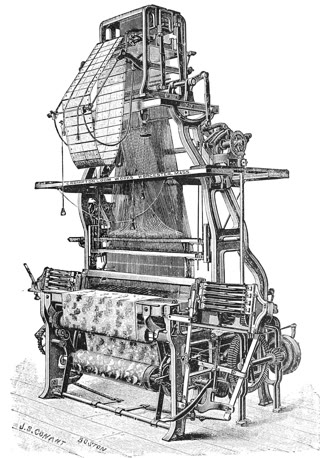
Jacquard's attachment — mounted above an ordinary loom — replaced the draw boy with punched cards:
- Each card carried one row of the pattern, encoded as a grid of holes.
- A bank of spring-loaded needles pressed against the card each pass. Where a hole was punched, the needle passed through; where there was no hole, the needle pushed its hook out of engagement — and that warp thread stayed down (or rose, depending on the loom's rigging).
- Cards were chained together into a continuous loop, advanced one card per shuttle pass.
So: hole = this thread lifts; no hole = it doesn't. One binary decision per thread per row, thousands of decisions per card, chained into sequences long enough to weave pictures.
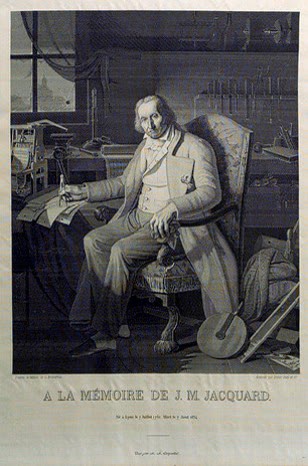
The famous woven portrait of Jacquard — produced by the Lyon firm Didier, Petit et Cie — required about 24,000 cards, and its fidelity still startles people who see it.
Why it is the ancestor of programming
The loom did three things no earlier machine had:
- The pattern was data. The same loom wove any design; you changed the deck of cards, not the machine. Hardware and its "code" were finally separate things.
- Programs were portable. A card deck was a library — one atelier's pattern could be punched, sold, shipped, and woven on any Jacquard loom. Patterns became a tradeable commodity in themselves.
- Errors were in the cards, not the machine. Punch a hole wrong and the cloth came out wrong in exactly that spot — the world's first bugs, traceable to a specific instruction.
Weavers even developed card-punching as a skilled trade: a designer's draft was transferred to squared pattern paper, then punched row by row — the direct ancestor of "coding from a spec." Lyon developed a whole cottage industry of punchers and card-lacing specialists.
Controversy
The loom was not welcomed. Lyon was the center of French silk weaving, and the draw boys and journeymen whose work the cards automated attacked the early machines — looms were smashed and Jacquard was reportedly dragged from his loom and thrown into the Rhône. The technology won anyway: by 1812 there were some 11,000 Jacquard looms in France, and the riots became one of history's first recorded episodes of labor unrest against automation — decades before the Luddites made the pattern famous in England.
The economics were unstoppable: figured silk that took weeks now took days, at a fraction of the cost, and the same design could be reproduced identically a hundred times. Lyon's output boomed; the draw-boy trade disappeared. The argument — does a machine that makes goods cheaper destroy the people who made them — is the same one industries have repeated ever since.
Lineage to computing
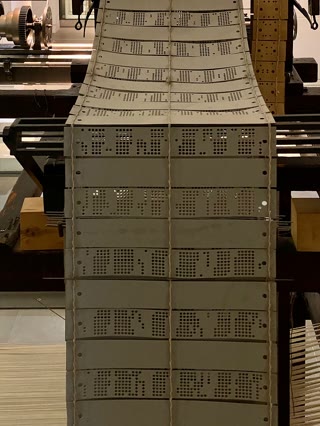
The loom's cards passed the idea of instructions on paper directly into computing:
- Charles Babbage explicitly adopted Jacquard-style punched cards for his Analytical Engine (1830s) — its operation and variable cards were program and data, and Ada Lovelace's 1843 notes assumed that model. Babbage owned a copy of the woven portrait and loved showing it to visitors as proof of what cards could encode.
- Herman Hollerith's 1890 census tabulator used punched cards for data processing, and the company that grew from it — IBM — fixed the card as an industry standard for nearly a century.
- Program and data punched cards remained the normal way to store a program until interactive terminals arrived in the 1970s — a direct line of descent a century and a half long.
When computing historians say the Jacquard loom "invented programming," they mean it separated the machine from the sequence of operations it performs — the single idea every language since is built on.
See also
- Joseph-Marie Jacquard
- Punched card
- Charles Babbage · Analytical Engine · Ada Lovelace
- Herman Hollerith · IBM
- History of Programming
References
- Essinger, James. Jacquard's Web: How a Hand-Loom Led to the Birth of the Information Age (Oxford UP, 2004).
- Bowness, Charles. "The Jacquard Machine." Proceedings of the Institution of Mechanical Engineers (1880).