
History of Science
The history of science is the biography of a single, subversive idea: that nature operates by rules anyone can discover by looking, measuring, and checking — and that no authority, however ancient, outranks a careful observation. It took most of human civilization to invent that idea, and it has been fighting for its life ever since. This page follows it from clay star-tables to sequenced genomes — and to the newest instrument of all, the computer.
The ancient world — watching the sky
Systematic science begins, as so much does, on Babylonian clay: astronomers kept continuous eclipse and planetary records for centuries — the longest data series in ancient history — and could predict sky events arithmetically. Egypt kept medical papyri that distinguished "an ailment I will treat" from "an ailment I will not." Observation-first knowledge was already real; what it lacked was theory.
The Greeks supplied theory — with the caveat that they often supplied it instead of looking. Aristotle systematized nature brilliantly and authoritatively wrong (heavier things fall faster; nature abhors a vacuum). Yet the same civilization produced genuinely empirical giants:
- Eratosthenes (c. 240 BCE) measured Earth's circumference from noon shadows in two cities — within a few percent of the true value, with a stick and a well.
- Archimedes (c. 250 BCE) fused experiment and proof — buoyancy in the bath, levers in the treatise, "give me a place to stand."
- Ptolemy built the Almagest — a wrong-model astronomy so mathematically capable it stayed useful for 1,400 years, a standing lesson that predictive power is not the same thing as truth.
- Alexandria's Museion and Library made scholarship institutional — and showed how much of it could burn.
The long preservation — and a method appears
While Europe inherited fragments, the Islamic golden age translated, preserved, and — critically — improved. Baghdad's House of Wisdom collected the Greek corpus; then Ibn al-Haytham (Alhazen, c. 965–1040) did something new with it: the Book of Optics treats light as a physical thing to be tested with controlled experiments — hypothesis, apparatus, replication. Many historians call him the first true scientist rather than philosopher: the method had arrived, six centuries before it was named. Ibn Sina's Canon of Medicine taught medicine for 600 years.
China, meanwhile, compiled a scientific tradition of unmatched engineering fruitfulness: the compass, gunpowder, movable-type printing, continuous astronomical records, seismographs. Needham's famous question — why didn't the scientific revolution happen there? — is still debated; the record itself is not.
The revolution (1543–1687)
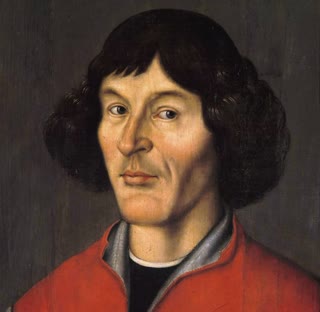
In 1543, two books quietly unmade the cosmos: Copernicus' De revolutionibus put the Sun at the center (published as he lay dying — he'd delayed for decades), and Vesalius' Fabrica showed the human body's actual anatomy, drawn from dissection rather than Galen's authority. Look, don't recite: the revolution had a method before it had results.
The results came in a cascade:
- Tycho Brahe spent twenty years producing the most precise pre-telescopic observations ever made — data as a life's work.
- Kepler inherited the data and cracked: Mars moves in an ellipse — three laws (1609–19) that killed 2,000 years of perfect circles.
- Galileo pointed a telescope at the sky (1609): moons orbiting Jupiter, phases of Venus, craters on a not-perfect Moon. Then he experimented — inclined planes, falling bodies — mathematizing motion itself. In 1633 the Church tried him for it.
Bacon wrote the method down (Novum Organum, 1620 — induction from observation); Descartes wrote the doubt down (1637); the Royal Society (1660) built the institution and chose as its motto Nullius in verba — "on no one's word." Science now had machinery: societies, journals, instruments, a doctrine of verification.
Newton's century — the universe as clockwork
Then Newton — a man who had spent more hours on alchemy and theology than physics, which tells you how much physics he did — published the Principia (1687) and unified the heavens and the falling apple under one law. Gravitation, three laws of motion, the calculus built to say it. The universe became a mechanism: lawful, calculable, everywhere the same. Halley funded the book and got a comet named in gratitude.
The eighteenth century industrialized the insight. Linnaeus sorted life into taxonomy (1735). Franklin dragged lightning out of the sky onto paper (1752). Herschel found a new planet with a homemade telescope (1781). Hutton read deep time in Scottish rocks — geology teaching the Earth was old beyond scripture's arithmetic. And steam engines started paying for laboratories, beginning the feedback loop — science → technology → more science — we're still inside.
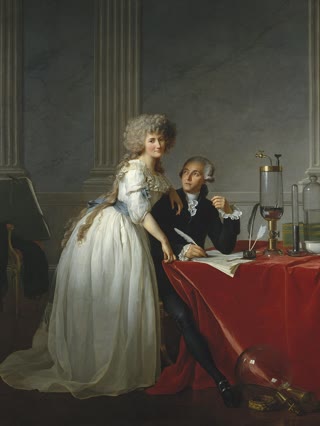
Lavoisier completed the Enlightenment's program in chemistry: measure everything, especially mass. Conservation of mass, the end of phlogiston, the first modern chemistry textbook (1789) — and in 1794, the guillotine. Lagrange's eulogy endures: "It took them only a moment to make that head fall, and a hundred years may not produce another like it."
The nineteenth century — everything connects
Science became a profession — universities, degrees, journals, labs — and the discoveries came in waves:
- Electromagnetism: Ørsted's compass needle twitch (1820), Faraday's fields (a bookbinder's apprentice who could not read the math and saw deeper for it), Maxwell's equations (1865) — electricity, magnetism, and light itself in four lines. Radio was now inevitable.
- Evolution: Darwin (1859) — twenty years of barnacles and dread before publishing — and Wallace, who had reached the same theory independently a year earlier. Life became a process, not an inventory.
- The periodic table: Mendeleev (1869) sorted the elements by weight and gaps, then predicted the missing ones — gallium found 1875, germanium 1886 — the table as prophecy.
- Germ theory: Semmelweis (1847, ignored, died in an asylum — hand-washing, the cheapest life-saving discovery ever resisted), Pasteur, Lister, Koch. Cities became survivable.
- Mendel (1866): a monk, a monastery garden, 28,000 pea plants — the mathematical law of heredity, published in obscurity and unread for 34 years until three scientists rediscovered it in 1900.
Wrong for centuries — a sampler
| Everyone believed | Reality | Broken by |
|---|---|---|
| Earth at the center | heliocentrism | Copernicus → Galileo |
| Phlogiston (fire-stuff) | oxidation | Lavoisier |
| Spontaneous generation | germ theory | Pasteur |
| The luminiferous ether | relativity | Michelson–Morley → Einstein |
| Fixed continents | plate tectonics | Wegener → 1960s |
| Ulcers = stress | H. pylori bacteria | Marshall & Warren (1982) |
| Humans apart from nature | evolution | Darwin & Wallace |
Science's proudest tradition is being wrong on schedule.
Physics remade (1895–1939)
In 1895 Röntgen discovered X-rays; in 1896 Becquerel found radioactivity in a drawer; in 1897 Thomson found the electron. Physics, declared nearly finished, was just starting:
- Planck (1900) quantized energy — reluctantly, hoping it was a trick.
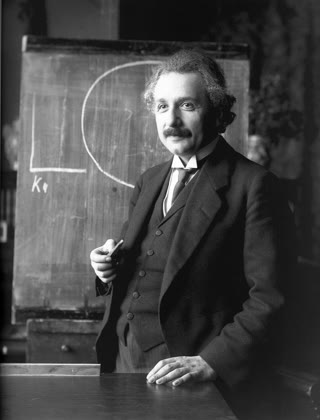
- Einstein's annus mirabilis (1905): photoelectric effect (light comes in packets), Brownian motion (atoms are real), special relativity, and E=mc² — four papers, any one a career. General relativity (1915) made gravity geometry.
- The Curies: Marie — two Nobels, in two different sciences (1903, 1911), the only person ever — isolated polonium and radium in a shed; the field she founded eventually helped kill her.
- Rutherford found the nucleus (1911); Bohr put orbits on it (1913); Heisenberg, Schrödinger, Dirac rebuilt the whole subatomic world as quantum mechanics (1925–27) — nature fundamentally probabilistic, a conclusion Einstein never accepted and experiment keeps confirming anyway.
- Hubble (1929): the universe is expanding — it had a beginning, an idea so strange physics initially invented fudge factors to avoid it.
Big science — war, atoms, and the double helix
The Second World War made science industrial: radar, rocketry, penicillin mass-produced (Fleming's 1928 moldy dish, rescued by Florey and Chain), and the Manhattan Project — physics' collective bargaining with the state, and its permanent moral shadow.
Then came the peacetime detonations:
- 1953 — DNA: Watson and Crick built the double helix on Rosalind Franklin's X-ray data — shown to them without her knowledge — plus Chargaff's ratios. Franklin died in 1958, before the 1962 Nobel; history has since repaired the credit if not the process.
- Plate tectonics: Wegener's 1912 continental drift was mocked for fifty years (right data, no mechanism) — vindicated in the 1960s by seafloor spreading. Geology had a paradigm shift in a career's length.
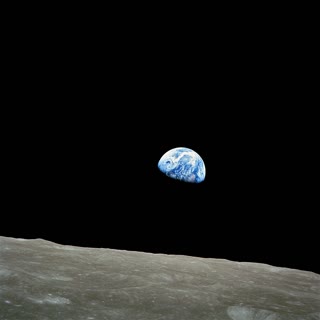
- The space age: Sputnik (1957), and in 1968 Apollo 8's Earthrise — the photograph that arguably did more for environmental consciousness than any paper — followed by Apollo 11 (1969).
- Information meets biology: the Human Genome Project (2003), CRISPR gene editing (2012), and a century of molecular biology becoming, increasingly, a data science.
The newest instrument — computation
Every instrument on this timeline opened a world that was invisible before: the telescope, moons; the microscope, cells; the accelerator, quarks. The computer — Turing's abstraction made real by Zuse's relays and ENIAC's tubes — opened something different: not a region of nature but the simulation of nature itself. Climate, folding proteins, colliding galaxies — questions too big to solve and too slow to experiment now get computed.
Science today runs on three legs — theory, experiment, and computation — and the third is the only one still growing its reach exponentially: gravitational waves (2015), the first black-hole photograph (2019), protein structures predicted wholesale by AlphaFold (2020–21), mRNA vaccine design in days (2020). Even its failures are new: the reproducibility crisis, fought with the same tools that caused it — better statistics, shared data, shared code.
See also
- History of Mathematics · History of Language
- History of Electricity · History of Programming — the twin timelines
- Alan Turing · Alonzo Church · Lambda calculus — where science met computability
- Konrad Zuse · Z3 — the first instrument of the third leg
- Donna Strickland — a modern Nobel laureate's story
- Ada Lovelace · Charles Babbage — computation imagined early
- AdaLogic BASIC
References
- Kuhn, Thomas S. The Structure of Scientific Revolutions (U. Chicago Press, 1962).
- Dampier, William Cecil. A History of Science and Its Relations with Philosophy and Religion (Cambridge UP, 1929).