
History of Education
The history of education begins long before schools existed — long before writing, farming, or cities. It is the story of how each generation hands its knowledge to the next, and it is older than our species: the evidence suggests that systematic teaching was practiced by hominins before Homo sapiens appeared.
What follows is not a single story. Separate civilizations, unaware of one another, answered the same questions in different ways — whom to teach, what to teach, and why. Only in the last two centuries did those answers begin to merge into the global institution we now call school.
Before school: deep time
For most of human existence, education had no buildings, no texts, and no name. A Paleolithic child learned by watching, playing, and imitating — the same way young wolves and chimpanzees learn — except that human children had far more to absorb: not just where to find food, but how to shape stone, read weather, and take their place in a community bound by stories and custom.
We can still see this teaching in the archaeological record. At ancient knapping sites, the clumsy flakes left by beginners lie beside the work of skilled hands. Some stone-tool traditions stayed standardized for hundreds of thousands of years — a consistency almost impossible to maintain without someone showing someone else how it was done. Experiments with modern learners confirm it: advanced flaking is nearly impossible to figure out alone. The technique was taught, hand over hand, for longer than agriculture has existed.
Settled life, beginning around 10,000 BCE, produced a new figure: the specialist. Potters, weavers, healers, and priests each guarded skills that took years to acquire, and they passed them on through apprenticeship — a master, a few learners, long supervised practice. The arrangement still operates wherever the work cannot be faked: surgical residencies, trade apprenticeships, and engineering mentorships are its living descendants.
Mesopotamia: the invention of school
Writing was invented in Mesopotamia to keep accounts, but its deeper consequence was that knowledge could outlive the knower. Somebody then had to teach the writing. By about 2000 BCE, Sumerian cities contained the edubba — the "tablet house" — the first institution in the record that existed only to teach.
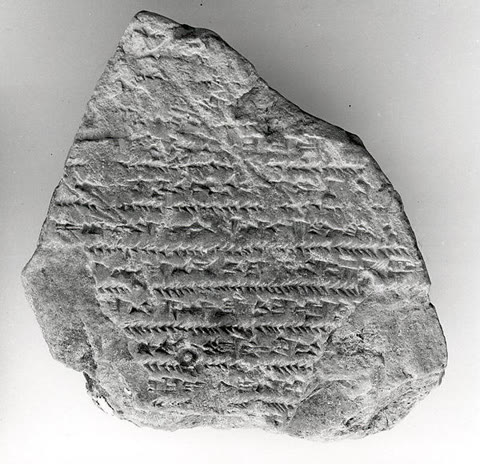
We know what an edubba day looked like because a student described one. The Sumerian composition Schooldays, reconstructed by the scholar S. N. Kramer, follows a boy through his routine: he recites yesterday's tablet, copies a new text at the master's dictation, is questioned by the staff member known as "the man in charge of the whip," and goes home to give his father an account. The father, hearing that the boy was beaten, invites the teacher to dinner. It is a recognizable school story — graded exercises, discipline, daily assessment — written four thousand years ago.
The curriculum was practical: future scribes began with lexical lists, long catalogues of words grouped by type — history's first textbooks — and worked up to literature, law, and mathematics. The graduates ran the state. Every tax record, treaty, and epic from that world, including Gilgamesh, survives because children were once sat on benches and taught to press a reed into clay.
Egypt: the scribal state
Egypt ran a parallel experiment organized around the temple. Its school was the per-ankh, the "House of Life," where scribes learned the hieroglyphic and hieratic scripts, mathematics, medicine, and theology inside the institution whose records they would one day keep. The instructional text known as The Satire of the Trades argues the point like a recruiting speech: every trade has a master to answer to — "except the scribe, who is the master."
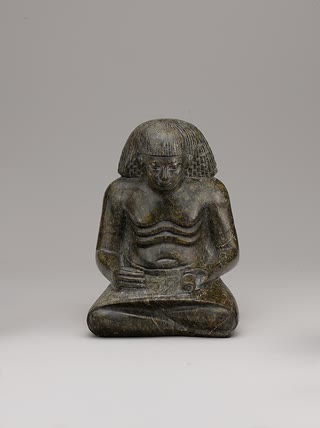
Students learned by copying wisdom literature — texts such as The Instruction of Ptahhotep, among the oldest assigned readings anywhere — absorbing orthography and ethics at once. The syllabus was the canon. Egyptian schooling kept the Mesopotamian bargain: literacy as a purchased ladder out of manual labor, mostly for boys. But the scribe's standing reached further in Egypt than it ever did between the rivers: in Egyptian art, the scribe sits while everyone else stands.
India: the guru and the monastery
The Indian tradition answered the question differently: education as a relationship. In the gurukula, a pupil left home and lived in the teacher's household, often for years, learning the Vedic texts by recitation. The oral transmission was so exact that works composed more than three thousand years ago survive in essentially unbroken memory. No writing system of the era achieved greater fidelity.
Two centers mark the Indian record. Takshashila (Taxila), flourishing from about the fifth century BCE, drew students from across Asia to teachers of medicine, law, statecraft, and grammar; tradition associates it with Panini, whose grammar compressed Sanskrit into fewer than 4,000 algebraic rules — one of the earliest formal grammars in any language. Nalanda, founded in the fifth century CE under the Gupta kings, grew into the largest seat of organized learning the ancient world produced. The Chinese pilgrim Xuanzang, who studied there, reported some ten thousand students in residence, working through Buddhist logic, medicine, grammar, and mathematics. The monastery burned in 1193.
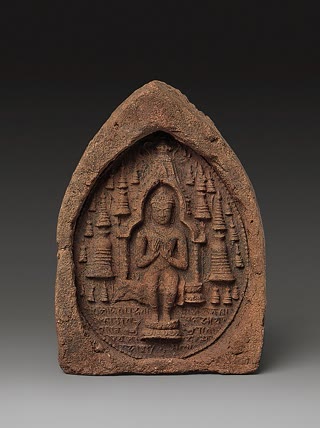
Nalanda anticipated, by centuries, arrangements Europe would later claim as its own: the residential university, the library as the institution's heart, the formal debate as an examination. Its scholars carried the model into Tibet, and its silhouette — cloister, library, disputing masters — is the ancestor of every campus since.
China: the sage and the examination
Confucius (551–479 BCE) did something quietly radical: he taught whoever came. His principle that "in education there should be no class distinctions" (Analects 15.39) made him antiquity's most consequential private teacher, and the Analects the most assigned text in history. Where Mesopotamia trained clerks, Confucius argued that the product of education is character: the cultivated person first governs himself, then his family, then the state.
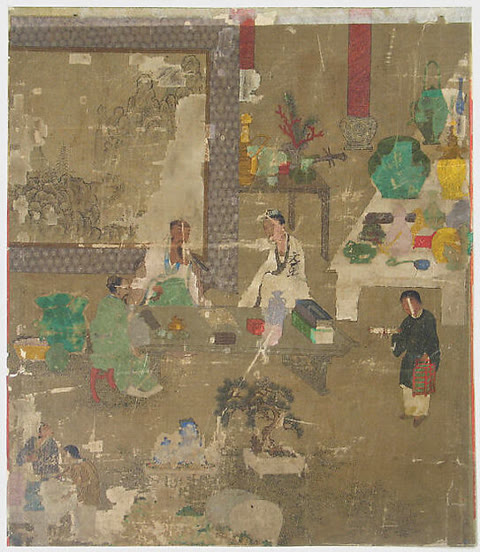
China built the idea into the state twice over. An imperial academy (taixue) trained officials from 124 BCE. Then the civil-service examination — keju, formalized under the Sui dynasty in 605 CE and administered until 1905 — made learning the lawful road to office. For thirteen centuries a farmer's son could in principle sit the same papers as a minister's, and the scripts were recopied by hand so examiners graded the work, not the signature.
Greece: paideia and the interrogative method
Greece turned education into a civic ideal: paideia, the complete formation of the citizen. An Athenian boy passed through three teachers — the grammatistes for letters, the kitharistes for the lyre (music as moral training), and the paidotribes for physical education — a curriculum of mind, soul, and body that endured for a millennium.
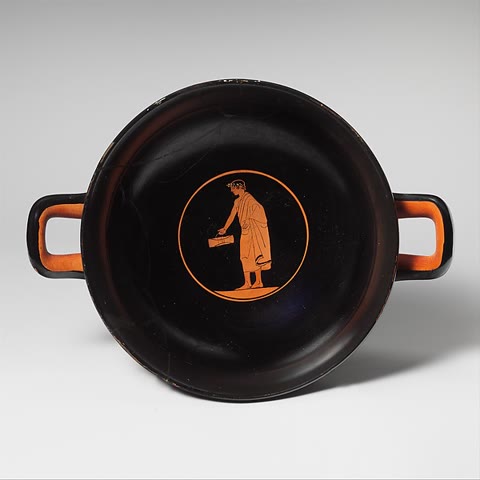
The decisive Greek contribution was a method. Socrates replaced delivery with interrogation — he treated the student's own reason as the text, and the questioning technique still bears his name. His pupil Plato founded the Academy (c. 387 BCE) in a grove outside Athens; later tradition claimed its gate read "Let no one ignorant of geometry enter." Plato's pupil Aristotle established the Lyceum (335 BCE), where scholars lectured while walking and, for the first time, organized the whole of human knowledge into distinct disciplines.
Rome: the curriculum becomes a ladder
Rome took what Greece improvised and turned it into a system. The litterator taught letters in small street schools, the grammaticus drilled grammar and the poets, and the rhetor finished students in public speaking — three rungs that produced the trained orator. Rome's greatest schoolmaster then wrote the manual.
Quintilian's Institutio Oratoria (c. 95 CE) is the founding treatise of pedagogy as a discipline. Against the practice of his own age, he argued that children learn better in groups than under private tutors, that praise works better than fear, that games belong in early instruction, and that beating a pupil is both degrading and counterproductive. Nineteen centuries of educational research have largely confirmed him; the rod was simply the slowest of his arguments to win.
The Islamic golden thread
While European learning contracted into monasteries, the Islamic world built the widest educational network yet attempted. The kuttab carried Qur'anic literacy to children across an expanding civilization — mass elementary instruction as religious duty — while the Bayt al-Hikma (House of Wisdom) in ninth-century Baghdad paid scholars to translate the Greek, Persian, and Sanskrit corpora, and then to exceed them. Algebra (al-jabr) and algorithm (from al-Khwarizmi) survive as loan-words from its output.
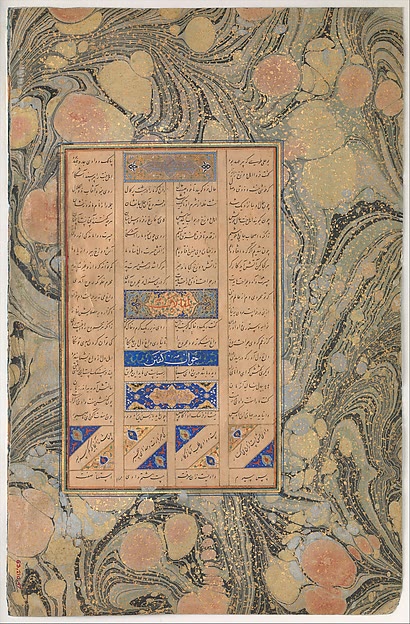
At Fez, a merchant's daughter named Fatima al-Fihri devoted her inheritance in 859 CE to founding al-Qarawiyyin — a mosque-school that matured into a university and still confers degrees. It is widely cited, by UNESCO among others, as the oldest continuously operating degree-granting institution in the world — founded by a Muslim woman more than two centuries before Bologna. Islamic scholarship also produced the ijazah, a master's license certifying that a graduate could transmit a particular text: the recognizable ancestor of the academic degree, which reached Europe through the same Latin translations that carried Arabic science west.
Europe: monastery, cathedral, university
Early medieval Europe kept learning alive through monastic and cathedral schools — the abbey schola, the bishop's school, and Charlemagne's palace circle under Alcuin, convened to restore literacy at court itself. As the cities grew and students multiplied, Europe produced its most durable invention: the universitas, a legally chartered guild of masters and scholars.
Bologna (conventionally 1088) taught law, Paris (c. 1150) theology, and Oxford grew through the twelfth century. The medieval university standardized the machinery: the arts curriculum of the trivium (grammar, logic, rhetoric) and quadrivium (arithmetic, geometry, music, astronomy), the lecture, the disputation as examination, and the academic degree. The scholastic method — state the authority, raise the objections, reconcile — sounds rigid until one recognizes its descendant: the research paper, with citations, counterarguments, and synthesis.
Print: the book for everyone
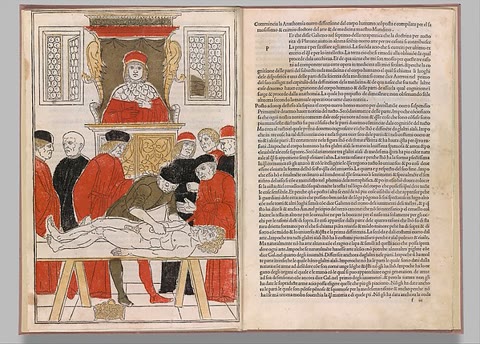
Around 1440, Gutenberg's press removed education's oldest bottleneck — the cost of the text. A manuscript Bible had consumed the skins of a herd; print made the codex common, and a classroom where every student holds the same page is a fundamentally different institution. Grammars, catechisms, and eventually newspapers carried literacy out of the cloister and into the home — where mothers taught most children their first letters, a fact the institutional histories long failed to record.
Print's great educator was Johann Amos Comenius. His Orbis Pictus (1658) — "The World in Pictures" — was the first illustrated textbook for children, teaching reading and the world together, in the vernacular, with pictures. His earlier Didactica Magna (1632) had already argued for universal schooling — every child, girls and boys, poor and rich — more than a century before any state attempted it.
The global turn: schooling for everyone
Around 1800 the parallel traditions converge into one global history: the state takes education from church and family and makes it compulsory. Prussia codified general compulsory attendance through eighteenth-century legislation (the decree of 1717; the General State Law of 1794); Horace Mann's common-school movement carried the model through Massachusetts from 1837; France, Britain, and eventually most of the world followed within two generations.
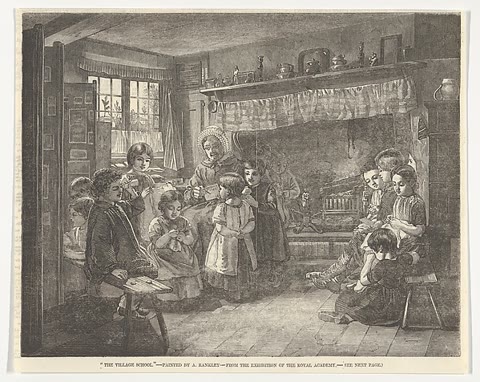
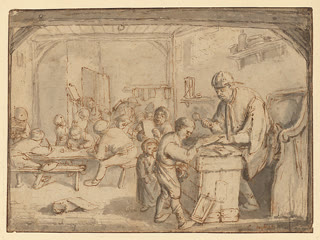
Early mass schooling ran on economy: the monitorial systems of Joseph Lancaster and Andrew Bell (c. 1800) seated hundreds of pupils in a single hall under one master, with instruction cascading through monitors — older pupils teaching younger — a cheap mechanism for delivering basic literacy to industrial cities. The pedagogical objections came quickly and were justified. Pestalozzi taught through objects rather than recitation. Fröbel founded the kindergarten (1837), formalizing the idea that play is the young child's work. Dewey built his laboratory school at Chicago (1896) around learning by doing. Montessori's Casa dei Bambini (1907) showed that children choose meaningful materials over toys when the environment respects them.
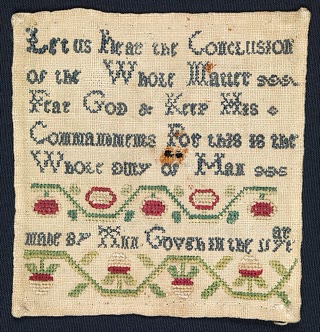
At the same time, the doors widened. Girls — long confined to domestic instruction, charity schools, and dame schools — entered formal education through the nineteenth century. The sampler below is a girl's schoolwork preserved in silk: letters, verse, moral instruction, and a marketable skill in one artifact. Women's colleges followed, and by the twentieth century education's oldest exclusion had begun its long repeal.
The one-room schoolhouse
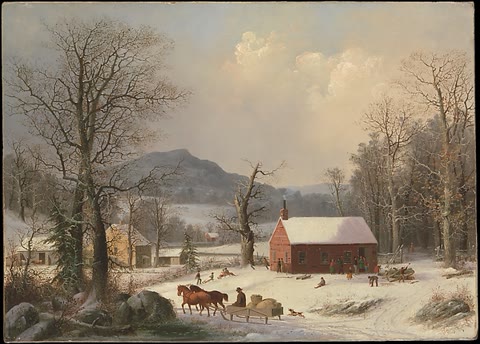
The image deserves its own chapter. For most of literate history, this was school: one room, one teacher, children of every age, a stove, a well, and slates. Older pupils helped younger — the monitorial idea in its gentler form. Instruction ran through reading, spelling, arithmetic, and deportment; the district paid in board and little else. The system was underfunded and unadorned, and it worked: nineteenth-century America built one of the world's most literate populations on it. The model survives, diminished but intact, in rural districts on every continent — and in modern multi-age classrooms that quietly reinvent it.
The twentieth century: the machine learns to teach
Industrial schooling — age-graded classes, bells, standardized tests — met its first technological challengers mid-century. Sidney Pressey's testing-and-teaching device (1920s) and B. F. Skinner's teaching machines (1950s) proposed programmed instruction: material in small steps, immediate feedback, self-paced progress. The machines themselves mostly failed. The idea did not — it is the logic inside every adaptive-learning application running today.
PLATO (1960, University of Illinois) put students at terminals wired to a shared mainframe and, almost in passing, invented online forums, instant messaging, multiplayer games, and computer-based instruction. Television promised a classroom in every home; radio actually delivered lessons to millions of remote children, and Sesame Street (1969) proved a screen could teach when it was designed to.
The digital era and beyond
The personal computer brought the machine's classroom into the home; the internet brought the library. Wikipedia (2001) became the largest collaborative teaching document ever produced; the MOOCs of 2008–2011 turned a single university lecture into a worldwide event; and by the 2020s the question had inverted. It is no longer whether a machine can teach — it is what the human teacher is for, once a patient, inexhaustible tutor lives in every pocket.
AdaLogic BASIC belongs to this history by design: a family-safe language built so that a child's first programs read like English, in an environment where the lesson, the code, and the running result share one surface — the edubba's clay tablet, at last able to compute. The mission has not changed since Sumer. Only the tablet has.
Threads that never changed
Across twelve millennia and every civilization surveyed, four things recur:
- The covenant — a master takes responsibility for a learner's formation. From the knapping floor to the AI tutor, education is a relationship before it is an institution.
- The widening circle — priests' sons, then scribes, then citizens, then taxpayers, then everyone. Each era's scandal was its predecessor's convention: the history of education is largely the history of who was finally admitted.
- The mediating tool — clay, scroll, codex, print, screen. Each medium refought the contest between memory and external record, and each time the written-down lesson won.
- The abiding quarrel — state versus individual, drill versus play, canon versus choice, examination versus judgment. Athens against the Sophists, restated in every generation's terms.
See also
- AdaLogic BASIC — the contemporary instrument, and the language this wiki teaches
- History of Learning — the biology beneath the institutions
- History of Programming · History of Science · History of Mathematics · History of Language · History of Electricity — the companion volumes in this series
- Learn · Handbook · Examples — this platform's own answer to the oldest question
- Charles Babbage · Alan Turing · Ada Lovelace — the figures who built the machine that teaches
References
- Kramer, S. N., "Schooldays: A Sumerian Composition Relating to the Education of a Scribe" — the edubba from a pupil's perspective
- Plato, Republic VII and Protagoras — the founding dispute over education and the state
- Quintilian, Institutio Oratoria (c. 95 CE) — the first systematic pedagogy
- Confucius, Analects (esp. 15.39) — "in education, no class distinctions"
- Xuanzang, Great Tang Records on the Western Regions — the principal eyewitness account of Nalanda
- Comenius, Didactica Magna (1632) and Orbis Pictus (1658) — universal education and the first illustrated textbook
- Skinner, B. F., "The Science of Learning and the Art of Teaching" (1954) — the manifesto of programmed instruction
- Metropolitan Museum of Art, Open Access collection (CC0) — all images in this article