

Google LLC is an American multinational technology company that dominates Internet search, online advertising, cloud computing, mobile operating systems, web browsers, video sharing, and — increasingly — artificial intelligence. Founded in 1998 by Stanford University graduate students Larry Page and Sergey Brin, Google began as a search engine named after a misspelling of "googol," the number 10^100. Its stated mission is "to organize the world’s information and make it universally accessible and useful."[1]
Twenty-eight years later, Google is no longer just a search engine. It is the centerpiece of Alphabet Inc., a holding company whose 2025 revenues reached $402.8 billion. Google Search processes more than 8.5 billion queries per day. Android runs on more than 3 billion active devices. YouTube has more than 2.7 billion monthly logged-in users. Google Chrome is the world’s most popular browser by a wide margin. The company’s advertising business accounts for roughly three-quarters of Alphabet’s revenue and has made Google the largest seller of online advertising in history.
This article traces how two Stanford PhD students turned a dorm-room research project called BackRub into a company that shapes how billions of people find information, communicate, work, navigate, shop, and think.
Origins: BackRub, PageRank, and the $100,000 check
Larry Page arrived at Stanford’s computer science graduate program in 1995. Sergey Brin, a year ahead of him, was assigned to show Page around campus. According to Google’s own history, they disagreed about nearly everything at first, but by 1996 they were collaborating on a search engine called BackRub, so named because it analyzed the Web’s backlink structure to rank pages.[2]
Page’s insight, borrowed from academic citation analysis, was that a link from one web page to another could be treated as a vote of importance. The more links a page received — especially from other important pages — the more authoritative it was likely to be. Brin and Page formalized this idea as PageRank, an algorithm that assigned a numerical weight to every page based on the link graph. They described the system in a 1998 Stanford paper, "The Anatomy of a Large-Scale Hypertextual Web Search Engine," which became one of the most influential papers in the history of the Web.[3]
In August 1998, Sun Microsystems co-founder Andy Bechtolsheim wrote a check for $100,000 to "Google Inc." — a company that did not yet exist. Page and Brin incorporated the business days later and moved into the garage of Susan Wojcicki (later employee #16 and long-time YouTube CEO) at 232 Santa Margarita Avenue in Menlo Park, California. The garage, with its blue carpet and ping-pong table, is now a Silicon Valley landmark.
The search engine that ate the Web
Google’s early search results were dramatically better than those of AltaVista, Yahoo, Lycos, Excite, and AskJeeves — the dominant engines of the late 1990s. Those engines relied heavily on keyword density and meta tags, which were easily manipulated. Google’s link-based ranking was harder to game and produced more relevant results.
Inside PageRank
PageRank treats the Web as a directed graph. Every link from page A to page B is a vote, but not all votes are equal. A link from a highly ranked page counts more than a link from an obscure page. Mathematically, PageRank computes the principal eigenvector of a modified adjacency matrix, producing a probability distribution over pages. The algorithm was elegant, scalable, and — crucially — resistant to the crude manipulation that plagued keyword-based engines.
Google combined PageRank with traditional information-retrieval signals: term frequency, anchor text, domain authority, and eventually hundreds of other ranking factors. The result was a search engine that seemed to understand intent, not just words. By 2000, Google was handling 100 million queries per day. By 2010, that number was over 1 billion. By 2026, it is more than 8.5 billion per day — roughly 100,000 queries every second.
The crawl index serve loop
Google’s search infrastructure operates in three massive stages:
- Crawl: Googlebot, a distributed web crawler, fetches billions of pages continuously, following links and sitemaps.
- Index: The crawled content is parsed, tokenized, and stored in a vast inverted index distributed across Google’s data centers.
- Serve: When a user searches, Google ranks candidate pages in milliseconds using signals from the index, the knowledge graph, personalization data, and real-time context.
This pipeline requires one of the largest computing infrastructures ever built. Google does not disclose the exact number of servers, but estimates based on public data-center footprints have ranged from 2.5 million to over 10 million servers worldwide. Google has built or leased more than 40 data-center campuses on four continents and operates a global private fiber network with undersea cables connecting continents.
The move beyond ten blue links
Google’s results page evolved from a simple list of links into a knowledge platform. The introduction of Universal Search in 2007 blended web results with images, videos, news, maps, and books. Google Knowledge Graph (2012) added structured entity information directly into results — birth dates, company founders, movie cast members — reducing the need to click through to other sites. Featured snippets (2014) pulled answers directly from web pages. By 2026, AI Overviews summarize search results at the top of the page, answering questions without requiring users to visit source sites — a change that has drawn both praise and publisher complaints.
| Year | Milestone |
|---|---|
| 1996 | BackRub research project begins at Stanford |
| 1998 | Google Inc. incorporated; moves to Susan Wojcicki’s garage |
| 1999 | $25 million in venture funding from Sequoia Capital and Kleiner Perkins |
| 2000 | Google becomes the default search provider for Yahoo; launches AdWords |
| 2001 | Eric Schmidt becomes CEO; Google becomes profitable |
| 2002 | Google News launches; AOL switches to Google search |
| 2004 | Gmail launches with 1 GB of storage; IPO at $85 per share |
| 2005 | Google Maps, Google Earth, and Android acquisition |
| 2006 | YouTube acquired for $1.65 billion in stock |
| 2007 | DoubleClick acquired for $3.1 billion |
| 2008 | Google Chrome browser launches |
| 2010 | Google withdraws from China after censorship disputes; Android explodes |
| 2011 | Larry Page returns as CEO; Google+ launched |
| 2012 | Google Glass introduced; Google Play and Drive unify services |
| 2014 | DeepMind acquired; Nest acquired |
| 2015 | Alphabet Inc. created; Google becomes a subsidiary; Sundar Pichai becomes Google CEO |
| 2016 | AlphaGo defeats Lee Sedol at Go |
| 2019 | Google+ shut down; Stadia announced |
| 2021 | Privacy Sandbox replaces third-party cookies in Chrome |
| 2022 | LaMDA conversational AI shown; ChatGPT panic inside Google |
| 2023 | Bard released; Gemini model family announced |
| 2024 | Court rules Google maintains illegal search monopoly |
| 2025 | Department of Justice wins advertising-technology antitrust case |
| 2026 | Gemini integrated across Search, Workspace, Cloud, and Pixel |

How Google makes money
Google’s business model rests on a simple but enormously powerful loop: give users the best free search, email, maps, video, browser, and mobile operating system; capture their attention and data; sell advertisers highly targeted access to that attention.
The attention economy
Google’s free services are not charitable. They are the world’s most efficient attention-harvesting machines. Every search query reveals intent. Every email thread contains commercial signals. Every YouTube watch suggests interests. Every Maps route exposes location patterns. Every Android app usage builds a profile. Google combines these signals to predict what users will click, buy, watch, or do next — and sells those predictions to advertisers.
This model created a paradox: Google built tools that made information radically more accessible while also concentrating unprecedented surveillance power in one company. The services are individually useful; the system as a whole is a data-collection apparatus of historic scale.
Advertising
Roughly 77% of Alphabet’s revenue comes from advertising. The two pillars are:
- Google Search ads (text ads placed next to search results, auctioned through Google Ads).
- YouTube and display ads (video ads, banner ads, and programmatic ads served through Google Marketing Platform and AdSense).
Google’s advertising auction is a generalized second-price auction with quality-score adjustments. Advertisers bid on keywords; Google ranks ads by a combination of bid amount, expected click-through rate, ad relevance, and landing-page quality. The result is a system that feels fair to advertisers while giving Google enormous pricing power.
In 2024, a federal court ruled that Google had illegally maintained a monopoly in general search services and search text advertising, partly through exclusive distribution deals with Apple, Mozilla, Android phone makers, and wireless carriers that made Google the default search engine across most devices. The court described these deals as a "feedback loop" that reinforced Google’s dominance: revenue from search ads funded payments to distributors, which preserved default placement, which maintained query volume, which improved the search index, which made Google even harder to compete with.[4]
Cloud and enterprise
Google Cloud is the company’s fastest-growing major business, though it remains third behind Amazon Web Services and Microsoft Azure. Google Cloud offers compute, storage, machine learning, data analytics, and enterprise collaboration tools. In 2025, cloud revenue exceeded $40 billion for the first time. The division’s crown jewel is its AI infrastructure: Google designed the Tensor Processing Unit (TPU), a custom chip optimized for machine-learning workloads, and has been among the first to deploy large clusters of NVIDIA’s latest AI accelerators.
Hardware and devices
Google’s hardware efforts have been more uneven than its software businesses, but they serve a strategic purpose: demonstrate what Android, AI, and Google services can do when integrated with custom silicon and industrial design.
| Device line | First launched | Role |
|---|---|---|
| Nexus phones | 2010 | Reference Android devices built with partners |
| Pixel phones | 2016 | Google-designed flagship phones; showcase for computational photography and AI |
| Pixel Buds | 2017 | Earbuds with real-time translation and Assistant integration |
| Nest | 2014 (acquired), 2016 (smart speakers) | Smart home ecosystem (thermostats, cameras, speakers) |
| Chromecast | 2013 | Cheap streaming device for TVs |
| Pixelbook / Chromebook Pixel | 2013–2017 | High-end Chrome OS laptops |
| Google Glass | 2013 | Augmented-reality headset; consumer failure, enterprise niche |
| Stadia | 2019 | Cloud gaming service; shut down January 2023 |
| Pixel Watch / Fitbit | 2022 | Wearables and health tracking |
The Pixel line has never rivaled iPhone or Samsung Galaxy in unit sales, but it has established Google as a serious smartphone maker and forced Android partners to compete on camera quality and AI features. Google’s custom Tensor mobile chips, introduced with Pixel 6 in 2021, are designed to accelerate machine-learning workloads on-device.
Global infrastructure: the computer behind the search box
Google’s technical dominance rests on a physical infrastructure that is difficult to replicate. The company designs its own servers, networking gear, and — most distinctively — its own machine-learning chips.
Data centers
Google operates more than 40 data-center regions and zones around the world, with major campuses in Iowa, Oklahoma, Oregon, North Carolina, Belgium, Finland, Ireland, the Netherlands, Singapore, Taiwan, Chile, and Australia. The facilities are designed for extreme efficiency: custom servers, advanced cooling, and renewable-energy purchases that have made Google the world’s largest corporate buyer of renewable power.
Networking
Google owns or leases a global fiber network and has invested in more than a dozen undersea cables, including Curie (U.S.–Chile), Dunant (U.S.–France), Equiano (Europe–Africa), and Firmina (U.S.–Argentina). This private network lets Google move data between its data centers without paying transit fees and without relying entirely on public internet backbone providers.
Tensor Processing Units (TPUs)
In 2016, Google revealed that it had been using custom ASICs called Tensor Processing Units to accelerate machine-learning inference in its data centers. Unlike general-purpose GPUs, TPUs are optimized specifically for the matrix operations common in neural networks. By 2026, Google’s TPU v6 and Cloud TPU generations compete directly with NVIDIA GPUs for training and serving large AI models.
The product empire
Google’s product strategy has always been expansive. The company launches dozens of products, kills many of them, and keeps the ones that reach scale. The survivors now form an ecosystem that touches nearly every online activity.
| Product | Launched | Users / Scale | Role in Google’s strategy |
|---|---|---|---|
| Google Search | 1998 | ~8.5 billion queries/day | Traffic, data, and advertising foundation |
| Gmail | 2004 | 1.8+ billion users | Identity, retention, Workspace entry point |
| Google Maps | 2005 | 1+ billion monthly users | Local search, location data, navigation |
| YouTube | 2005 (acquired 2006) | 2.7+ billion logged-in monthly | Video advertising, culture, search |
| Android | 2008 | 3+ billion active devices | Mobile platform, app distribution, data |
| Google Chrome | 2008 | ~65% browser market share | Web standard control, search retention |
| Google Drive / Docs | 2012 | part of 3 billion Workspace installs | Enterprise lock-in, collaboration |
| Google Photos | 2015 | 1 billion+ users | AI image recognition, storage |
| Google Cloud | 2008–2012 (relaunched) | ~$40 billion annual revenue | Enterprise AI and compute |
| Google Assistant | 2016 | on 1 billion devices | Voice search, smart home |
| Google Translate | 2006 | 100+ languages | Information access, AI showcase |
| TensorFlow / JAX | 2015/2020 | Dominant ML frameworks | Developer ecosystem, research influence |
Android: the open-source Trojan horse
Google acquired Android Inc. in 2005 for an estimated $50 million. At the time, the purchase was a head-scratcher. By 2010, it was clear that Android was the most strategically important acquisition Google had ever made.
Android is open-source at its base (the Android Open Source Project, or AOSP), but Google’s proprietary mobile services — the Play Store, Google Play Services, Gmail, Maps, and YouTube — are what make a phone functional in most markets. Phone manufacturers who want access to the Play Store must agree to preload Google’s apps and make Google the default search engine. This arrangement gave Google a dominant position in mobile search and app distribution without the antitrust scrutiny that would have come with owning the operating system outright in the Apple model.
By 2026, Android runs on roughly 71% of smartphones worldwide and is the foundation of smart TVs, wearables, automotive infotainment systems, and Internet-of-Things devices. It is arguably the most widely deployed operating system in history.

Chrome and the browser wars
Google launched Chrome in 2008, a direct challenge to Microsoft’s Internet Explorer and Mozilla’s Firefox. Chrome’s technical advantages were substantial: each tab ran as a separate process, JavaScript performance was dramatically faster thanks to the V8 engine, and the minimalist interface reduced UI clutter.
Chrome quickly became the world’s dominant browser. Its importance to Google extends beyond market share. Chrome is a distribution channel for Google Search, a platform for pushing Web standards, and a vehicle for initiatives like the Privacy Sandbox, which replaces third-party cookies with Google-controlled alternatives. Chrome’s dominance has also drawn regulatory attention: the U.S. Department of Justice has proposed forcing Google to divest Chrome as a remedy in its search monopoly case.
YouTube: from startup to cultural institution
Google acquired YouTube in 2006 for $1.65 billion in stock, a price that seemed absurd for a video site with no clear revenue model and constant copyright problems. The acquisition is now regarded as one of the best technology deals of all time.
YouTube solved its copyright problem with Content ID, a fingerprinting system that lets rights holders claim, monetize, or block uploaded material. It built an advertising business around pre-roll and mid-roll video ads, and later added subscriptions (YouTube Premium), merchandise, channel memberships, and Super Chat donations. By 2026, YouTube is both the world’s largest video platform and one of the most important search engines in its own right — the second-most-used search service on the planet after Google Search itself.

The people who built Google
Larry Page and Sergey Brin
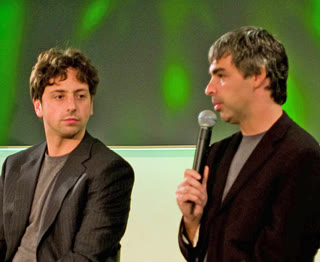
Larry Page (born 1973) and Sergey Brin (born 1973 in Moscow, Soviet Union; emigrated to the U.S. in 1979) met at Stanford in 1995. Page was the product and systems visionary; Brin was the mathematician and engineer. Together they wrote the original BackRub crawler and PageRank algorithm.
Page served as CEO from 1998 to 2001 and again from 2011 to 2015. Brin focused on special projects, including Google Glass and the secretive research division Google X. Both stepped back from day-to-day management in 2019, leaving Sundar Pichai as CEO of both Google and Alphabet.
Eric Schmidt
Eric Schmidt, a veteran of Sun Microsystems and Novell, was Google’s CEO from 2001 to 2011. His role was to provide adult supervision: building a sales organization, taking the company public, and managing relationships with regulators and partners. Schmidt’s famous adult-supervision arrangement with Page and Brin helped Google scale without losing its engineering culture.
Sundar Pichai
Sundar Pichai joined Google in 2004 and rose by leading Chrome and Android. He became Google CEO in 2015 and Alphabet CEO in 2019. Pichai’s tenure has been defined by AI, antitrust litigation, and the transition from an advertising-first company to one betting heavily on cloud and machine learning.
Google and artificial intelligence
Google’s AI roots run deep. The company hired Geoffrey Hinton in 2013, acquired DeepMind in 2014, and open-sourced the TensorFlow machine-learning framework in 2015. Google researchers invented the Transformer architecture in 2017, the foundational technology behind modern large language models. Google’s 2017 paper, "Attention Is All You Need," has been cited tens of thousands of times.
Key AI milestones
| Year | Milestone | Significance |
|---|---|---|
| 2011 | Google Brain project begins | Large-scale neural networks in production |
| 2014 | DeepMind acquired | Reinforcement learning and general-purpose AI research |
| 2015 | TensorFlow open-sourced | Became the dominant ML framework for several years |
| 2016 | AlphaGo defeats Lee Sedol | Landmark moment for reinforcement learning |
| 2017 | Transformer architecture published | Foundation of GPT, Gemini, Claude, and modern LLMs |
| 2018 | BERT released | Pre-trained language model for search and NLP |
| 2021 | LaMDA conversational model | Early large language model focused on dialogue |
| 2021 | MUM model | Multimodal, multilingual search understanding |
| 2022 | LaMDA goes public (Lambda 2) | ChatGPT competitor in development |
| 2023 | Bard launched; Gemini announced | Response to OpenAI; unified model family |
| 2024 | Gemini 1.5 Pro with 1M+ context | Long-context reasoning breakthrough |
| 2025 | Gemini 2.0 family | Native multimodal agentic capabilities |
| 2026 | Gemini integrated everywhere | Search, Workspace, Cloud, Android, Pixel, Chrome |
The ChatGPT shock
Despite its research leadership, Google was caught off guard by ChatGPT in late 2022. Internal documents and media reports described a sense of urgency bordering on panic inside the company. Google had been cautious about releasing powerful language models broadly, fearing reputational risk, safety issues, and cannibalization of its search business. OpenAI had no such hesitation.
Google rushed out Bard in March 2023, then reorganized around the Gemini model family developed by Google DeepMind under Demis Hassabis. By 2026, Gemini powers AI Overviews in Search, writing assistance in Gmail and Docs, code generation in Cloud, on-device intelligence in Pixel and Android, and enterprise agents in Workspace.
Google is positioning itself as the AI company that can combine research, data, compute, distribution, and consumer products in one stack. Whether that combination restores its former invincibility or invites more regulatory scrutiny is the central question of Google’s next decade.
Antitrust, regulation, and the monopoly verdicts
Google has been investigated or fined by antitrust authorities on nearly every continent. The most consequential cases are in the United States.
Search monopoly case (2020–2024)
The U.S. Department of Justice and a coalition of state attorneys general sued Google in 2020, alleging that Google illegally maintained monopolies in general search services and search text advertising. In August 2024, Judge Amit Mehta ruled that Google had violated Section 2 of the Sherman Act by using exclusive distribution agreements to lock out rivals. The remedies phase, concluded in 2025, ordered Google to share search data, syndicate search and search-text ads, and stop paying for default placement in certain ways. More drastic structural remedies, including a Chrome divestiture, were rejected but remain under appeal.[5]
Advertising-technology case (2023–2025)
A separate DOJ case targeted Google’s ad-tech stack, including its publisher ad server (formerly DoubleClick for Publishers) and ad exchange (AdX). In 2025, a federal court found that Google had monopolized the publisher ad server and ad exchange markets and had unlawfully tied them together. The court ordered behavioral remedies designed to open the market to rivals and required closer integration with third-party and open-source solutions.
Europe and other jurisdictions
The European Union has fined Google more than €8 billion in three major cases: shopping comparison abuse (2017, €2.4 billion), Android tying (2018, €4.3 billion), and AdSense restrictions (2019, €1.5 billion). Under the Digital Markets Act, Google is now classified as a "gatekeeper," subject to strict interoperability, data-sharing, and non-discrimination rules.
India, Japan, South Korea, and Australia
- India: The Competition Commission of India has fined Google multiple times for Android abuse and Play Store policies, including a 2022 order of roughly $160 million.
- South Korea: Passed a law forcing app stores to allow alternative payment systems, directly targeting Google Play and Apple App Store commissions.
- Japan: The Fair Trade Commission has scrutinized Google’s default-search deals with Android manufacturers.
- Australia: Enacted a news-media bargaining code requiring Google and Meta to pay publishers for news content surfaced on their platforms.
The pattern is consistent across jurisdictions: Google’s integrated stack — search, ads, browser, mobile OS, app store, video — creates frictionless user experiences and powerful network effects, but regulators increasingly view the same integration as a barrier to competition.
The culture: data, autonomy, and "Don't be evil"
Google’s early culture was famous for being engineer-driven, data-driven, and unconventional. Employees were encouraged to spend 20% of their time on side projects. The company’s unofficial motto, "Don't be evil," appeared in its 2004 IPO prospectus and became a symbol of its idealism — and later a target of criticism.
Google’s campuses are known for free meals, nap pods, foosball, and whimsical decor. The company’s research culture produced innovations in distributed systems, machine learning, energy efficiency, and autonomous vehicles (Waymo, spun out of Google X in 2016). Critics argue that the same culture became insular and complacent, shielded from competition by monopoly profits.
By 2026, Google is a more conventional company than it once was: slower to launch, more cautious about risk, more heavily regulated, and more focused on shareholder returns. The question of whether it can still innovate at scale is debated both inside and outside the company.
Alphabet: the holding company
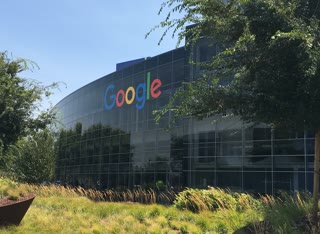
In 2015, Google restructured under Alphabet Inc., a holding company. The idea was to separate the highly profitable core Google businesses (Search, Ads, YouTube, Android, Chrome, Cloud, Hardware) from ambitious "Other Bets" that could operate with more independence and accountability.
Other Bets include Waymo (autonomous vehicles), Verily (life sciences), Calico (longevity research), Fiber (broadband), and X (the moonshot factory). Most Other Bets lose money; Waymo is the standout, operating commercial robotaxi services in several U.S. cities by 2026.
Alphabet’s 2025 revenue of $402.8 billion and operating income of $129.0 billion make it one of the most profitable companies ever created. Google contributes the overwhelming majority of that revenue and nearly all of the profit.
The honest critique
Google’s dominance has generated real benefits: fast, relevant search; free email with massive storage; accurate maps; an open mobile platform; and powerful AI tools. It has also generated serious criticism:
- Privacy: Google’s business model depends on collecting and analyzing user data on a scale that few other companies can match.
- Market power: Competitors in search, advertising, browsers, mobile operating systems, and video have argued that Google uses its platforms to favor its own services.
- Content moderation: YouTube has struggled with misinformation, extremism, copyright infringement, and child safety across billions of hours of video.
- Labor and ethics: Google has faced employee protests over military contracts (Project Maven), sexual harassment payouts, AI ethics board cancellations, and the treatment of contract workers.
- Innovation slowdown: Some observers argue that Google’s research leadership has not always translated into product leadership, especially in generative AI.
Conclusion: the infrastructure layer
Google is no longer just a search engine. It is an infrastructure layer of the modern internet — the default way billions of people find information, watch video, navigate the physical world, communicate, and increasingly interact with artificial intelligence. That position has made Google one of the most valuable and influential companies in history. It has also made Google one of the most scrutinized.
The central tension in Google’s future is this: the same scale that lets it build world-class AI, operate global infrastructure, and offer free services to billions is also the scale that makes regulators, competitors, and citizens nervous. Every Google product decision ripples across markets. Every algorithm change affects publishers, advertisers, and democratic discourse. Every data-collection practice raises privacy questions.
Google’s most likely future is not collapse or irrelevance — its core businesses are too deeply embedded. The realistic range is between continued dominance with heavier regulation and a gradual erosion of monopoly rents as AI, privacy laws, and open alternatives redistribute power. Either way, the company Page and Brin started in a Menlo Park garage has already changed the shape of human knowledge. The search box, the map, the video platform, the mobile OS, and the AI assistant are now part of the basic fabric of daily life. Google built them, and in building them, redefined what a technology company can be.
See also
- History of AI — Google DeepMind and the Transformer are covered there
- Rust — Google uses Rust in Android and other systems
- Ada — Google is named in NSA memory-safety guidance alongside Ada
- SPARK — formally verifiable Ada subset
- Ada vs Rust: The Memory Safety Showdown — discusses Google's Android memory-safety data
References
- Alphabet Inc., Form 10-K filings, U.S. SEC EDGAR.
- StatCounter Global Stats and company reports for market-share figures (2025–2026).
Footnotes
- ↑ Google Inc., "Our Story", about.google
- ↑ "History of Google", Wikipedia; see also the primary source in note 3 below
- ↑ S. Brin and L. Page, "The Anatomy of a Large-Scale Hypertextual Web Search Engine," Computer Networks 30, 1998, pp. 107–117 — research.google
- ↑ United States v. Google LLC, 747 F. Supp. 3d 1 (D.D.C. 2024) — Memorandum Opinion, Aug. 5, 2024 (PDF)
- ↑ U.S. Department of Justice, "Department of Justice Wins Significant Remedies Against Google", press release, September 2, 2025