
Facit EDB
Facit EDB was a Swedish vacuum-tube mainframe — a licensed, improved copy of the state-designed BESK computer — manufactured by the office-machinery giant Åtvidabergs Industrier (Facit) beginning in 1957. Nine were built, and the machine became Sweden's first truly commercial computer: sold as products and rented by the hour at Facit service bureaus in Stockholm, Gothenburg, and Düsseldorf. Its story is also a corporate cautionary tale — the state laboratory's engineers defected to private industry, built a successful machine, and then watched IBM take the market out from under them within five years.[1]
Background: an office empire and a state lab
Facit (Åtvidabergs industrier AB, of Åtvidaberg, Östergötland) was one of Sweden's great industrial names — a world-scale manufacturer of mechanical calculators, typewriters, and office machines. From 1953 it watched the work of Matematikmaskinnämnden (MMN — the Swedish Board for Computing Machinery), the state body that had built BESK (Binär Elektronisk SekvensKalkylator, 1953), then one of the world's fastest computers — an IAS-architecture machine of vacuum tubes developed under chief designer Erik Stemme.[2]
The trouble was structural: MMN was a government board, and the state was unwilling to fund a BESK successor. In May 1955, Gunnar Sundblad — CEO of the Iggesund forestry company — warned Facit's chief executive Rolf Dencker that MMN risked dissolution, and proposed that Facit, Saab, Boliden, and ASEA form a joint foundation to keep its engineers employed. Facit's board declined the consortium. On 12 December 1955 it chose a sharper option: hire the people itself.[3]
The "BESK boys"
From late 1955 through 1956 Facit recruited eighteen members of the MMN team — internally nicknamed "the BESK boys" — most importantly BESK's chief designer Erik Stemme, whom Saab was simultaneously trying to hire (Saab's loss became Datasaab's gain in a different direction, as it built its own line instead). The transfer of state personnel to private industry was blessed at cabinet level: finance minister Gunnar Sträng approved it, holding that computer manufacturing was not the government's business.[4]
The engineers joined Facit's electronics department under Bertil Nyströmer — and rather than relocate to the Åtvidaberg headquarters, they stayed in Stockholm, in premises on Jungfrugatan, so the team would not have to move. Stemme and Nyströmer took a study trip to the United States in spring 1956.[5]
The machine
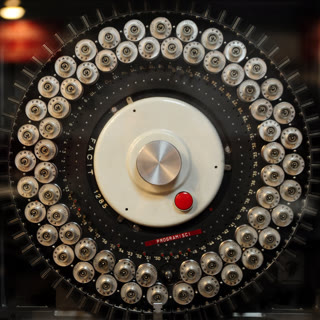
Facit bought the BESK drawings in 1956, and the first copy was inaugurated in October 1957 as Facit EDB — EDB for elektronisk databehandling, "electronic data processing." It was the first fully Swedish series-production computer. The copy improved on the original: double BESK's core memory, and from 1958 Facit's own ECM 64 carousel memory — an advanced magnetic-tape store in which cartridges were mechanically swapped into the read position, cutting data-access time dramatically over conventional tape.[6]
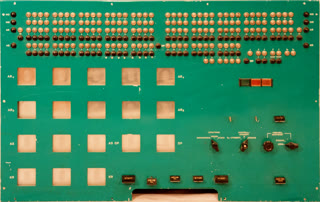
The first machine was installed as a service computer at Åtvidaberg's service central on Karlavägen, Stockholm: customers brought programs and paid by the hour — one of Europe's earliest computing service bureaus. Demand was heavy, meteorological calculation prominent among it.[2]
Architecture and performance
Like BESK, Facit EDB was an IAS machine — built on the architecture of the Institute for Advanced Study computer (von Neumann's Princeton design family): programs loaded into working memory, where input and output data also lived. IAS machines were not software-compatible with one another, but shared the architectural blueprint. The machine combined vacuum tubes and germanium diodes, and because tubes burned out routinely, programs were written with breakpoints — checkpoints from which a calculation could resume after a tube was replaced.[7]
| Parameter | Facit EDB |
|---|---|
| Element base | Vacuum tubes + germanium diodes |
| Architecture | IAS-type, fully BESK-compatible (same operator panel, same programs) |
| Word length | 40 bits (~11 decimal digits); pure binary, base-16 oriented |
| Working memory | Ferrite core — 32 K full words: 2 K directly addressable "inner" + 30 K "outer" storage; eight independent 4 K units (six in the main rack, two separate) |
| Memory cycle | 5 µs read/write (whole memory) |
| Arithmetic | 40-bit fixed point; built-in 32+8-bit floating point (~10 µs add) |
| Speed | ≈100,000 operations/second |
| External memory | ECM 64 carousel magnetic-tape unit (from 1958) |
Input/output: paper-tape reader (500–1,000 characters/s, 5–8 channel tape) · ECM 64 carousel tape in/out · typewriter (~10 chars/s) · tape punch (~150 chars/s) · line printer (11 lines/s × 160 chars) · the operator's control desk, with registers visualized on lamps and nixie displays.[8]
Software: FA-5 to Algol
The first EDBs ran programs in machine code, FA-5 (Fiktiva Adresser, "fictitious addresses"), or "Alfakod" — essentially a symbolic assembler — with Autocode in use as well, plus the library of standard BESK software the machine could run outright.[9]
When ALGOL 60 was being standardized, both MMN and Facit participated in the work. Ingemar Dahlstrand led the group building an ALGOL 60 compiler for the Facit EDB (1960–1964; the other principal programmer was Sture Laryd). The first version was ready in October 1961, and Autocode programs were phased out in favor of Algol. Dahlstrand later consulted with Axel Bring and Gunnar Hellström on Algol-Genius, the dialect for Datasaab's D21/D22/D23 series — the EDB's compiler work propagating into the next Swedish generation.[10]
The nine machines
Nine Facit EDBs were manufactured — a remarkable production run for a vacuum-tube machine — and their destinations map the whole shape of early Swedish computing demand: aircraft design, defense, industry, science, insurance, and consulting engineering.[11]
| User | Site | Inaugurated |
|---|---|---|
| Åtvidaberg service central | Karlavägen, Stockholm | 1 October 1957 |
| ASEA | Västerås | 12 December 1958 |
| Matematikmaskinnämnden | Drottninggatan, Stockholm | 2 October 1959 |
| Åtvidaberg service central | Karlavägen, Stockholm (moved to Düsseldorf 1962) | 1960 |
| Åtvidaberg service central | Gothenburg | November 1960 |
| Facit AB | Solna | September 1961 |
| Norwegian Meteorological Institute | Oslo | 1 March 1962 |
| Försvarets radioanstalt (National Defence Radio Establishment) | Stockholm | July 1962 |
| Försäkringsbolaget Framtiden (now Trygg-Hansa) | Stockholm | November 1962 |
Details worth holding: MMN — the lab the team had left — bought an EDB itself. The FRA machine (EDB-3, 1963 per one account) gave the signals-intelligence agency round-the-clock access and carried punched-card reader and punch as I/O. And the machine did real engineering: stability calculations for the Tingstad Tunnel beneath the Göta älv were among its documented workloads.[12]
IBM, and the end
Facit had recruited Edy Velander to its board in 1956 specifically for the mainframe strategy. His spring-1957 American study trip reported that Facit was, at that moment, on time — but that hard competition was coming, above all from IBM, and that Facit's survivable niche was peripherals. The forecast was precise: in 1959 IBM moved fast into Facit's Swedish home market.[3]
In 1960 the effort was spun into a subsidiary, Facit Electronics AB, with Nyströmer as CEO and a new factory in Solna — the mission: make the mainframe venture profitable. Instead, the next two years were marked by open conflict between business management and the engineers — above all Nyströmer versus Stemme — over reporting and development delays. After a review by the consultancy Bohlin & Strömberg, the subsidiary was wound up at the turn of 1962/63: Facit Electronics folded back into Facit as an electronics division, reoriented to peripherals and military products — the tape punches and readers it had built moved to Åtvidaberg, and the EDB service centers were recast as Industridata, a company whose whole business was selling computing power to industry.[13]
Legacy
The Facit EDB occupies a peculiar place in computing history: the moment computer-building left the Swedish state for private industry — and proof that the transfer worked technically even where it failed commercially. Nine machines, a service-bureau model before the industry had a name for it, one of the first ALGOL compilers, and a diaspora of engineers who carried the expertise onward into Datasaab and Industridata. Machines and components survive at Tekniska museet in Stockholm, Göteborgs Stadsmuseum, and Warsaw's Museum of Technology.[14]
Timeline
| Year | Event |
|---|---|
| 1953 | Facit begins following MMN's computer work; BESK running |
| May 1955 | Sundblad warns Dencker: MMN may dissolve; consortium proposed |
| 12 Dec 1955 | Facit board decides to recruit MMN's engineers instead |
| 1955–56 | The "BESK boys" — 18 staff incl. Erik Stemme — join Facit; Sträng approves |
| Spring 1956 | Stemme + Nyströmer US study trip; BESK drawings purchased |
| Spring 1957 | Velander's US trip — the IBM warning |
| Oct 1957 | First Facit EDB inaugurated, Karlavägen service bureau |
| 1958 | ECM 64 carousel memory introduced |
| 1959 | IBM moves into the Swedish market |
| 1960 | Facit Electronics AB formed, Solna factory |
| 1960–64 | Dahlstrand's group builds the ALGOL 60 compiler (first version Oct 1961) |
| 1961–62 | Machines to Solna, Oslo, FRA, Framtiden |
| 1962/63 | Facit Electronics wound up → peripherals + Industridata |
References
- Tord-Jöran Hallberg, IT-gryning: svensk datahistoria från 1840- till 1960-talet (Studentlitteratur, 2007) — principal Swedish computer history
- Tom Petersson, I teknikrevolutionens centrum: företagsledning och utveckling i Facit, 1957–1972 (Uppsala University, 2003) — the corporate narrative: recruitment, Velander, Facit Electronics' collapse
- Per Lundin (ed.), Att arbeta med 1950-talets matematikmaskiner — Tekniska museet witness seminar transcripts (2005, 2006)
- Germund Dahlquist & Carl-Erik Fröberg, "Datamaskinutvecklingen i Sverige" (Svensk Naturvetenskap, 1971)
- Ingemar Dahlstrand, "The Early Nordic Software Effort" (IFIP HiNC1, 2003) — the Algol compiler
- sv.wikipedia "Facit EDB" + en.wikipedia "FACIT EDB" — machine list, specs, installation table
- Tekniska museet and Göteborgs Stadsmuseum collection records
See also
- BESK — the parent machine at MMN · BARK — Sweden's first computer (relay, 1950)
- SMIL · Datasaab · TRASK — the rest of the Swedish line
- MESM · Kiev computer — the contemporary Soviet counterparts
- ALGOL · Carousel memory
Footnotes
- ↑ Hallberg, IT-gryning (2007); Petersson (2003); sv.wikipedia
- ↑ Hallberg 2007; sv.wikipedia
- ↑ Petersson 2003
- ↑ Petersson 2003; Hallberg 2007
- ↑ Petersson 2003; Lundin 2005 witness seminar
- ↑ Hallberg 2007; Dahlquist & Fröberg 1971; sv.wikipedia
- ↑ sv.wikipedia; en.wikipedia
- ↑ sv.wikipedia
- ↑ Lundin 2006 witness seminar
- ↑ Dahlstrand, "The Early Nordic Software Effort" (2003); Yngvell 1994
- ↑ Hallberg 2007; Dahlquist & Fröberg 1971; Tekniska museet
- ↑ sv.wikipedia; Göteborgs Stadsmuseum; Bjälkefors 2012
- ↑ Petersson 2003; Dahlstrand 2003
- ↑ Tekniska museet; Göteborgs Stadsmuseum; sv.wikipedia