
ENIAC
ENIAC — the Electronic Numerical Integrator and Computer — was the first programmable, electronic, general-purpose digital computer. Designed by John Mauchly and J. Presper Eckert at the University of Pennsylvania's Moore School of Electrical Engineering and built for the U.S. Army between 1943 and 1945, it was publicly unveiled in Philadelphia in February 1946 and remained in service until October 1955. Roughly a thousand times faster than the electromechanical machines that preceded it, ENIAC is widely regarded as the beginning of the computer age.[1][2]
Its historical significance is doubled by who programmed it. ENIAC's first programming staff were six women — Kay McNulty, Betty Jennings, Betty Snyder, Marlyn Wescoff, Fran Bilas, and Ruth Lichterman — who invented the discipline of programming in the act of preparing the machine for its work.[3]
Origins
ENIAC grew out of two problems that met at the Moore School in the early 1940s. The first was the Army's: the Ballistic Research Laboratory at Aberdeen Proving Ground could not produce artillery firing tables fast enough. Each table was a heavy computation performed by human "computers" — overwhelmingly women — working with desk calculators, and the war's appetite for new guns and shells made the backlog permanent.[4]
The second was Mauchly's. A physicist at Ursinus College who had built analog devices to model weather statistics, Mauchly had become convinced that digital electronic counting — vacuum tubes operating as switches — could outperform every other approach to computation. He arrived at the Moore School in 1941 as an instructor in its wartime engineering program, where he met the graduate student assigned to assist him: J. Presper Eckert, a brilliant circuit designer only twenty-two years old. In August 1942 Mauchly circulated a memorandum, The Use of High Speed Vacuum Tube Devices for Calculating, proposing an electronic digital calculator; in April 1943 the Army signed a contract — Project PX — for its construction, supervised on the Army side by Lieutenant Herman Goldstine, whose wife Adele Goldstine would write the machine's only manual and train its first programmers.[5]
Design
ENIAC was a decimal machine, not a binary one: each of its digits lived on a ten-position ring counter, and signed numbers were handled by complement arithmetic. Its core was twenty accumulators — units that could each store one ten-digit number and add or subtract at electronic speed. Around them sat specialized units: a high-speed multiplier, a divider/square-rooter, three function tables (banks of rotary switches holding up to 1,200 constants each), a master programmer for sequencing, an initiating unit, a cycling unit supplying the timing pulses, and punched-card input/output — an IBM card reader feeding a constant transmitter, and a card punch for results.[6]
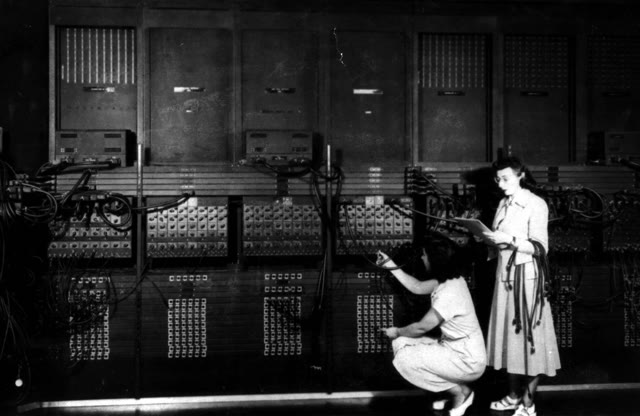
There was no program store in the modern sense. A computation was realized by physically configuring the machine: plugging patch cables between units on plugboards, setting switches, and arranging the accumulators and function tables into a plan. "Programming" ENIAC for a new problem could take days of rewiring — but the machine then executed in milliseconds what took human computers days.[3]
The machine by the numbers
- ~17,500 vacuum tubes, 7,200 crystal diodes, 1,500 relays, ~70,000 resistors, ~10,000 capacitors
- ~30 short tons, occupying about 1,800 square feet of floor space in forty panels
- ~150 kilowatts of electrical power
- ~5,000 additions or ~357 multiplications per second — roughly a thousand times faster than any existing machine
- Tube failure on a cycle of days: reliability, not speed, was the limiting engineering problem, and Eckert's conservative derating of components is what made continuous operation possible[7]
Programming by six women
The Army selected six of its human computers to program the machine: Kay McNulty, Betty Jennings, Betty Snyder, Marlyn Wescoff, Fran Bilas, and Ruth Lichterman — the ENIAC six, the first programmers. Trained by Adele Goldstine and given only the engineers' block diagrams, they taught themselves the machine and then taught it to compute — inventing flowcharts, subroutines, verification practice, and debugging as they went. Their full story is told at The first programmers.[3]
Operations
ENIAC's first real computation was not artillery at all. In late 1945, before the public unveiling, the machine ran a classified feasibility calculation for Los Alamos — hydrodynamics work related to thermonuclear weapon research, associated with John von Neumann's circle. Firing-table work followed immediately afterward, at rates that made the corps' old backlog look medieval.[4]
On February 14–15, 1946, the Army unveiled ENIAC to the press at the Moore School. The showpiece was a sixty-second trajectory computed faster than the shell would have flown it; newspapers christened it the "Giant Brain." The six women who programmed it went unrecorded in the coverage — in some accounts introduced to reporters as models.[8]
In 1947 ENIAC was dismantled, moved to Aberdeen Proving Ground, Maryland, and rebuilt in Building 328, where it ran for eight more years. In 1948 it was converted to a stored-program mode of operation — the function tables repurposed as read-only memory holding instruction sequences — which removed the plugboard rewiring for most work and made it, by construction, one of the earliest machines to run stored programs. It continued in continuous service on ballistics, weather, and scientific computation until it was switched off for the last time on October 2, 1955.[4]
The patent battle
Eckert and Mauchly filed a patent on ENIAC in 1947 (granted 1964, U.S. Patent 3,120,606), but by then they had left the Moore School to found the Eckert–Mauchly Computer Corporation — builders of BINAC and UNIVAC — and the patent was assigned to their corporate successors, eventually Sperry Rand. In the 1973 federal trial Honeywell v. Sperry Rand, the court invalidated the ENIAC patent entirely, finding that Mauchly had derived key ideas from John Vincent Atanasoff, whose earlier Atanasoff–Berry Computer at Iowa State Mauchly had visited and studied in 1941. The ruling placed ENIAC's design in the public domain and made it permanently contested ground in the history of computing: first electronic general-purpose computer in operation, but not first in conception.[9]
Legacy
ENIAC's conceptual heir was EDVAC, the stored-program machine Mauchly, Eckert, and von Neumann's circle designed next — the famous 1945 draft report that spread the stored-program architecture worldwide. ENIAC itself is the ancestor by practice rather than by blueprint: it proved that electronic digital computation worked at scale, and it trained the first programmers, who carried the discipline into UNIVAC, COBOL, and the commercial industry.[4]
Physical pieces survive in several places: panels at the University of Pennsylvania and the Smithsonian's National Museum of American History, a functioning-era accumulator and units at Aberdeen, and fragments in collections worldwide. In 1996–97, for its fiftieth anniversary, University of Pennsylvania students re-implemented the entire machine on a single integrated circuit — ENIAC-on-a-Chip, compressing thirty tons of 1946 hardware into a die a few millimeters across. It holds IEEE Milestone status as the machine that began the era this site is built on.[10]
See also
- The first programmers — the six women who made it compute
- Kay McNulty · Fran Bilas · Betty Jennings · Betty Snyder · Marlyn Wescoff · Ruth Lichterman
- UNIVAC I — its commercial descendant
- History of Programming · History of Mathematics
References
- Haigh, Thomas, Mark Priestley, and Crispin Rope. ENIAC in Action: Making and Remaking the Modern Computer (MIT Press, 2016).
- Kleiman, Kathy. Proving Ground: The Untold Story of the Six Women Who Programmed the World's First Modern Computer (Grand Central, 2022).
- McCartney, Scott. ENIAC: The Triumphs and Tragedies of the World's First Computer (Walker, 1999).
- Goldstine, Herman H. The Computer from Pascal to von Neumann (Princeton University Press, 1972).
- Goldstine, Adele. Complete Report of the ENIAC (U.S. Army, 1946).
- Honeywell Inc. v. Sperry Rand Corp., 180 U.S.P.Q. 673 (D. Minn. 1973).
- U.S. Army photographs of ENIAC, 1945–1955 (public domain).
Footnotes
- ↑ Haigh, Priestley & Rope, ENIAC in Action (MIT Press, 2016)
- ↑ McCartney, ENIAC: The Triumphs and Tragedies of the World's First Computer (1999)
- ↑ Kleiman, Proving Ground (2022)
- ↑ Haigh, Priestley & Rope, ENIAC in Action (2016)
- ↑ McCartney, ENIAC (1999); Goldstine, The Computer from Pascal to von Neumann (1972)
- ↑ Haigh, Priestley & Rope, ENIAC in Action (2016); Adele Goldstine, Complete Report of the ENIAC (1946)
- ↑ ENIAC in Action (2016)
- ↑ Kleiman, Proving Ground (2022); contemporary press coverage
- ↑ Honeywell v. Sperry Rand, 180 U.S.P.Q. 673 (D. Minn. 1973); Burks, Who Invented the Computer? (2003)
- ↑ IEEE Milestone citation, ENIAC; University of Pennsylvania ENIAC-on-a-Chip project