
Chevalier de Saint-Georges
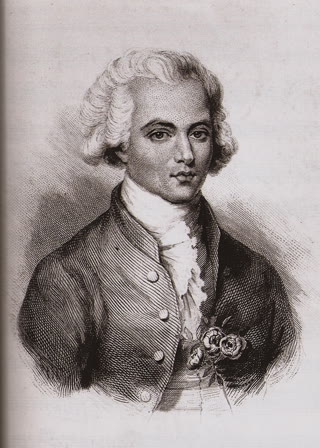
Joseph Bologne, Chevalier de Saint-Georges (25 December 1745 – 9 June 1799) was a French violinist, conductor, composer, champion fencer, and soldier — the first classical composer of African descent to achieve widespread acclaim in Europe. Born in Guadeloupe to a white plantation owner and an enslaved African woman, he became, in the words of a contemporary American visitor, "the most accomplished man in Europe in riding, running, shooting, fencing, dancing, musick."[1]
He led the finest orchestra in Paris, premiered Haydn's celebrated Paris Symphonies, played music privately with Marie Antoinette, fought exhibition matches before the Prince of Wales, commanded the first military unit in Europe led by a man of colour — and then watched the Revolution he served imprison him while half his music burned quietly into oblivion. What survives is enough to prove the legend was real.
Early life
Guadeloupe and France
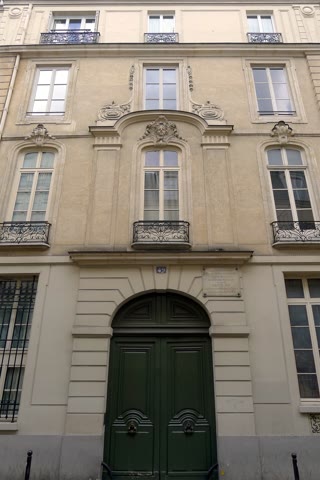
Joseph was born on Christmas Day 1745 in Baillif, a parish near Basse-Terre on the island of Guadeloupe in the French West Indies. His father, Georges de Bologne, was a gentleman farmer who had taken the name "Saint-Georges" after one of his plantations; his mother, called Nanon, was a seventeen-year-old enslaved African — most likely of Senegalese origin — who served in the Bologne household. Georges was legally married to another woman, Elisabeth Mérican, but he acknowledged Joseph as his son and gave him the Bologne name.[2]
In 1747, accused of murder, Georges Bologne fled to France with his family; pardoned two years later, he returned to Guadeloupe. In August 1753 the seven-year-old Joseph was sent across the Atlantic to be educated — boarded with the Jesuits in Angoulême, where his uncle Pierre could keep an eye on him. In 1755 his parents followed on the ship L'Aimable Rose, landing at Bordeaux and reuniting the family in a spacious apartment at 49 rue Saint-André-des-Arts on Paris's Left Bank — the same house where Joseph grew into a young man.
The fencing prodigy
At thirteen Joseph was enrolled in the Académie d'équitation run by the master-at-arms Texier de La Boëssière in the rue Saint-Honoré, where riding and swordsmanship were taught together. La Boëssière's son remembered what happened next: "At fifteen his progress was so rapid that he was already beating the best swordsmen, and at seventeen he developed the greatest speed imaginable."[3]
The proof came in a public match. Alexandre Picard, a fencing master of Rouen, had mocked the student as "La Boëssière's upstart mulatto." When the two met — before a crowd that had bet heavily and, according to the chroniclers, had split along the line between partisans and opponents of slavery — Bologne won. His father rewarded him with a horse and buggy.
At the fencing venues of Paris the young champion met three people who would shape his life: the celebrated master Domenico Angelo and his son Henry; the Chevalier d'Éon, soldier, spy and future fencing partner; and a teenage prince, Louis-Philippe d'Orléans — the future Philippe Égalité, whose patronage would raise Saint-Georges and whose downfall would nearly drag him to the scaffold.
Gendarme of the King's Guard
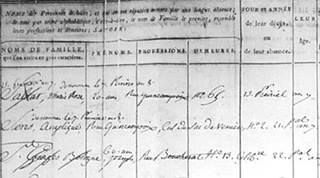
After the Picard victory — and by 1766, on graduating from the academy — Bologne was appointed Gendarme de la garde du roi, an officer of the king's household bodyguard at Versailles, and made a chevalier. He took the style of his father's plantation and was known ever after as the Chevalier de Saint-Georges. The title of nobility itself he could never legally hold: illegitimate birth barred the inheritance, and a royal decree of 5 April 1762 ordered all "nègres et gens de couleur" — nominally free the moment they set foot on French soil — to register with the Admiralty within two months.[4]
When Georges Bologne died in Guadeloupe in 1774, his plantations and annuity passed to his legitimate daughter Elisabeth Benedictine; Joseph received nothing but the name he had already made famous. His mother Nanon stayed with him in Paris and, in a testament dated 17 June 1778, left him everything she had — signing herself, tellingly, "Anne Danneveau." Her son signed "Mr De Bolongna St-George."
Musical life and career
The Concert des Amateurs
Who taught Saint-Georges the violin is one of his biography's genuine gaps — his father sent him to study music in Paris at seven, and the adult technique implies years of serious practice. The claim by Fétis that he studied with Jean-Marie Leclair is discounted by modern biographers; some of his style suggests Pierre Gaviniès. What is documented is the esteem of his elders: in 1764 Antonio Lolli dedicated two violin concertos to the Bolognes — "to M. de Bologne de Saint-Georges, who gave the arts a priceless gift in the person of his son" — and in 1766 François-Joseph Gossec dedicated six string trios to Joseph himself.[5]
In 1769, Paris was astonished to find the famous fencer sitting in the violin section of Gossec's new orchestra, the Concert des Amateurs, in the Hôtel de Soubise. Within two years Gossec made him concertmaster. His own Op. 1 — six string quartets, among the first composed in France, inspired by the early Haydn quartets that Baron Bagge had carried back from Vienna — appeared around 1770; Carl Stamitz dedicated a set of quartets to him the same year. In 1772 he stepped forward as soloist, playing his first two violin concertos with Gossec conducting. The critics noted that he was "appreciated not as much for his compositions as for his performances, enrapturing especially the feminine members of his audience."[6]
In 1773 Gossec moved up to direct the Concert Spirituel and handed the Amateurs to Saint-Georges. Under his baton it became something France had never had — a disciplined orchestra. The encyclopedist of music Jean-Benjamin de La Borde wrote that it performed "with great precision and delicate nuances" and called it "the best orchestra for symphonies in Paris, and perhaps in all of Europe."[7]
The petition
Early in 1776 the Paris Opéra — the Académie royale de Musique — was collapsing financially and artistically, and Saint-Georges, creator of the best-disciplined French orchestra since Lully, was proposed as its director. Three of the Opéra's reigning divas — the dancer Marie-Madeleine Guimard and the singers Rosalie Levasseur and Sophie Arnould — petitioned the Queen to stop it. According to Baron von Grimm's Correspondance littéraire, they argued "that their honour and delicate conscience could never allow them to submit to the orders of a mulatto." The post went to Antoine Dauvergne.[8]
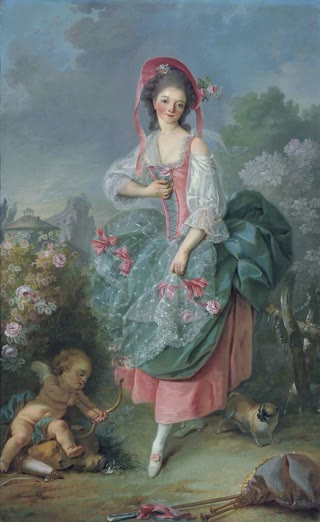
To dampen the scandal, Louis XVI took the Opéra back from the city of Paris into royal management. Marie Antoinette moved her music-making into her private apartments and the little Théâtre de la Reine at Versailles — and Saint-Georges was among the few musicians admitted to perform with the Queen, probably playing his violin sonatas while she accompanied on fortepiano.[9]
The petition had capped his advancement all the same. He published two more violin concertos and a pair of symphonies concertantes, then all but abandoned instrumental music after his final quartets of 1785, turning to opera — where the doors of the Opéra itself remained closed to him.
Operas, patrons, and the Grimm house
His first opera, Ernestine — libretto by Pierre Choderlos de Laclos, later infamous for Les Liaisons dangereuses — premiered at the Comédie-Italienne on 19 July 1777. The critics liked the music and savaged the libretto, then considered more important than the score. The Queen attended to support him, but when the audience kept echoing a coachman's cry of "Ohé, Ohé," she administered the coup de grâce by calling to her driver: "To Versailles, Ohé!" The opera did not survive; only a few numbers do.[10]
Failure left him exposed, and rescue came from Madame de Montesson, the secretly married (morganatic) wife of the Duke of Orléans, who engaged him as musical director of her fashionable private theatre — a venue beyond the reach of the Opéra's monopoly. The Duke made him Lieutenant de la chasse of his hunting grounds at Raincy, worth 2,000 livres a year. At Raincy he composed La Partie de chasse (1778), which earned what Ernestine had missed: "The public received the work with loud applause... there is every reason to encourage him to continue." It was repeated at the royal château of Marly at the Queen's request.[11]
His masterpiece for the stage was L'Amant anonyme (The Anonymous Lover, 1780), on a libretto adapted by Madame de Genlis from her own play — a comedy of a man who loves a young widow but dares not tell her, wooing her anonymously with gifts instead. It is the only one of his six opéras comiques to survive complete, the manuscript resting in the Bibliothèque nationale de France — and the only opera by an eighteenth-century composer of African descent to do so. It waited 236 years for its first complete modern staging, in Charleston in 2016, and has since been recorded commercially.[12]
One small crossing of paths deserves note: through the summer of 1778 Saint-Georges lodged at Baron Grimm's residence on the Chaussée d'Antin, at the invitation of his patroness's circle. That same summer a twenty-two-year-old Wolfgang Amadeus Mozart moved into the same house after his mother died in Paris. Two of the century's musicians under one roof; whether they ever spoke is unrecorded. The nickname "Black Mozart" would come much later — see the section on the name below.
The Concert Olympique and Haydn
In 1781 the Amateurs folded when the Compte rendu exposed the state of the royal finances — its patrons' money had gone, among other places, into Beaumarchais's fund for the American revolutionaries. Saint-Georges appealed to his friend the Duke of Orléans, who revived the orchestra inside the exclusive masonic Loge Olympique. Renamed the Concert de la Loge Olympique, with virtually the same personnel, it played in the Théâtre du Palais-Royal: the best musicians in Paris who could also pass as Freemasons.[13]
In 1785 the orchestra's patron Count d'Ogny commissioned six new symphonies from Haydn, and asked Saint-Georges to write to Vienna and settle the details. Saint-Georges conducted the premieres of what became the most famous symphonies of the age — the Paris Symphonies, including No. 85, La Reine, the Queen's favourite — in the Salle des Gardes-Suisses of the Tuileries, the largest hall available, to meet the demand.[14]
Marie Antoinette attended the concerts at the Hôtel de Soubise — sometimes without warning — so the orchestra simply performed in court dress at all times. A witness described the musicians in 1786 "in embroidered suits, lace cuffs, swords at their sides and feathered hats on the benches. Such an orchestra was a sight to behold, and no less pleasant to listen to." The new bow perfected by François Tourte made the brilliant effects possible.[15]
London
First trip, 1787
When the Duke's rebuilding of the Palais-Royal left the orchestra homeless and Saint-Georges unemployed, the Duke and his aide Brissot de Warville dispatched him to London — officially as an exhibition fencer for the Prince of Wales, who had long wanted to meet him; unofficially, Brissot judged a celebrated "man of colour" the perfect courier to the English abolitionists — William Wilberforce, Thomas Clarkson and their circle — whose Society for Effecting the Abolition of the Slave Trade his own projected Amis des Noirs would mirror.[16]
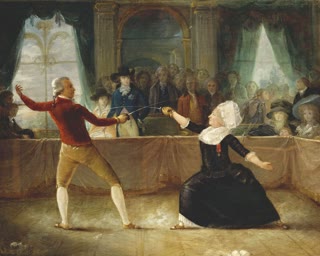
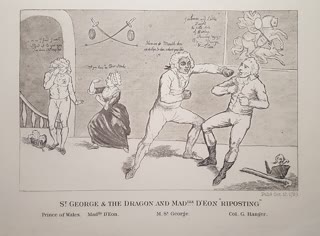
He stayed with his old fencing-circle friends the Angelos, who arranged exhibition matches. The most famous, at Carlton House on 9 April 1787, pitted him against the Chevalière d& § 39Éon — Captain d'Éon, the veteran dragoon and royal spy then living publicly as a woman — before the Prince of Wales. Robineau's painting of the match shows d'Éon scoring a hit; gossips said the Chevalier yielded out of gallantry, though having fenced her in Paris he was probably deferring to her fifty-nine years. He also played a Robineau concerto for the Anacreontic Society, and sat for the American painter Mather Brown. Asked whether the portrait was a true likeness, Saint-Georges answered: "Alas, Madame — it is frightfully so."[17]
Second trip, 1789–90
Back in France, the Estates General opened on 5 May 1789 — Saint-Georges stood in the gallery beside Laclos and heard the finance minister Necker declare that "the slave trade is a barbarous practice and must be eliminated." The Bastille fell in July; titles of nobility followed. The Chevalier, though he never legally held nobility, dropped his particle and became simply citoyen Saint-Georges.
In August 1789 Laclos sent him back to London — officially to attend on the exiled Duke of Orléans, probably also to keep a compromised Orléanist out of reach. He took rooms at Grenier's hotel on Jermyn Street, fenced for the Prince at the Marine Pavilion in Brighton, rode fox hunts and went to the races at Newmarket, and when the Duke arrived that October became his companion in "horse racing, young women, and champagne." He could not pay Grenier's bill and financed the journey home by staging a fencing match.[18]
In early July 1790, walking home from Greenwich, he was attacked again: a man with a pistol demanded his purse, Saint-Georges disarmed him, four more emerged from hiding, and he put all of them out of action — receiving "only some contusions which did not keep him from going on that night to play music in the company of friends." The staged look of the robbery has led biographers to suspect an assassination arranged by the slave trade's friends against a known abolitionist.[19]
Revolution and war
Lille
On 8 July 1790, though running a fever, Saint-Georges was the star of a fencing tournament in Lille's municipal ballroom: "Lightning is no faster than his arms." The illness proved to be "brain fever" and put him in bed for six weeks; nursed by citizens of the city, he composed while bedridden a one-act opera, Guillaume tout cœur, ou les amis du village, dedicated to them — premiered 8 September 1790, his last opera, now lost entirely.[20]
He settled at 550 rue Notre-Dame and stayed. In September 1790 he was among the first to join Lille's Garde Nationale; he built yet another orchestra, gave weekly concerts through the winter, and at the last of them the mayor of Lille placed a crown of laurels on his head. In April 1791, in Amiens to give Easter concerts, his party was refused service at a hotel dining room; the paper noted he "remained perfectly calm — remarkable for a man with his means to defend himself."[21]
He also carried in his repertoire an extraordinary solo piece, The Love and Death of the Poor Little Bird — programmatic music for violin alone in three scenes: the bird greeting spring, pursuing a love who chooses another, then weakening into silence. The singer Louise Fusil, who heard him play it constantly, ranked his improvisations with Berlioz: "We did not know then this expressive... depiction of a dramatic scene, which Mr. Berlioz later revealed to us."[22]
Colonel of the Légion Saint-Georges
When France declared war on Austria in April 1792, Saint-Georges was already a captain commanding a company of volunteers — his men held the line at Baisieux while the regular cavalry routed around them after General Dillon's disastrous advance on Tournai. That September, the Saint-Dominguan deputy Julien Raimond petitioned the National Assembly to raise a legion of free men of colour; the Assembly created the Légion franche de cavalerie des Américains et du Midi, soon known simply as the Légion Saint-Georges, with the Chevalier as its colonel — probably the first military unit in Europe officered substantially by men of colour.[23]
His war soon collided with the Revolution's machinery. In late March 1793, as General Dumouriez drifted toward treason, arrested commissioners were escorted under Saint-Georges's guard; on 2 April he defended Lille itself against Dumouriez's man Miaczinsky, sent to seize the city. In May he was summoned to Paris to testify at Miaczinsky's trial — and while there, his own house was searched, turning up papers linking him to Philippe Égalité and to Dumouriez. On 18 May, in civilian clothes, he performed Gossec's requiem in Lille for the murdered General Théobald Dillon — an obituary concert in the middle of his own undoing.[24]
The accusations came anyway: misuse of funds, Orléanist connections, the wrong friends. On 25 September 1793 he and ten of his officers were dismissed; the legion was disbanded; on 29 September, twelve days after the Law of Suspects had made vague suspicion itself a crime, he was arrested without charge — probably for having known Marie Antoinette, Brissot, and Philippe Égalité, all of them guillotined within weeks. He was held at Chantilly, then at Hondainville; it seems he was condemned, in the Tribunal's language, for "non-revolutionary activities such as music events."[25]
He spent eleven months in prison. Released 24 October 1794, he petitioned for reinstatement, was arrested again in the White Terror, released again in May 1795, and dismissed once more that October. In 1797 he appealed to the Directory one last time, signing his petition simply "George":
"I continue to show loyalty to the revolution. Since the beginning of the war, I have been serving with relentless enthusiasm, but the persecution I suffered has not diminished. I have no other resources — only to restore my original position."
It failed.[26]
The Saint-Domingue question
Biographers have long claimed that after prison Saint-Georges sailed for Saint-Domingue — perhaps even meeting Toussaint Louverture. The story is doubtful. A 1789 report that he landed in Martinique with 15,000 rifles is certainly false — he was in London and Lille. As for the convoy of civil commissioners to Saint-Domingue, two of his men (Captain Collin and Lamotte) appear on a ship's payroll, and Louise Fusil remembered him sailing; but no manifest or contemporary press places Saint-Georges himself aboard, and most historians believe he never left Europe again. A fact dies exactly this way — one good story, uncorrected.[27]
Last years
His mother Nanon died on 16 December 1795; the following March he signed her will as executor. In April 1796 he and his old friend Lamotte gave a benefit concert for the impoverished Carl Stamitz. Then, improbably, he rebuilt one more orchestra: Le Cercle de l'Harmonie, housed like the old Olympique in a Masonic lodge at the former Palais-Royal (now renamed, with vicious irony, the Palais-Égalité). Le Mercure français reported that the concerts "under the direction of the famous Saint Georges left nothing to be desired as to the choice of pieces or the superiority of their execution." He went on performing through 1798.[28]
Death
Rejected by the army for the last time, he said of his last instrument — sounding like any veteran proud of his longevity: "Towards the end of my life, I was particularly devoted to my violin. Never before did I play it so well."
A bladder ulcer he had concealed turned gangrenous. Captain Nicholas Duhamel, an old officer of the Légion, found him dying alone in his flat on the rue de Chartres-Saint-Honoré and carried him to his own apartment on the rue de Boucherat, where he was cared for until the end. He died at five in the evening on 21 Prairial — 9 June 1799 — aged fifty-three. The necrology recorded that his death "was marked by the calm of the wise and the dignity of the strong." He was buried at the Cimetière Sainte-Marguerite; the cemetery was later built over, and his death certificate burned with the Paris city archives in the fires of the Commune in 1871. What survives is the report of the men who came to carry his body away.[29]
Charles Maurice, writing that year, paired him with another giant who had died twenty-four days earlier:
"This year died, twenty-four days apart, two extraordinary but very different men, Beaumarchais and Saint-Georges; both Masters at sparring; the one who could be touched by a foil was not the one who was more enviable for his virtues."[30]
The man
He was remembered as the finest all-round athlete of his generation — a swimmer who, it was said, crossed the Seine using only one arm; a dancer sought by every salon; a rider and marksman in the king's hunts. John Adams's informant swore he "will hit the Button, any Button on the Coat or Waistcoat of the greatest Masters" with a sword, and "hit a Crown Piece in the Air with a Pistoll Ball." Women pursued him; the great dancer Guimard — the same who later petitioned against his Opéra appointment — is said to have been refused. A gossip sheet credited him with a long affair with the Marquise de Montalembert, young wife of an old general; the night attack of 1 May 1779 in which he and a friend fought off six assailants in the rue de la Chaussée-d'Antin was blamed, variously, on the general's revenge, on secret policemen from Versailles, or on a case of mistaken identity.[31]
He had one son, born around 1781, who would serve as a cavalry officer — a quiet fact that keeps surfacing in the records and sinking again.
Works
Saint-Georges composed fast and published in a burst between 1771 and 1779, in the sentimental, galant Parisian manner:
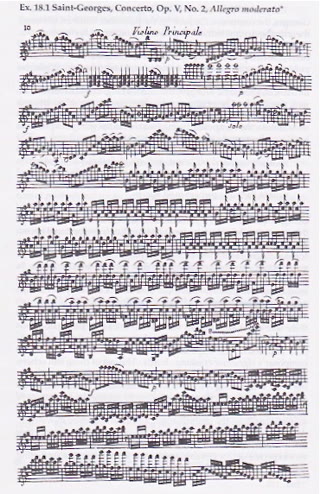
- Violin concertos — 14 known (published in pairs as Opp. II, III, IV, V, VII, VIII and XII; several were reissued under conflicting numbers, a bibliographer's tangle)
- Symphonies concertantes — 8 (Opp. VI, IX, X, XIII); the light, double-soloist genre was a Parisian specialty of which he was a chief exponent
- Symphonies — 2 (Op. XI)
- String quartets — 18: Op. 1 (1771), the Au goût du jour set (1779), and Op. 14 (1785)
- Sonatas — three for keyboard with violin (Op. 1a), a harp-and-flute sonata, six posthumous violin duos-sonatas (Pleyel, 1800)
- Violin duets — six, plus a rondeau for two violins
- Operas — six opéras comiques: Ernestine (1777), La Partie de chasse (1778), L'Amant anonyme (1780), La Fille garçon (1787), Aline et Dupré (1788), Guillaume tout cœur (1790); only L'Amant anonyme survives complete
- Vocal music — a dozen airs, duos and scène, mostly surviving from the two lost early operas, in the BnF Recueil (ms. 4077)
Lost works
The losses are the silent half of his catalogue: a cello sonata premiered in Lille in 1792, a clarinet concerto, a bassoon concerto, the full scores of five of six operas, the Poor Little Bird — heard by thousands, never written down. Claims that Napoleon ordered his scores burned, or banned his music, circulate in the older literature without evidence; Banat notes that his reputation survived intact in elite memory. The likelier killer was the usual one — time, indifference, and paper.[32]
False works
He attracted forgeries as famous men do. The opera Le Droit du seigneur is by J.-P.-E. Martini; the charming violin piece Les Caquets, long cited as characteristically his, was composed in 1936 by Henri Casadesus, a serial forger who also manufactured a Handel viola concerto and a "childhood" Mozart concerto.[33]
The "Black Mozart" question
Saint-Georges was Mozart's elder by eleven years and outlived him by eight; they briefly lodged under the same Parisian roof. The label "Black Mozart" clings to him in modern retellings — rejected by some as a diminishment that measures him against a whiter yardstick, embraced by others as a rescue. The violinist Randall Goosby settled it in a sentence: "I prefer to think of Mozart as the white Chevalier."[34]
Legacy
His memory never quite died in France — fencers remembered the Chevalier when musicians had forgotten — but the modern resurrection is substantial:
- The Festival International de Musique Saint-Georges, founded in Guadeloupe and directed by conductor Marlon Daniel, has since 2018 restored his music to his native islands with concerts, conferences and masterclasses.
- L'Amant anonyme returned to the stage complete in Charleston (2016), streamed from Los Angeles Opera (2020), and was recorded by Chicago's Haymarket Opera Company (2022).
- The film Chevalier (2022), with Kelvin Harrison Jr. as Saint-Georges, brought the story to cinemas — freely dramatized, but the broad strokes are true.
- Beyoncé's "Daughter" on Cowboy Carter (2024) quotes the Adagio of his Violin Concerto Op. 3 No. 1.
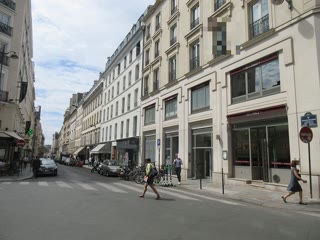
- A short street near La Madeleine in Paris — the rue du Chevalier-de-Saint-George — was renamed for him in 2002.
Much of what he made is gone — five of six operas, three concertos, the Poor Little Bird, even his death certificate, burned with the city archives in 1871. What remains is played, recorded, and growing every year. The man who was nearly erased is being un-erased, one concert and one page at a time.
See also
- Nina Leontyeva — another Preserver the encyclopedia keeps
- History of Learning — the long history he belongs to
Footnotes
- ↑ John Adams, diary entry of 17 May 1779: "He is the most accomplished Man in Europe in Riding, Running, Shooting, Fencing, Dancing, Musick. He will hit the Button, any Button on the Coat or Waistcoat of the greatest Masters. He will hit a Crown Piece in the Air with a Pistoll Ball."
- ↑ Standard biographical literature: Gabriel Banat, The Chevalier de Saint-Georges: Virtuoso of the Sword and the Bow (Pendragon Press, 2006); Alain Guédé, Monsieur de Saint-George (1999, English trans. 2003); Pierre Bardin, Joseph de Saint George, le Chevalier Noir (2006).
- ↑ Antoine La Boëssière fils, Traité de l'art des armes (1818), on Saint-Georges's progress at his father's academy.
- ↑ Banat (2006), on the 1762 Admiralty registration decree, issued as the Seven Years' War ended and France reconsidered the status of free people of colour.
- ↑ Lolli's dedication of the Op. 2 concertos (1764) and Gossec's Op. 9 trios (1766), cited throughout the Saint-Georges literature.
- ↑ Contemporary press reception of the 1772 concerto début, quoted in Banat (2006).
- ↑ Jean-Benjamin de La Borde, Essai sur la musique ancienne et moderne (1780), on the Concert des Amateurs under Saint-Georges.
- ↑ Friedrich Melchior, Baron von Grimm, Correspondance littéraire, philosophique et critique (January 1776), reporting the petition of Guimard, Levasseur and Arnould to Marie Antoinette.
- ↑ Banat (2006) and the Mémoires secrets tradition: Saint-Georges "admitted to perform music with the Queen" in her private salon.
- ↑ Contemporary reception of Ernestine (1777), including the Queen's reported retort; the score is lost apart from excerpts preserved in the Recueil d'airs et duos, BnF ms. 4077.
- ↑ Press reception of La Partie de chasse, Comédie-Italienne, 12 October 1778, quoted in Banat (2006).
- ↑ L'Amant anonyme, BnF département musique, ms. côte 4076; modern revival by conductor Marlon Daniel, Charleston Gaillard Center, 2016; critical edition by Opera Ritrovata for Los Angeles Opera / Colburn School, 2020; Haymarket Opera Company, Chicago, 2022 (recorded on Cedille Records).
- ↑ The refounding of the orchestra as the Concert de la Loge Olympique under the Duke of Orléans's patronage, 1781; Banat (2006).
- ↑ The Count d'Ogny's commission of Haydn's six Paris Symphonies (Nos. 82–87) for the Loge Olympique, negotiated by Saint-Georges, premiered under his direction at the Salle des Gardes-Suisses, Tuileries.
- ↑ Description of the Concert Olympique's court dress, 1786, quoted in the Saint-Georges literature; on the Tourte bow's role in the new virtuosity.
- ↑ Bardin and Banat on Brissot's double purpose for the 1787 London mission — fencing diplomacy for the Prince of Wales, and liaison with the English abolition movement for the embryonic Société des Amis des Noirs.
- ↑ The Carlton House match of 9 April 1787, painted by Abbé Alexandre-Auguste Robineau; the Mather Brown portrait (engraved by William Ward, 1788) and Saint-Georges's remark on it, reported by Mrs. Angelo.
- ↑ The second London sojourn: Bardin argues a Laclos mission; the Brighton match of 15 August 1789; Grenier's of Jermyn Street; the improvised benefit match, June 1790.
- ↑ The Greenwich attack of July 1790 and the assassination theory, reported in the contemporary press and discussed by Banat and Bardin.
- ↑ The Lille tournament of 8 July 1790, the subsequent illness, and the premiere of Guillaume tout cœur — quoted reviews in the Saint-Georges literature.
- ↑ The Amiens incident of 1791 and the local press account, quoted in Bardin.
- ↑ Louise Fusil, Souvenirs d'une actrice (1841), describing Saint-Georges's programmatic violin improvisation and comparing it to Berlioz.
- ↑ The Légion franche established 7–8 September 1792 at Raimond's petition; renamed 13e régiment de chasseurs à cheval in February 1793. Banat calls it "probably the first all non-white military unit" in Europe; in practice the corps mixed Black officers and men with white companies.
- ↑ The Dumouriez crisis of spring 1793: the escort at Orchies, the defence of Lille on 2 April, the Miaczinsky trial, and the requiem for Dillon — Banat and Bardin.
- ↑ The arrests of September 1793 under the Law of Suspects; imprisonment at Chantilly and the château of Hondainville; Banat (2006).
- ↑ Saint-Georges's petition to Director Rewbell, 3 May 1797, signed "George" — quoted in Banat (2006).
- ↑ The Saint-Domingue voyage controversy: La Laurencie calls it "Saint-Georges' last voyage"; Banat, Bardin and the archival record find no trace of him on the crossing.
- ↑ Le Cercle de l'Harmonie and the Mercure français review, April 1797.
- ↑ Cuvelier's necrology and La Boëssière fils on the final illness; the loss of the death certificate in the 1871 destruction of the Paris archives; the surviving body-removal report of 10 June 1799.
- ↑ Charles Maurice de Talleyrand-Périgord, 1799, on the deaths of Beaumarchais and Saint-Georges.
- ↑ The Montalembert affair and the Chaussée-d'Antin attack of 1 May 1779 per Bachaumont's Mémoires secrets; the competing explanations summarized in Bardin.
- ↑ On the claims of burned scores (advanced by Alain Guédé) and Banat's counter-argument; the documented losses from the 1792 Lille review and publisher records.
- ↑ The misattribution literature; on Casadesus's fabrications including Les Caquets (1936).
- ↑ Randall Goosby, interview remarks widely reported in the revival literature (2021–2022).