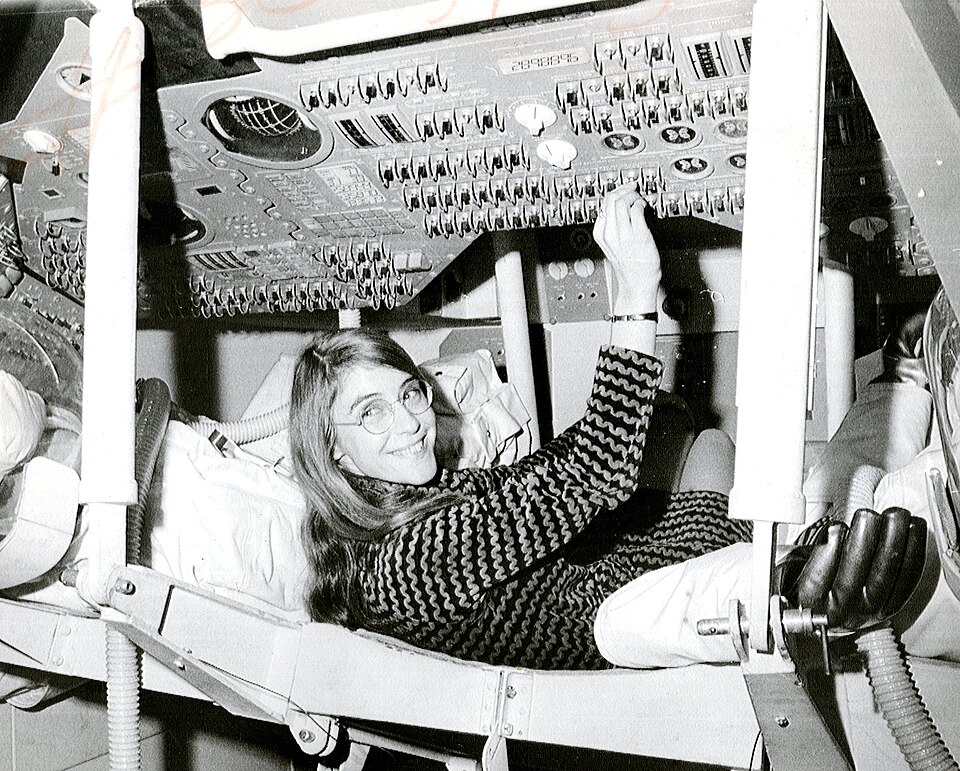
Hamilton inside an Apollo command module mockup, 1969. Photo: NASA (public domain).
In Memoriam
Margaret Hamilton
August 17, 1936 – September 30, 2026 · Computer scientist · Apollo flight software lead · Mother of "software engineering"
Margaret Hamilton led the MIT team that wrote the onboard flight
software for the Apollo program — the code that guided crews to the
Moon and back on a computer with a fraction of the memory in a
modern watch. She did it while inventing the discipline as she went:
she is the person who coined the term software engineering,
at a time when the phrase was treated as a joke.
From Paoli to Cambridge
Margaret Heafield was born in Paoli, Indiana, in 1936 and raised partly
in Michigan's Upper Peninsula, the daughter of a poet and philosophy
professor. She studied mathematics — with a minor in philosophy — at
Earlham College, earning her degree in 1958, the same year she married
James Hamilton. Their daughter Lauren was born in 1959.
She intended graduate school in abstract mathematics at Brandeis. Instead,
to support her husband through Harvard Law, she took what was meant to be
a temporary job at MIT — writing weather-prediction software for
Edward Lorenz (yes, the chaos-theory Lorenz) on the LGP-30 and
PDP-1 computers. There were no courses in programming; you learned by
doing it. She was good at it immediately.
That led to MIT's Lincoln Laboratory and the SAGE project — the
continent-sized air-defense system that was among the first to demand
software that could not fail. At Lincoln Lab, Hamilton developed a
reputation for solving the programs nobody else could fix; her
colleagues began handing her the hardest, strangest bugs. She was
learning fault tolerance on a machine guarding a continent.
Apollo
In 1965 MIT's Instrumentation Laboratory — later Draper — had won the
NASA contract for Apollo's onboard guidance. Hamilton was the first
programmer hired onto the Apollo project at MIT, and the first woman to
program for it. She began on the uncrewed missions, then rose to lead
the team writing the flight software for the crewed Command and Lunar
Modules. By 1968 she was responsible for the Command and Service Module
software; at the effort's peak, more than 400 people were writing code
for Apollo under the software division.
The machine her code had to fly was famously small: the Apollo Guidance
Computer ran at about 85 kilohertz with roughly 72 kilobytes of rope
memory — literally woven, wire by wire, through ferrite cores by the
"Little Old Ladies," the factory workers who threaded each program bit
by hand. Software wasn't written onto that memory; it was
manufactured into it. There was no patching it later.
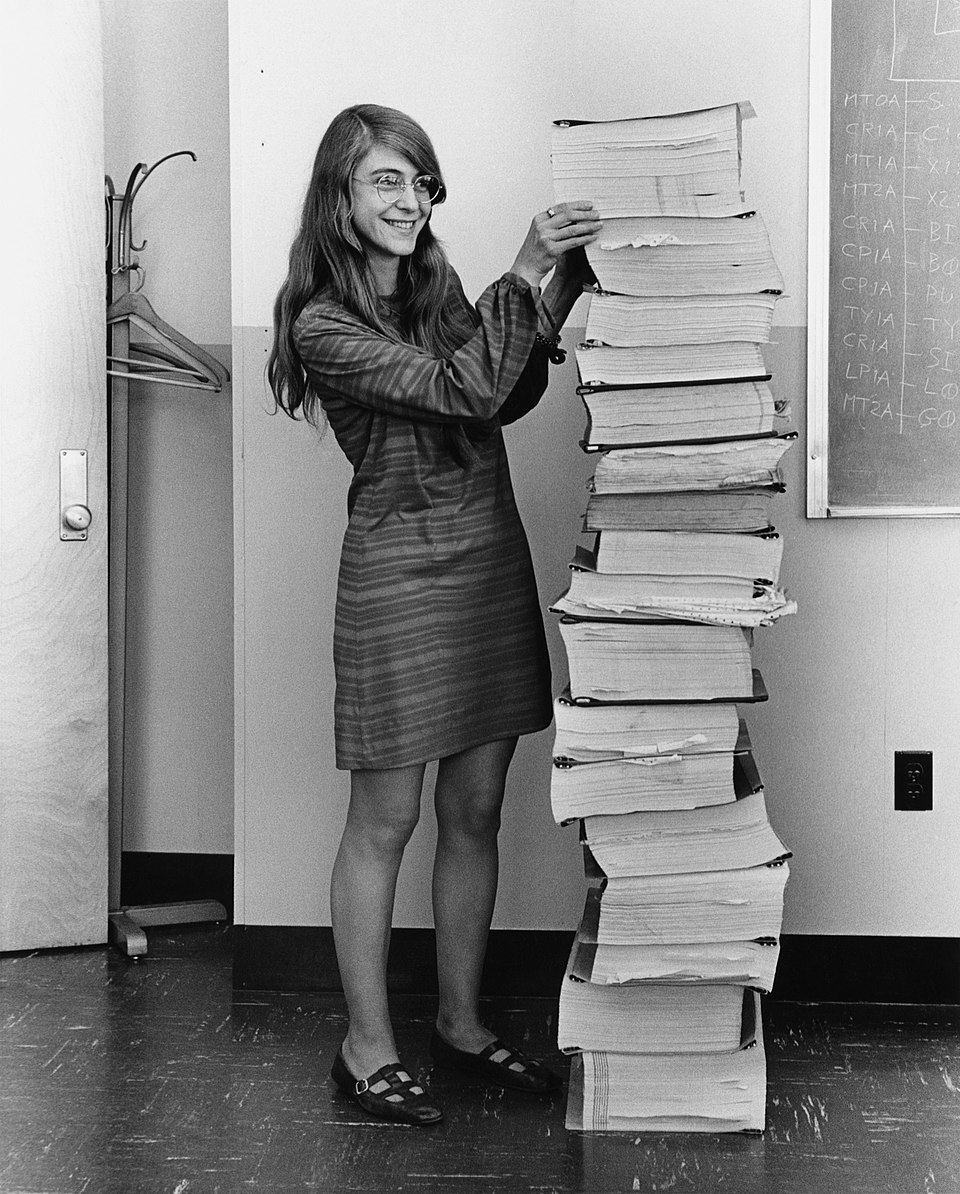
The famous photograph: Hamilton beside the printout of the Apollo Guidance Computer software — nearly as tall as she is. Every page was earned. (Draper Laboratory / public domain.)
Her Daughter Found the Bug Before NASA Did
One of the best stories in software history is a child's. Lauren
Hamilton, then about eight, would come to the lab on weekends and play
astronaut on the simulator. On one visit she mashed keys mid-simulation
and started a pre-launch program during flight — wiping the navigation
data out of the computer. Hamilton, realizing what had happened, argued
to add an error check so that sequence could never run in flight. The
answer from above: astronauts are trained never to make mistakes; it
can't happen.
On Apollo 8, astronaut Jim Lovell — doing exactly what Lauren had done —
accidentally started the same program, erasing his navigation data while
orbiting the Moon. Hamilton's team worked around the clock to rebuild
the tables and get the crew home. The check she had asked for went in
afterward. Every programmer recognizes the lesson: if a human can
do it, a human will do it.
Three Minutes That Proved Her Right
Her deepest obsession was error handling — a radical position at the
time. Software was expected to work or to fail; Hamilton insisted it
should keep working through failure: tell the crew what was
wrong, and protect the highest-priority work first. The Apollo software
ran under a priority-scheduled executive, with "priority displays" that
surfaced alarms instead of hiding them.
July 20, 1969. Apollo 11 is descending to the Sea of Tranquility when the
guidance computer begins blaring 1201 and 1202 executive
overflow alarms — the machine is being asked to do more than it
can, because a rendezvous radar is feeding it data it doesn't need.
Hamilton's design does exactly what she designed it to do: it drops the
low-priority work, keeps flying the landing, and tells the crew what's
happening. In Houston, 24-year-old engineer Jack Garman — who had
memorized the alarm codes — tells flight director Steve Bales what the
alarms mean. The call goes up: "go." Armstrong and
Aldrin land.
The lesson she left us: the alarms weren't a malfunction — they
were the system doing exactly what it was designed to do under
conditions nobody could fully predict. Write software that tells the
truth when it struggles, that ranks what matters, and that degrades
gracefully instead of dying silently. That idea — errors as designed
behavior, not surprises — is still the heart of good engineering, and
it's the same instinct behind tools that analyze code before
it runs.
"Software Engineering"
When Hamilton began calling what they did "software engineering," senior
colleagues laughed — hardware was engineering; software was something you
typed. She kept using the term until the work itself made it undeniable:
a discipline with requirements, design, testing, simulation, and review.
The phrase outlived the skeptics. It is now the name of the profession —
and she didn't just coin it, she demonstrated what it meant, on the way
to the Moon.
After Apollo — Engineering by Construction
Hamilton spent the following decades formalizing what Apollo taught
her: that systems should be made correct by design, not debugged
into correctness afterward. In 1976 she co-founded Higher Order
Software, which produced the USE.IT design tool — systems
specified under axiomatic rules so that entire classes of errors are
prevented before a line of code runs. In 1986 she founded
Hamilton Technologies in Cambridge, developing the
Universal Systems Language (USL) and its 001 Tool
Suite — "development before the fact," systems engineering where the
software inherits the rigor of the system it serves. She led that work
for the rest of her life.
Honors
1986 — Augusta Ada Lovelace Award, Association for Women in Computing (its first recipient)
2003 — NASA Exceptional Space Act Award — the largest award NASA had ever given an individual
2007 — Honorary doctorate, Bard College
2009 — Earlham College Outstanding Alumni Award (later an honorary degree)
2016 — Presidential Medal of Freedom, the highest civilian honor in the United States
2017 — Immortalized in LEGO's "Women of NASA" set
2019 — Intrepid Lifetime Achievement Award
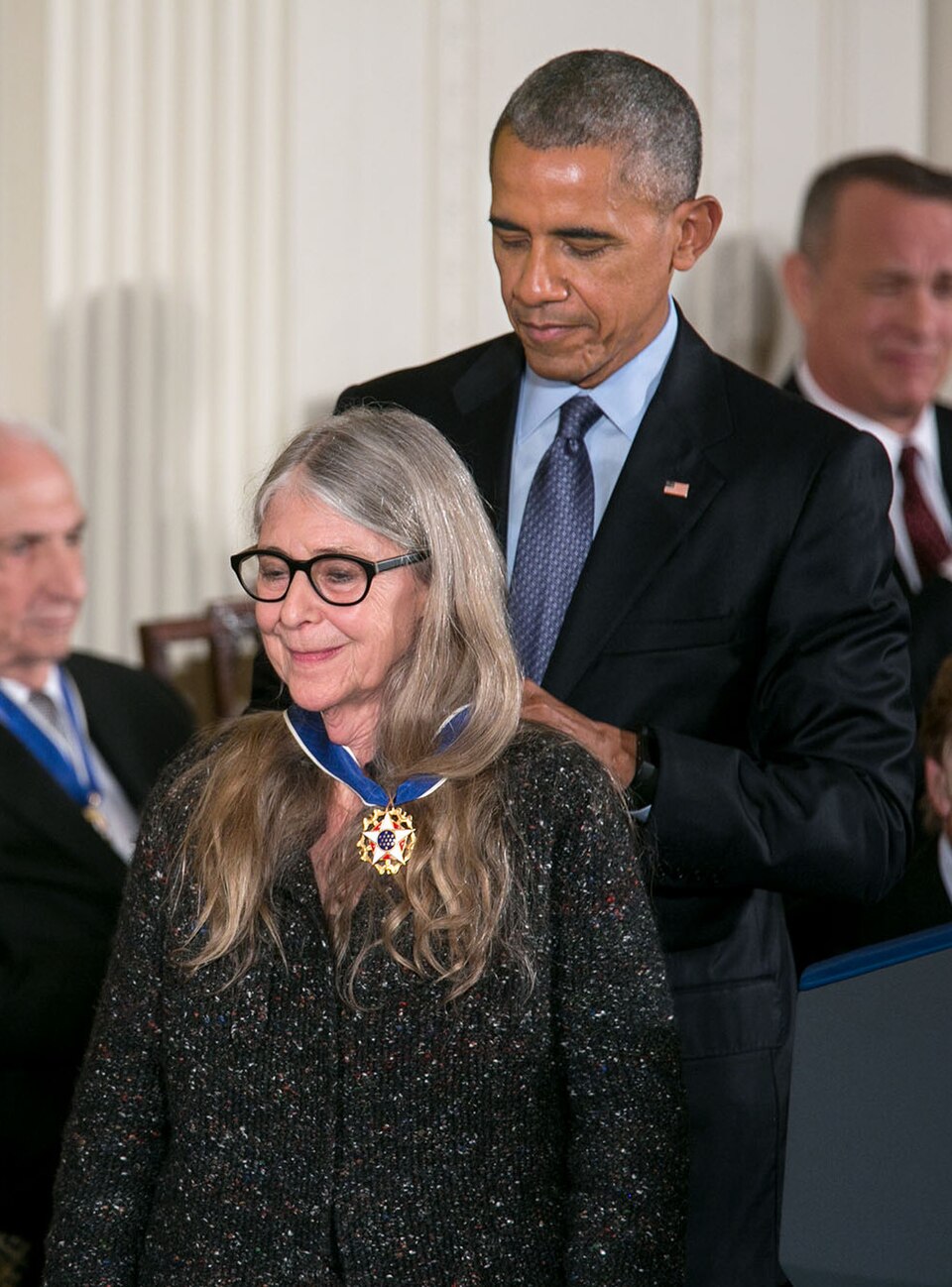
President Obama awarding Hamilton the Presidential Medal of Freedom, 2016 — "she symbolizes that generation of unsung women who helped send humankind into space." (White House photo — public domain.)
The Last Word
Hamilton died on September 30, 2026, in Cambridge — within sight of the
lab where she'd first learned what software could be. She was 90. She is
survived by her daughter Lauren — the little girl whose fingers once
found a bug NASA's processes couldn't — a son-in-law, two grandsons, and
four great-grandchildren. NASA's administrator called her "a pioneer
whose work helped make Apollo and humanity's first journeys to the Moon
possible." A memorial service is planned in Cambridge.
"There was no second chance. We knew that. We took our work seriously,
many of us beginning this journey while still in our 20s… We had to find
a way and we did. Looking back, we were the luckiest people in the world;
there was no choice but to be pioneers."
Why She's Among the Giants
This site exists to teach people to program. Hamilton is the person who
proved that programming could carry the weight of human lives — and that
doing so demanded rigor, humility, and a willingness to design for
failure you hoped would never come. A mother debugging in a lab at
midnight, a computer that refused to quit on the way down to the Sea of
Tranquility, and a word — engineering — that she made true by
doing it. She is exactly the kind of giant whose shoulders we stand on.