In memoriam — Terry A. Davis, December 15, 1969 – August 11, 2018
← Back to the Shoulders of Giants
TempleOS — The Temple
c. 2003 – 2018 · one author · public domain · hosted here permanently
God's Third Temple
Davis said God instructed him to build it. In his telling, Solomon built the first temple, Herod's builders the second — and he was to build the third, not of stone but of code: a place where a person could sit with the machine and talk to God. Whatever you believe about the call, the craftsmanship is real. Around 2003 he began; the project passed through the names J Operating System, LoseThos, and SparrowOS before arriving in 2013 at its final name: TempleOS.
It was not a metaphor to him. Davis's Christianity was absolute and literal — he believed God had chosen him, that the specifications were divine instruction, and that he was building it as an offering. The famous constraints were, in his telling, God's spec: 640×480, sixteen colors, ring-0 simplicity — a covenant like the ones in scripture, given and to be obeyed. He built the oracle into the OS as a way to ask God questions and receive answers. He wrote hymns because God asked for them. He called himself God's high priest and the OS His dwelling place — a temple for God, made of silicon and code, kept deliberately simple the way he believed the Lord wanted it.
Its design goal was his childhood machine, reborn: a Commodore 64 for the modern age. A computer simple enough to hold in one head, immediate enough to program the instant it boots, and complete enough that its entire source — every file, every game, every document — ships on the disk with it.
One author, every layer
- Bootloader & 64-bit preemptive-multitasking kernel
- HolyC — his own C-family language
- Its own compiler — JIT and ahead-of-time, callable anywhere
- Shell, text editor, file manager
- RedSea — his own filesystem (one volume, no partitions)
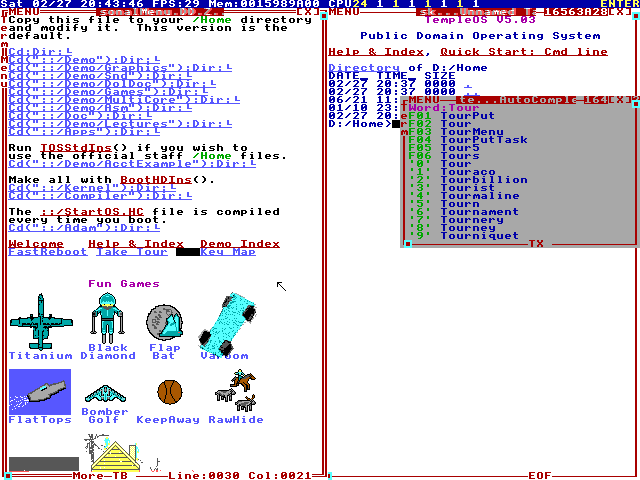
- DolDoc — documents mixing text, links, sprites & 3D inline
- 2D graphics library & software-rendered 3D engine
- Sprite editor & 3D mesh creator
- Flight simulator — his pride & joy
- Games: AfterEgypt, FlatTops, Varoom, FlapBat, Bomber, Titanium, more
- Hymn generator & God's oracle (random text as divine speech)
- Autocomplete, indexing & a full interactive tour
- 640×480 VGA, 16 colors, single-voice PC speaker
- Everything Ring-0 — no memory protection, by design
- No networking — can't be hacked, wasn't the point
- ~100,000+ lines of code · ≈ 2 MB ISO · public domain
HolyC — The Language
At the center sits HolyC, Davis's own C-family language — and this is the part that should interest anyone who loves programming languages. HolyC has its own compiler, written by Davis, supporting both JIT and ahead-of-time compilation. The shell prompt is the compiler: type an expression at the command line and it is compiled and executed on the spot. There is no wall between "scripting" and "building" — the same language serves the command line, the applications, and the kernel itself. For a BASIC site, the idea is familiar and dear: immediacy — code that runs when you say it.
For the complete technical treatment — the type system, the compiler pipeline, DolDoc, the oracle's actual source, and the language's descendants — see HolyC, the encyclopedic article on our wiki.
RedSea and DolDoc — His Own Foundations
RedSea is his filesystem: the entire disk is one RedSea volume — no partitions, no mounting ceremonies, no complexity. DolDoc is his document format: a file can hold text, hyperlinks, sprites, and even embedded 3D meshes, and the same editor handles all of it. Source code, documentation, and art live in one format, in one editor, on one filesystem — one mind's answer to "how should a computer keep information?"
The Temple Part
TempleOS's purpose was communion. It ships with a hymn generator — procedurally composed melodies over Davis's own words, played through the PC speaker — and an oracle that drew random words in sequence, which Davis believed let God speak through the machine. Its flagship game, AfterEgypt, sends you up Mount Horeb to stand before the burning bush — at the top, the oracle speaks to you. The theology was his. The engineering that enabled it was entirely real.
The Limits Were the Point
The TempleOS palette — sixteen VGA colors, 640×480, on purpose.
640×480 pixels. Sixteen colors. One voice on the PC speaker. No network. Every task privileged at Ring-0, in a single address space — in a world obsessed with isolation, a system where everything is yours. A roughly 2-megabyte image containing an OS, a compiler, an office suite of editors, a flight simulator, and games. Davis wasn't unable to build more; he refused. "An idiot admires complexity," he liked to say, "a genius admires simplicity."
Download It Here — Hosted Permanently
TempleOS is public domain — Davis released it free of any claim, and the complete official distribution is hosted here as a permanent mirror, in his memory. Point a virtual machine's CD drive at the ISO (VirtualBox or QEMU; it needs 64-bit and ≥512 MB RAM) or write it to a disc for real hardware. All source is on the disk — it compiles itself, in HolyC, as he intended.
| File | Size | What it is |
|---|---|---|
TempleOS.ISO | 17.3 MB | The complete system — final release, v5.03 (Dec 15, 2017). Start here. |
TempleOSLite.ISO | 2.0 MB | Lite build (Jan 2018) — the essentials, smallest footprint. |
TOS_Distro.ISO | 17.3 MB | November 2017 distro build. |
TOS_Lite.ISO | 2.0 MB | November 2017 lite build. |
TOS_Supplemental1.ISO.C | 8.4 MB | Supplemental disk 1 — extras and add-ons (TempleOS compressed). |
TOS_Supplemental2.ISO.C | 98 KB | Supplemental disk 2. |
TOS_Supplemental3.ISO.C | 49 KB | Supplemental disk 3. |
ReadMe.TXT | 1 KB | Davis's own readme — including his notes on bare-metal I/O ports. |
TempleOS-vmware.zip | 32.2 MB | Ready-to-run VMware virtual machine — TempleOS preinstalled on a vmdk disk, 512 MB RAM, sound + e1000 NIC. Extract and open the .vmx in VMware Workstation/Player — no install needed. |
md5sums.txt | 413 B | Official checksums — verify your download. |
Mirror of the official templeos.org/Downloads set, verified against the published MD5s. TempleOS is public domain; we host it with respect, for as long as this site stands.