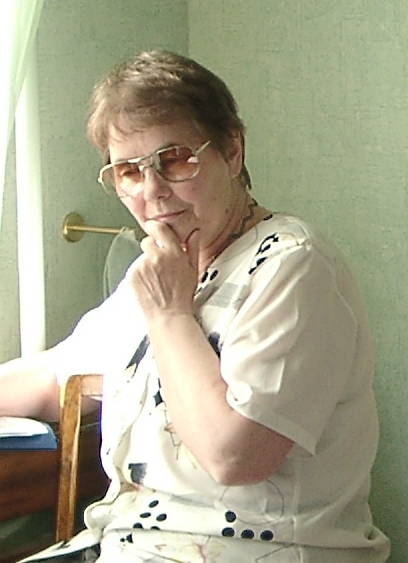
Leontyeva in 2002. Photo: Al Silonov, CC BY-SA 3.0, via Wikimedia Commons.
Pioneer
Nina Leontyeva
Born November 21, 1936 · Linguist · Employee no. 1 of Soviet machine translation · Builder of FRAP · Keeper of the record
Before she ever touched a computer, Nina Leontyeva was one
— her job title on a Soviet geological expedition was
tekhnik-vychislitel', "technician-calculator," a human
being with a slide rule. On May 1, 1959 she became the first
person ever hired by the USSR's Laboratory of Machine Translation.
She went on to lead FRAP, a French–Russian translation
system built on a radical premise — that a machine must
understand a text before it can translate it — as the
only woman, and the only non-Party member, ever to head a
laboratory at the All-Union Centre of Translation. And when the
official campaign came for her system, she outlasted it — and
wrote everything down.
A name assembled from a refrain
Her name was an accident of music. While her mother labored in
Naryan-Mar — a port town above the Arctic Circle, the end of the map —
her father, folklorist Nikolai Leontyev, paced the next room humming a
pseudo-"Georgian" refrain of his own invention: Nari, Nari,
Narina. Sent to register the birth still humming, he broke off
mid-syllable when the clerk asked the child's name — and the clerk
wrote down Narina. Her mother, who revered Saint Nina, the
enlightener of Georgia, had it changed. The daughter later learned
that Saint Nina is Georgia's patron: a father's invented Georgian song
had landed, by pure chance, on a genuinely Georgian name. Sixty years
on, she would write her own childhood in the third person, under the
discarded name — Grandmother Narina, watching a little girl called
Alya.
The North, the war, the human computer
Her childhood was the hard Soviet north and harder war years:
evacuated on the last Litfond train south to Stalinabad while her
father lost his legs to a wound; postwar Moscow province — hunger in
Burkovo, the Kostino barracks school beside a German POW camp. She
entered the Moscow State Pedagogical Institute in 1954, quit for a
time to work geological expeditions in the Tian Shan mountains and the
Karakum desert — that is where she held the "technician-calculator"
job, computing soil resistivity by hand — and returned to the evening
faculty, determined to work rather than sit in lectures.
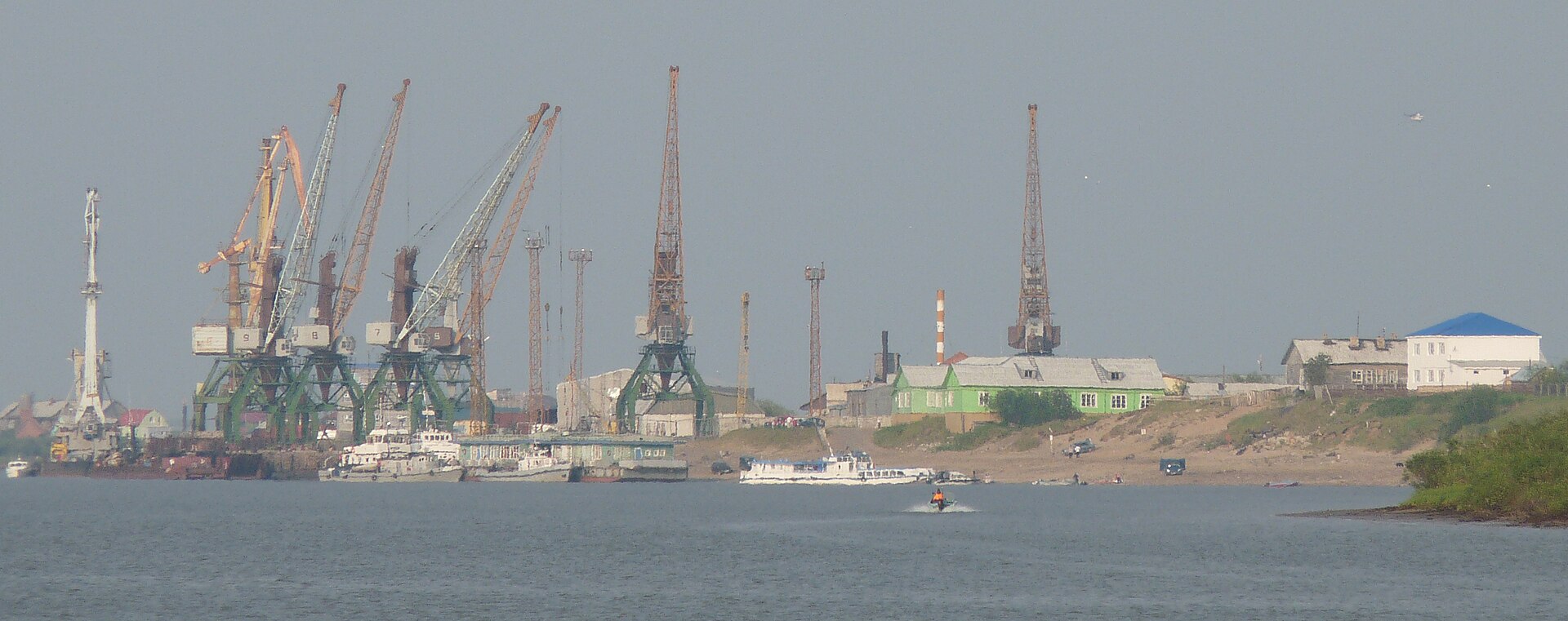
Naryan-Mar, above the Arctic Circle, seen from the Pechora river — the town at the end of the map where she was born. Photo: AAT, CC BY-SA 3.0, via Wikimedia Commons.
Luck arrived the first evening back: a secretary came into the class
announcing that the Institute of Linguistics needed "two girls." That
staircase led to the Laboratory of Machine Translation — a "virtual"
laboratory that never officially existed as a laboratory, run pro bono
by Viktor Rozentsveig, around which orbited a constellation of Soviet
structural science: Lyapunov, Melchuk, Apresyan, Paducheva,
Zholkovsky, Yesenin-Volpin. Leontyeva was its first hire — employee
number one, lab assistant by title — and she was still doing the work
sixty years later.
FRAP: translation through understanding
At the All-Union Centre of Translation in the mid-1970s, she took
over the French–Russian system — FRAP — without knowing French,
and defended the choice on principle: the system must never rely on a
linguist's intuition covering what the algorithm hadn't reached. FRAP
translated through understanding: it analyzed the source text
into a semantic structure first, then generated Russian from meaning —
the idea she had defended in her 1968 dissertation on the "semantic
incompleteness" of text.
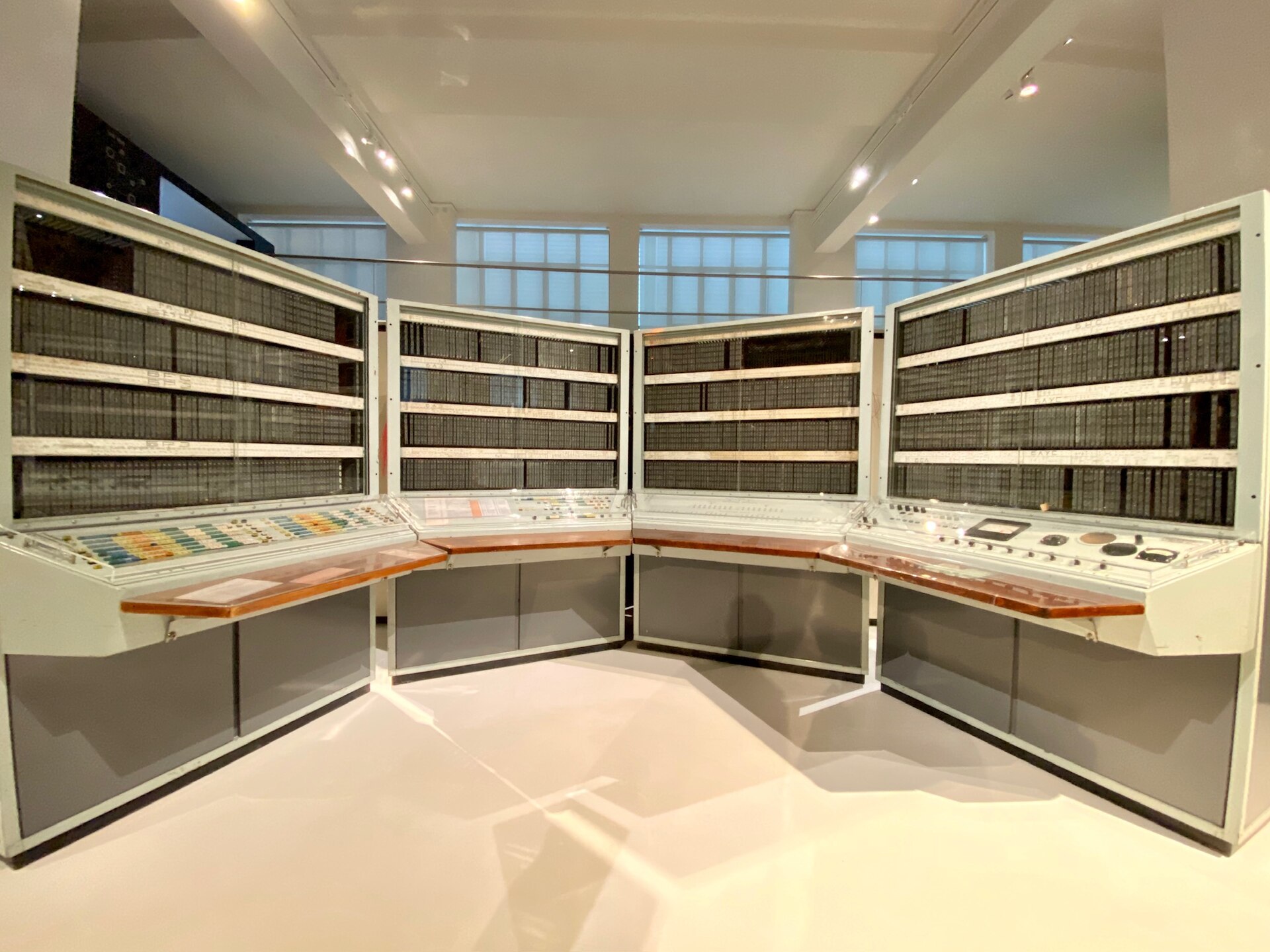
A BESM-6 — the workhorse Soviet scientific computer of the era in which the translation labs worked. Photo: Wikimedia Commons, CC0.
Then came what she called the political communiqué: a closed
seminar at the State Committee, organized by senior figures, whose
verdict against FRAP was written before the discussion she was invited
to had even happened. She learned of it only because a friendly rival
warned her. The smaller persecutions followed — the kind that never
make the history books but fill a career: blocked publications,
rehearsed denunciations, a system marked for closure. FRAP-2 was
delivered anyway, in 1985.
The long tail — and the taken system
Through the lean years at INION and ISK RAN she carried the idea —
automatic understanding of text — forward: the ROSS general
semantic dictionary, the RUSLAN analyzer, a doctorate of technical
sciences in 1990, the POLITEXT model. In 1999 she finally reached the
place she had wanted since school: the Research Computing Center of
Moscow State University. Seventeen years there — until the bitterest
entry in the whole record, when young programmers the collective had
hired walked away with the system and began selling it to its own
customers.
The notebooks
In her first retirement years, "instead of a standard boring report,"
she wrote six notebooks of memoirs and deposited them at
Prozhito, the public archive of personal diaries — childhood,
the career, the people, the persecutions, the apartments, the
foreigners — narrated, in the childhood volume, through the invented
persona of Grandmother Narina. She wrote them on a principle a
programmer friend gave her: writing about yourself is necessary
for two readers — you, and your grandchildren. She was still
adding to the corpus in 2024, at eighty-seven.
Why she kept it: machine translation's first generation
mostly left papers and systems that died with their funding.
Leontyeva left the record — the meetings, the verdicts written in
advance, the names, the staircases — in a form anyone can open. A
field that was almost erased now has its memory, because one lab
assistant decided to keep it.
The Last Word
"There I first understood what Freedom is."
Why She's Among the Giants
Hamilton made machines keep working through failure; Morgan read the
truth off the instruments; Leontyeva asked the hardest question in
computing — what does a text mean — and built a life around
it inside a system that punished the asking. She was present at the
creation: employee number one of an entire field in her country. And
she did the thing that turns a career into history — she kept a
complete record, and she gave it away.