In memoriam — Terry A. Davis, December 15, 1969 – August 11, 2018
← Back to the Shoulders of Giants
Terry A. Davis — His Life
December 15, 1969 – August 11, 2018
A Kid with a Commodore
Terry Andrew Davis was born in West Allis, Wisconsin, on December 15, 1969 — the same year Apollo 11 landed, as it happens — the son of an industrial engineer. He grew up at the exact moment the home computer arrived: he wrote his first programs in BASIC on school computers, and on the family's Commodore 64 he taught himself 6510 assembly language as a teenager. On a C64 there was nothing between you and the machine — you could hold the entire computer in your head. That feeling never left him; it became the blueprint for his life's work.
He studied at Arizona State University, earning a bachelor's degree in electrical engineering and then a master's degree in computer engineering — the rare person trained to understand a machine from the transistors up through the software stack.
A Working Programmer
In the 1990s Davis worked as a professional programmer, including a period at Ticketmaster writing in VMS. He knew the industry's way of building software intimately. What he would go on to build was not a failure to keep pace — it was a deliberate rejection of modern scale in favor of absolute, singular authorship.
SimStructure — Before the Temple
Between 2000 and 2001, before the operating system, Davis wrote SimStructure: a 2D physics simulation and control-systems program, built as a native Windows application in Visual C++ 6 with MFC forms. It was conventional in its tools — and anything but conventional underneath:
- A real physics engine: point masses and springs under gravity and electrostatic forces, with collisions handled through high-order spring overlaps.
- Serious numerical methods: an adaptive step-size Runge-Kutta 4/5 ordinary-differential-equation solver, adapted from Numerical Recipes in C, tightening its step automatically when bodies closed in or changed velocity fast.
- A built-in C-like scripting interpreter: years before HolyC — letting users write control loops, including PID controllers, to stabilize simulated hardware like an inverted pendulum or a hovering thrust-vectored rocket.
- Interactive mechanics: buoyancy, thrusters, and guns, all user-drivable inside the simulation.
On his late-career livestreams he demoed SimStructure to show where
his control-systems instincts came from — and the math didn't go to
waste. He carried the ODE engine forward into TempleOS itself: it
lives in the system's code (Adam/AMathODE) and powers the
RocketScience demo — one programmer's differential
equations, still running in his temple a decade and a half later.
The Illness Arrives (1996)
Around 1996, Davis suffered his first serious episode of mental illness. Convinced he was being pursued — by men in cars, by forces he couldn't name — he fled, driving through the Southwest until he was taken in and hospitalized. He was diagnosed with schizophrenia. The episodes recurred for the rest of his life, with stretches of clarity between them.
He could no longer hold conventional work. He moved in with his parents in Las Vegas and lived on disability. For most people that would be the end of the story. For Davis it was the beginning: from around 2003, living in his parents' spare bedroom, he started building an operating system. He worked on it essentially full-time — for a decade.
The Public Window
Davis did something almost no builder has ever done: he opened the whole process. For years he livestreamed — writing code on camera, explaining TempleOS layer by layer, answering questions, touring the source. The streams showed everything, and they were honest in both directions: genuine brilliance about compilers, kernels and graphics; and, at times, the illness speaking instead. Followers gathered — a devoted community of programmers who came for the technical mastery and stayed out of affection for the man. Platform after platform suspended his channels when the darker hours aired. The community kept finding him.
He was funny — sharp, self-aware funny. He also called himself "the smartest programmer who's ever lived" — and he was not joking. He said it plainly and he believed it; the audience adopted the line, and the strangest part is that a man who wrote an entire operating system alone made it hard to laugh off. His famous line about design survives him:
"An idiot admires complexity, a genius admires simplicity."
The Road (2017)
In 2017 Davis left his parents' home. He lived in his car for a while, then on the street, eventually settling around The Dalles, Oregon — a small town on the Columbia River where the public library's wi-fi became his studio. He kept streaming. He kept coding. The community that had formed around TempleOS helped where it could, and for stretches he was sheltered, fed, and still writing software.
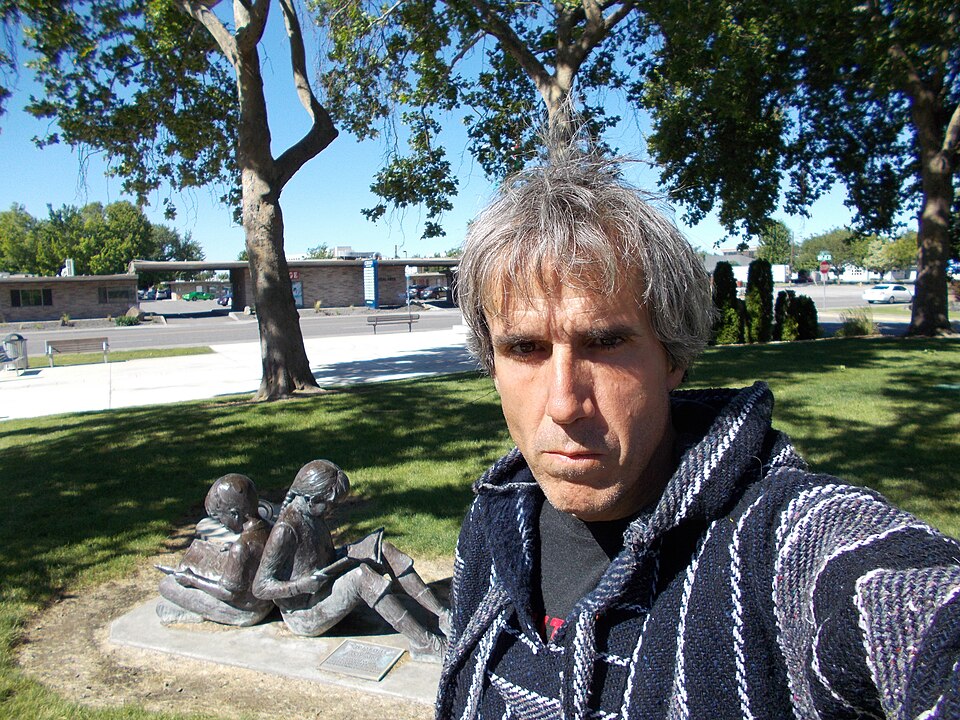
On the night of August 11, 2018, walking near the railroad tracks in The Dalles, he was struck by a train. He was 48 years old.
After Him
He was remembered almost immediately — and remembered correctly. Not as a curiosity or a cautionary tale, but as what he actually was: a programmer of extraordinary ability who, alone, did work that teams of hundreds usually do. Programmers study his videos still. TempleOS still boots. The games still run, the hymns still play, the oracle still answers — a working cathedral, in the public domain, exactly as he left it.
He asked little of the machine and gave it everything he had. If there's a better epitaph for a programmer, it hasn't been written yet.
For the full encyclopedic treatment of his life's work — the language, the compiler, the operating system, and the oracle, with his own words throughout — see HolyC on our wiki.