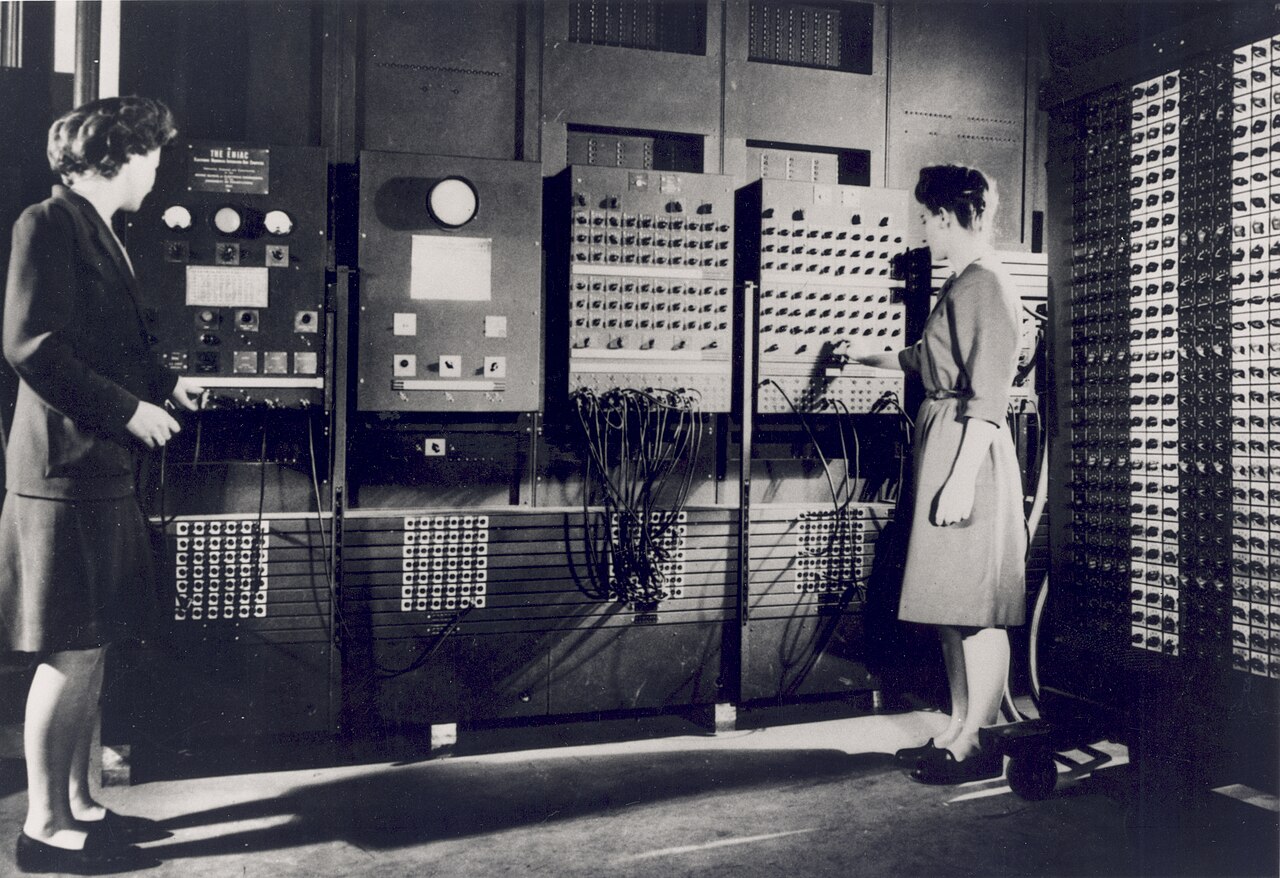
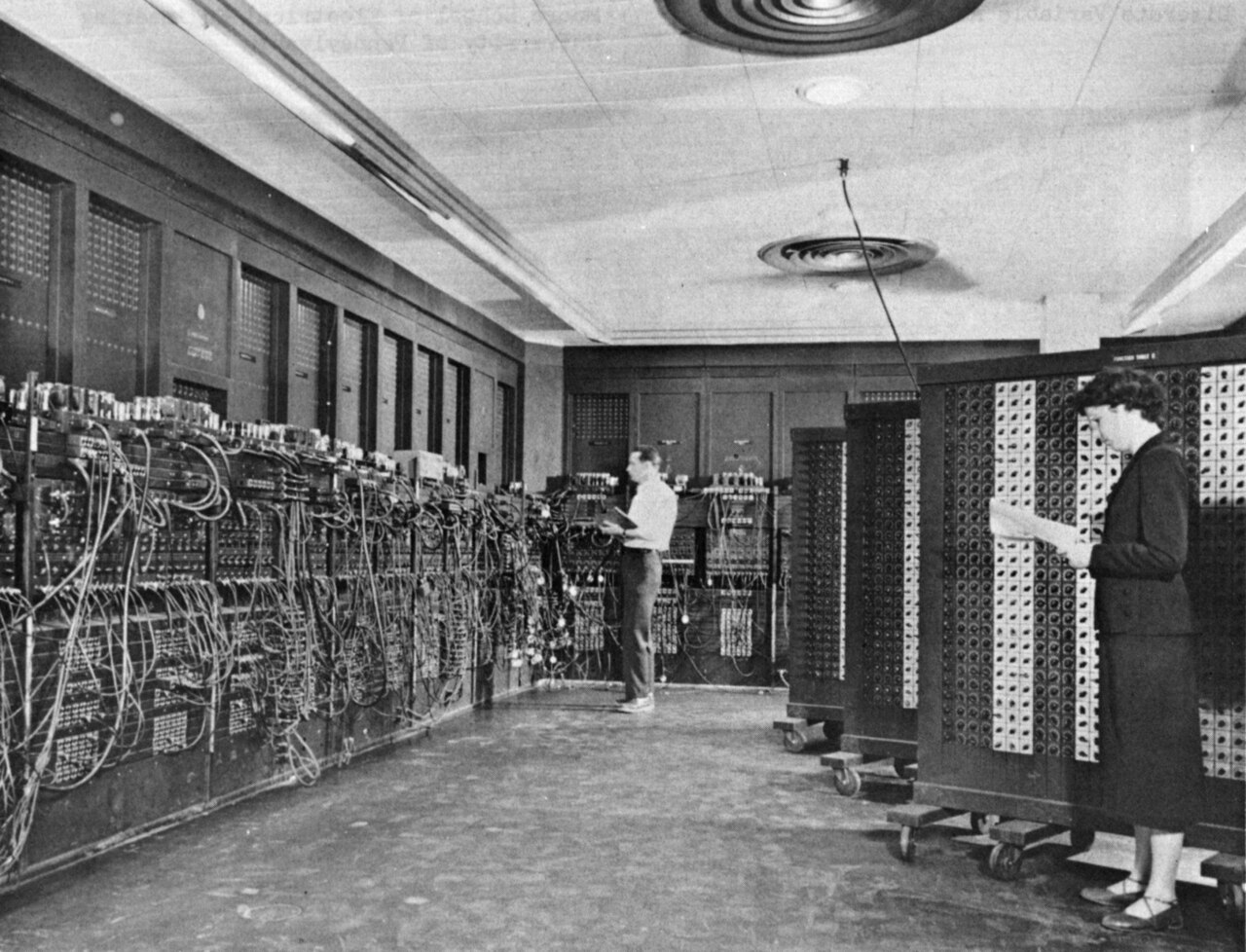
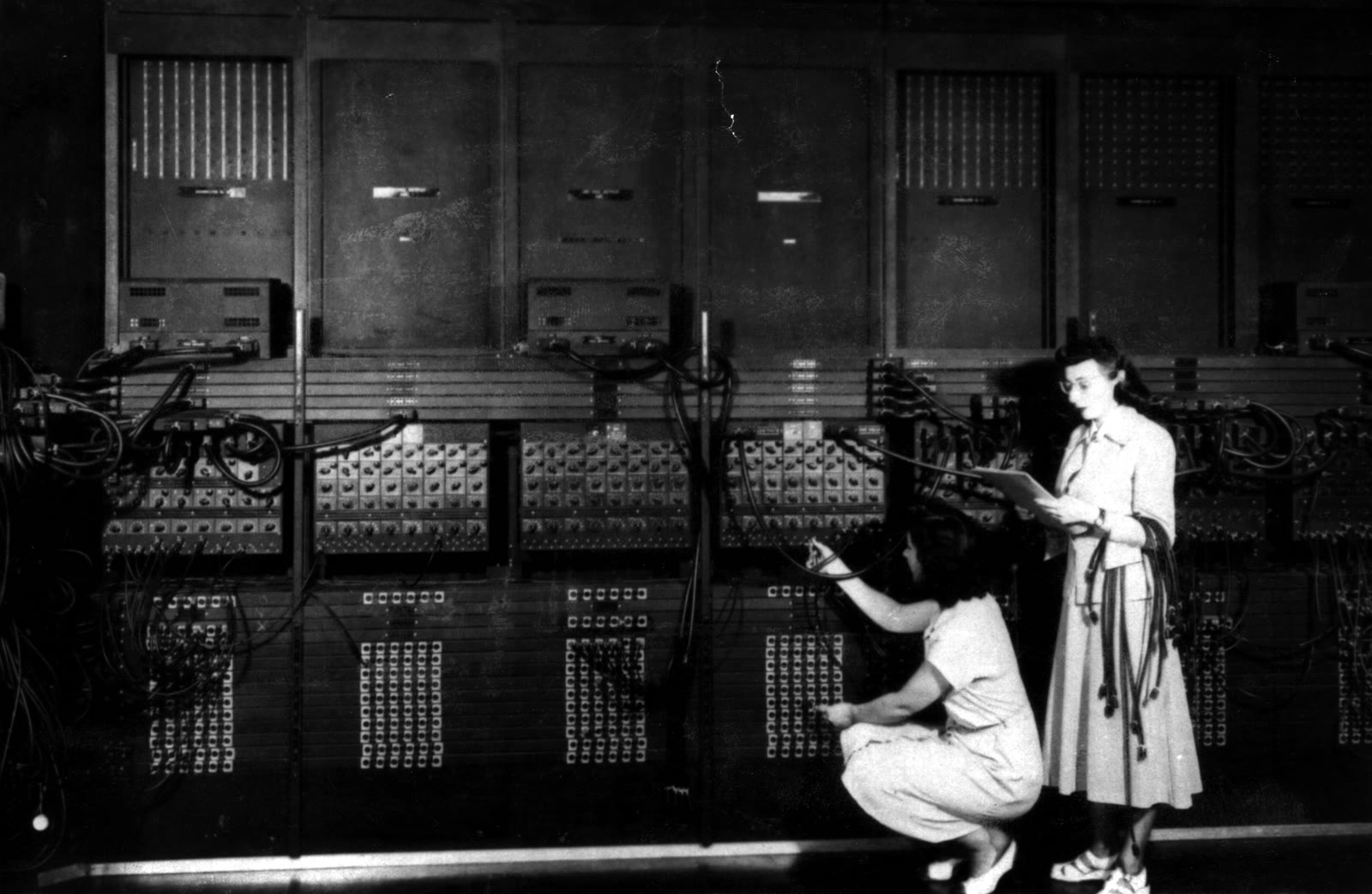
The ENIAC operators at the machine's panels, 1946 — "programming" meant wiring it by hand. Photo: U.S. Army / public domain.
Pioneer
Fran Bilas
March 2, 1922 – July 18, 2012 · Mathematician · One of the six original ENIAC programmers · Author of the machine's first sort routine and its program-check mechanisms
When Fran Bilas joined ENIAC in 1945, the job she was hired for
did not have a name yet. There was no programming
language, no manual, no instruction set to study — there was a
thirty-ton machine of 17,000 vacuum tubes and a stack of paper
block diagrams, and six women told to make it compute. She and
her five colleagues figured out how. Along the way Bilas wrote
the machine's first sort routine and built its program-check
mechanisms — the ancestors of everything we now call testing —
and stood at the panels when ENIAC was unveiled to the public
in February 1946.
The women who were the computers
Frances Elizabeth Bilas was born in Philadelphia and earned a
mathematics degree from Chestnut Hill College in 1942. She went
straight into wartime work: the Army's human-computer corps at the
University of Pennsylvania's Moore School, where dozens of women
computed artillery firing tables — long chains of arithmetic, run
on mechanical calculators and a room-sized analog machine called
the differential analyzer — for every gun, shell, and elevation the
Army fielded. The job title "computer" meant a person. Bilas was a
very good one, and like most of the corps, she was bored: the work
was essential, endless, and always behind.
In 1945 a call went around the corps for volunteers for a
classified project — a machine that would compute the same tables
electronically. Nobody could say more than that. Bilas
volunteered. So did Kay McNulty, Betty Jennings, Betty Snyder,
Marlyn Wescoff, and Ruth Lichterman. They would become known as the
ENIAC six — the first programmers in history.
Six volunteers, no manual
ENIAC — Electronic Numerical Integrator and Computer — was secret
even from the women hired to program it. They couldn't see the
machine at first; they were handed stacks of engineering block
diagrams and told to understand how it worked from the paper.
There was no stored program to write: "programming" meant planning
the computation down to the last signal, then physically realizing
it — plugging hundreds of cables between patch panels, setting
thousands of switches across forty panels of hardware, and
stepping the machine through its work until the output matched
the math. Every programming habit the profession later named —
flowcharts, subroutines, debugging — was invented here, out of
necessity, without knowing it was an invention.
ENIAC at the Moore School — thirty tons, 17,000 vacuum tubes, and no instruction manual. Photo: U.S. Army / public domain.
Bilas's particular fingerprints on that first machine are easy to
recognize in the profession today. She wrote ENIAC's first sort
routine — ordering being one of the first things anyone needed
a computer to actually do — and she built the machine's
program-check mechanisms: procedures that verified a run was
behaving correctly and located the fault when it wasn't. On a
machine that failed roughly every few days and offered no stack
trace, her checks were how you found out where a run had
gone wrong. She was, in effect, doing software validation and
fault-finding before either had a name.
The demonstration
On February 14–15, 1946 the Army unveiled ENIAC to the press —
the first time the public learned a fully electronic
general-purpose computer existed. The demonstration's showpiece
was a ballistic trajectory: ENIAC computed a shell's sixty-second
flight in less time than the shell took to fly it. Bilas was among
the operators who ran the machine through that famous unveiling —
though when the photographs and press coverage ran, the women at
the panels went unnamed and largely uncredited for decades. Some
were introduced to reporters as models.
Reprogramming ENIAC — a new problem meant physically rewiring the machine. Photo: U.S. Army / public domain.
After ENIAC
In 1947 Fran Bilas married William Spence, an Army engineer — and
the era's nepotism rules ended her federal computing career on the
spot. She kept programming anyway, moving to John Mauchly's new
company — the Eckert–Mauchly Computer Corporation that built
BINAC and then UNIVAC, the first commercial computer in the
United States — and working on its projects through the early
commercial era. Then, like most of the six, she stepped out of the
spotlight and raised a family while the field she had helped found
grew up around her.
The recognition took half a century. In 1997 the six ENIAC
programmers were inducted into the Women in Technology
International Hall of Fame, and the story — that the first
programmers were six women, not the two engineers whose names
were on the machine — finally began to be told correctly. Fran
Bilas Spence died on July 18, 2012, at ninety.
Why she's on the Roll: every programmer alive works the
way Bilas's team worked first — break the problem into steps the
machine can take, wire it up, and prove it works. She
built the ancestor of the test suite onto the very first
computer, because she understood the thing every generation of
programmers rediscovers: a program you can't check isn't done.
The six were told there was no such thing as programming; they
replied by inventing it — and Bilas invented the part of it that
catches your mistakes.
"We had no idea what we were getting into — and no idea how much
it would matter."
The six
Kay McNulty (Antonelli) — later wrote the documentation for ENIAC's successor
Betty Jennings (Bartik) — ran the famous trajectory demo; later led UNIVAC programming work
Betty Snyder (Holberton) — went on to help design COBOL and FORTRAN standards
Marlyn Wescoff (Meltzer)
Fran Bilas (Spence) — first sort routine; program-check mechanisms