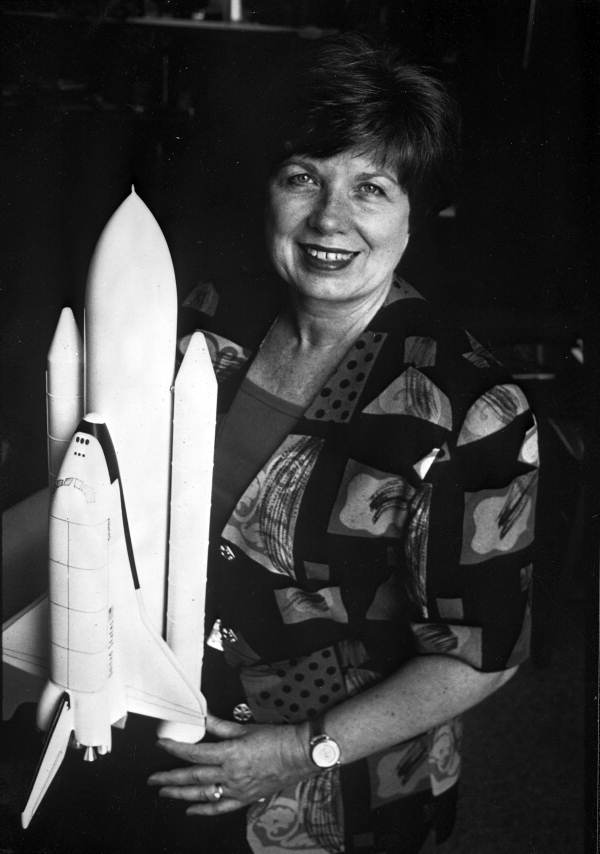
JoAnn H. Morgan, Kennedy Space Center. NASA photo (public domain).
Pioneer
JoAnn H. Morgan
Born December 4, 1940 · Aerospace engineer · Apollo 11 instrumentation controller · First female engineer at Kennedy Space Center · 45 years at NASA
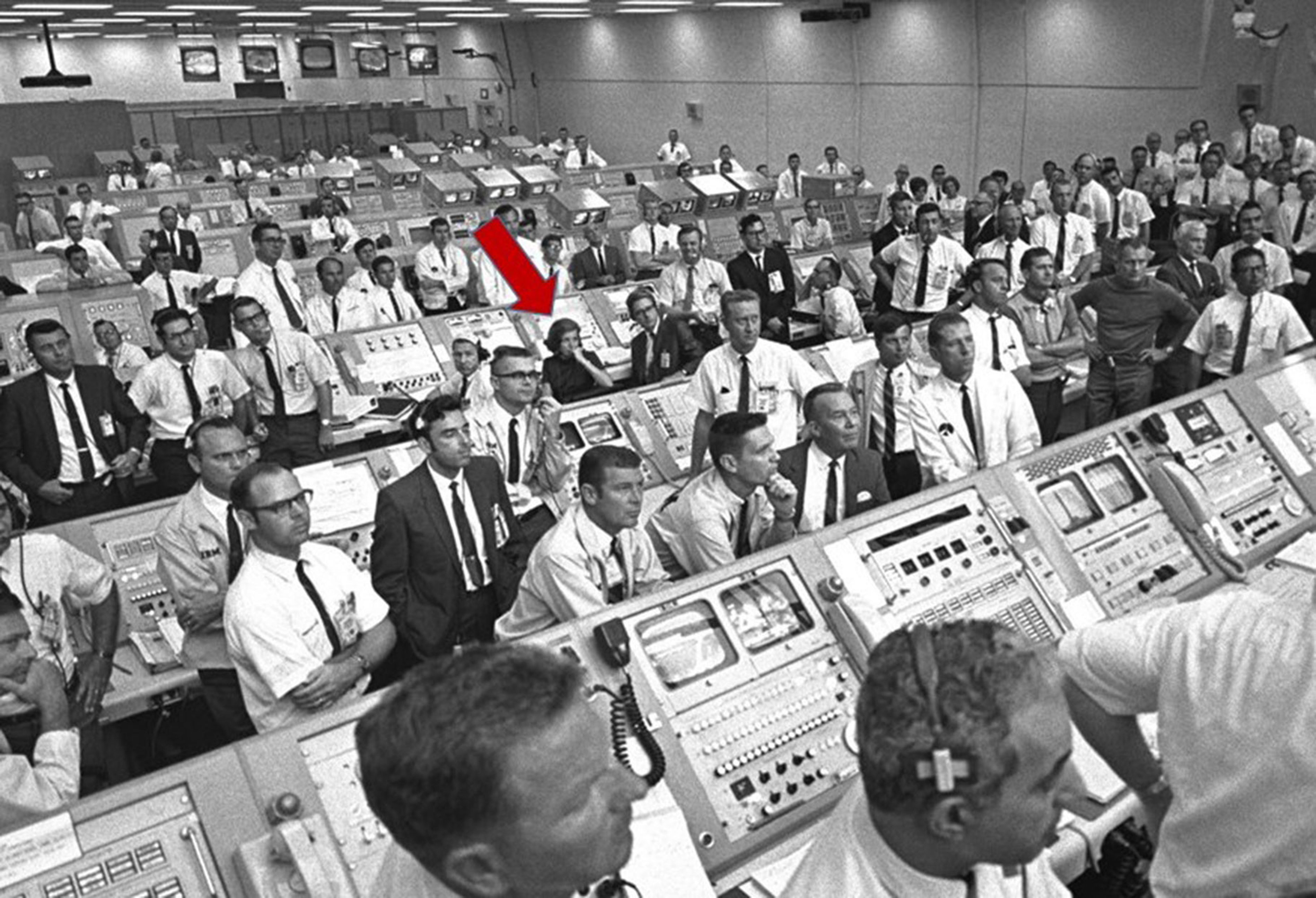
There is a photograph of Firing Room 1 taken seconds after Apollo 11
lifted off: rows of men in white shirts rising from their consoles,
and — left of center in the third row — one woman. That woman is
JoAnn Morgan. She was twenty-eight, the instrumentation controller
for the launch, and the first female engineer Kennedy Space Center
had ever employed. She had started work at Cape Canaveral the day
after her high-school graduation, in 1958 — before NASA existed —
and she stayed for forty-five years, climbing from junior
engineering aide to the center's associate deputy director.
Rocket fuel in her blood
Morgan was born in Huntsville, Alabama, in 1940 — the eldest of four
children of an Army family stationed near Redstone Arsenal, where
Wernher von Braun's rocket team was then building America's first
ballistic missiles. The family moved to Titusville, Florida, where her
father worked at Cape Canaveral in the Army's rocket program, and the
rockets rising over the Atlantic became the scenery of her childhood.
She met her future husband, Larry Morgan, in Titusville.
The day after she graduated from Titusville High School in June 1958,
the seventeen-year-old reported to Cape Canaveral as a civilian
engineering aide for the Army Ballistic Missile Agency — a summer
trainee program run through the University of Florida, inside the very
rocket effort von Braun directed. Months later that program was folded
into a new civilian agency built to answer Sputnik: NASA. Morgan had a
space agency job before most of the country knew there was one.
She studied mathematics at the University of Florida in Gainesville,
spending every summer back at the Cape designing and testing rocket
launch computer systems, and finished her bachelor's degree in
mathematics at Jacksonville State University in Alabama in 1963. That
year she joined NASA full-time at the new Kennedy Space Center. Kurt
Debus — KSC's first director — reviewed her record of technical papers,
data systems work and hardware experience, and steered her to dual
certification as a Measurement and Instrumentation Engineer and a Data
Systems Engineer. She was Kennedy's first female engineer.
The only woman in the Firing Room
Through the Mercury, Gemini and Apollo years Morgan worked the
unglamorous machinery of launch: she wrote algorithms for a Mars
trajectory, worked in the Vehicle Assembly Building, and helped
activate the consoles in the Launch Control Center's firing rooms —
work that earned her an achievement award for the activation of Apollo
Launch Complex 39. But the firing room itself was closed to her. The
blockhouses were sealed for hours-long countdown tests, and they had
been built without a women's restroom — a security guard had to clear
the men's room for her, and she was never allowed to be locked in at
liftoff for the tests she had prepared.
When a test supervisor once told her, flatly, that women weren't
allowed there, Morgan called her director, Karl Sendler. His answer
became famous in her retelling: "JoAnn, you get the test done.
Bring me the data." When Apollo 11's console assignments came, it
was Sendler who went to bat for her: "You are our best
communicator. You're going to be on the console for Apollo
11!"
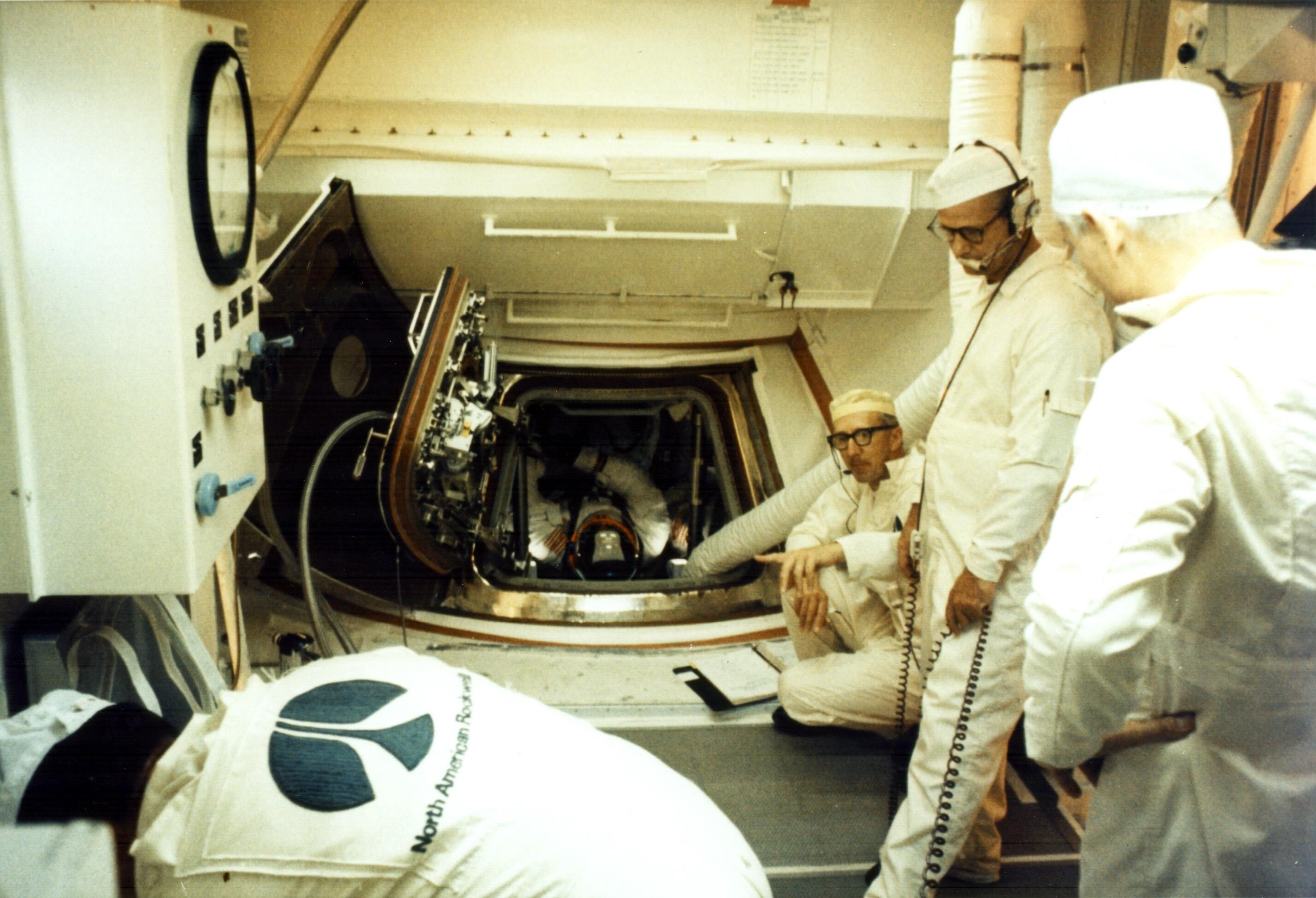
Morgan at her instrumentation console, Apollo 11, July 16, 1969. NASA photo (public domain).
Her station was instrumentation: the stream of readings from sensors
on the Saturn V's motors, structure and computers — the rocket's own
account of what it was doing, watched by a person who had to know what
every trace meant. On the morning of July 16, 1969, hundreds of
engineers filed into Firing Room 1 to launch the first crewed lunar
landing. One of them was a woman. At 9:32 a.m. the Saturn V rose, and
Morgan became part of the photograph that would follow her for the
rest of her life.
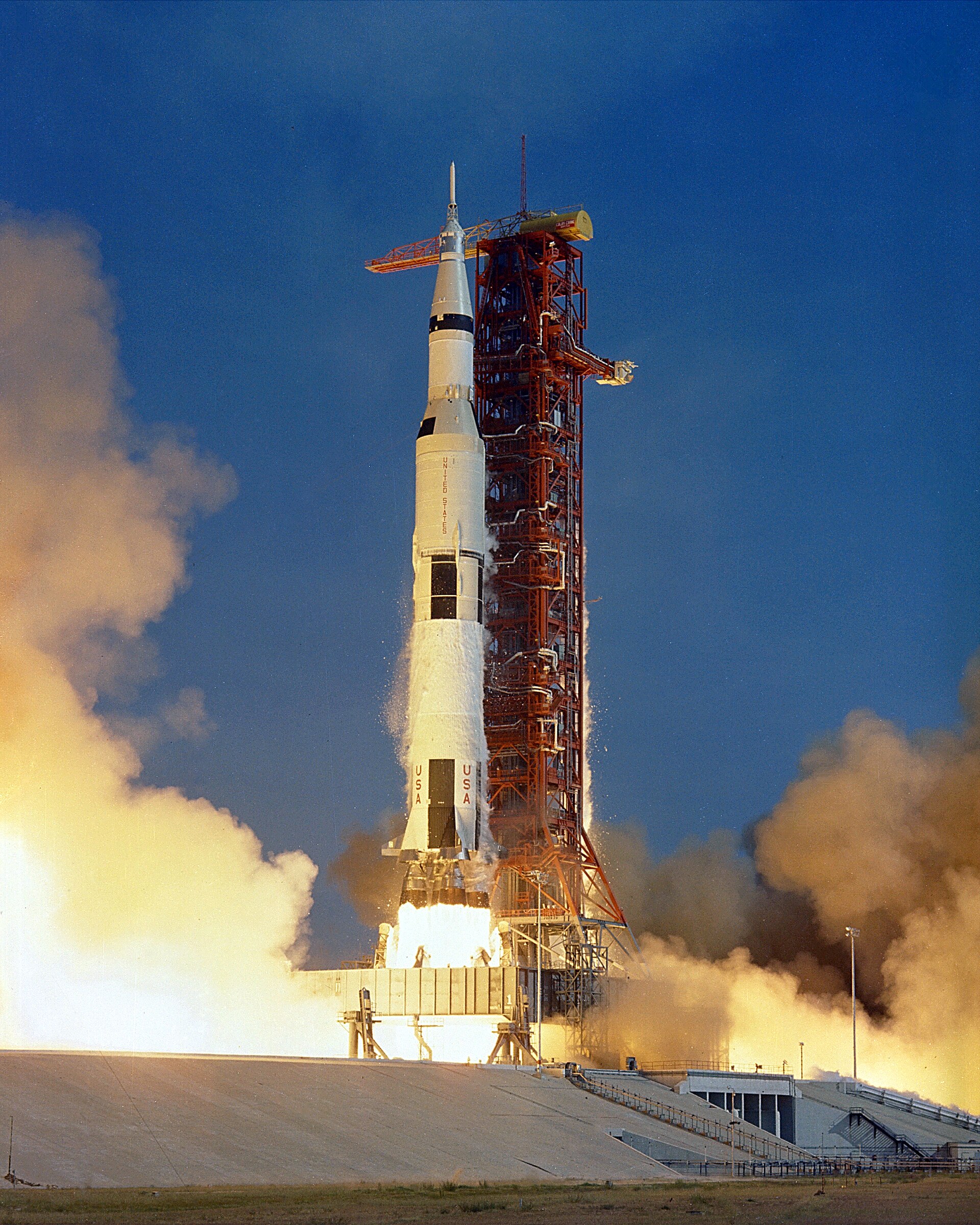
The famous photograph: the Apollo 11 launch team rises from their consoles to watch the liftoff. Morgan is seated, left of center, in the third row — the only woman in the room. NASA photo (public domain).The launch Morgan's instruments were watching: Apollo 11 clears the tower at LC-39A, July 16, 1969. NASA photo (public domain).
She stayed on the launch team through Apollo-Soyuz and Skylab. In the
back room of Mission Control in Houston that same week sat another
woman — 25-year-old mathematician Frances "Poppy" Northcutt — so
Apollo 11 had a woman in each of its two nerve centers. (And a note for
the record: JoAnn Morgan is not Barbara Morgan, the teacher-in-space
candidate who later flew on the shuttle — the surnames are a
coincidence.)
Forty-five years of firsts
Apollo was the visible summit; the career was the mountain. Morgan was
the first NASA woman to win a Sloan Fellowship, and spent it earning a
master's in management from Stanford. Back at Kennedy she became the
center's first woman division chief, then — after three years in the
payloads organization, including deputy director of Shuttle Cargo
Operations — was named Director of Payload Projects Management in
August 1986.
Morgan in her shuttle-era management years. Photo: State Archives of Florida / Florida Memory (public domain).
The list of firsts kept growing: first woman senior executive at
Kennedy Space Center, first woman to direct Safety and Mission
Assurance — the office whose director was one of the last two people
to certify a space shuttle ready to fly — and finally the center's
associate deputy director, its first woman in an executive position.
She finished her career as Director of External Relations and Business
Development and retired in August 2003 — forty-five years after the
summer job that predated the agency itself.
Honors
Presidential Distinguished Executive Rank Award — presented by Vice
President Al Gore, April 29, 1999; the nation's highest civil service
honor
Presidential Meritorious Executive — 1995 and 1998 (President
Clinton)
Florida Women's Hall of Fame — inducted 1995
Kurt H. Debus Award
Four NASA Exceptional Service medals · two Outstanding Leadership
medals
Achievement award for the activation of Apollo Launch Complex 39
First NASA woman to win a Sloan Fellowship (Stanford, M.S.
management)
Florida university trustee, appointed 2001 — UF Aerospace
Engineering, UCF College of Engineering, UWF Institute for Human and
Machine Cognition
The room she changed
Retirement did not end the mission. As a Florida university trustee
and advisor, Morgan saw the state's engineering data — and what it said
about women — and began endowing scholarships for women engineering
students at several universities. She kept speaking, kept mentoring,
kept showing up at Kennedy for Women's History Month.
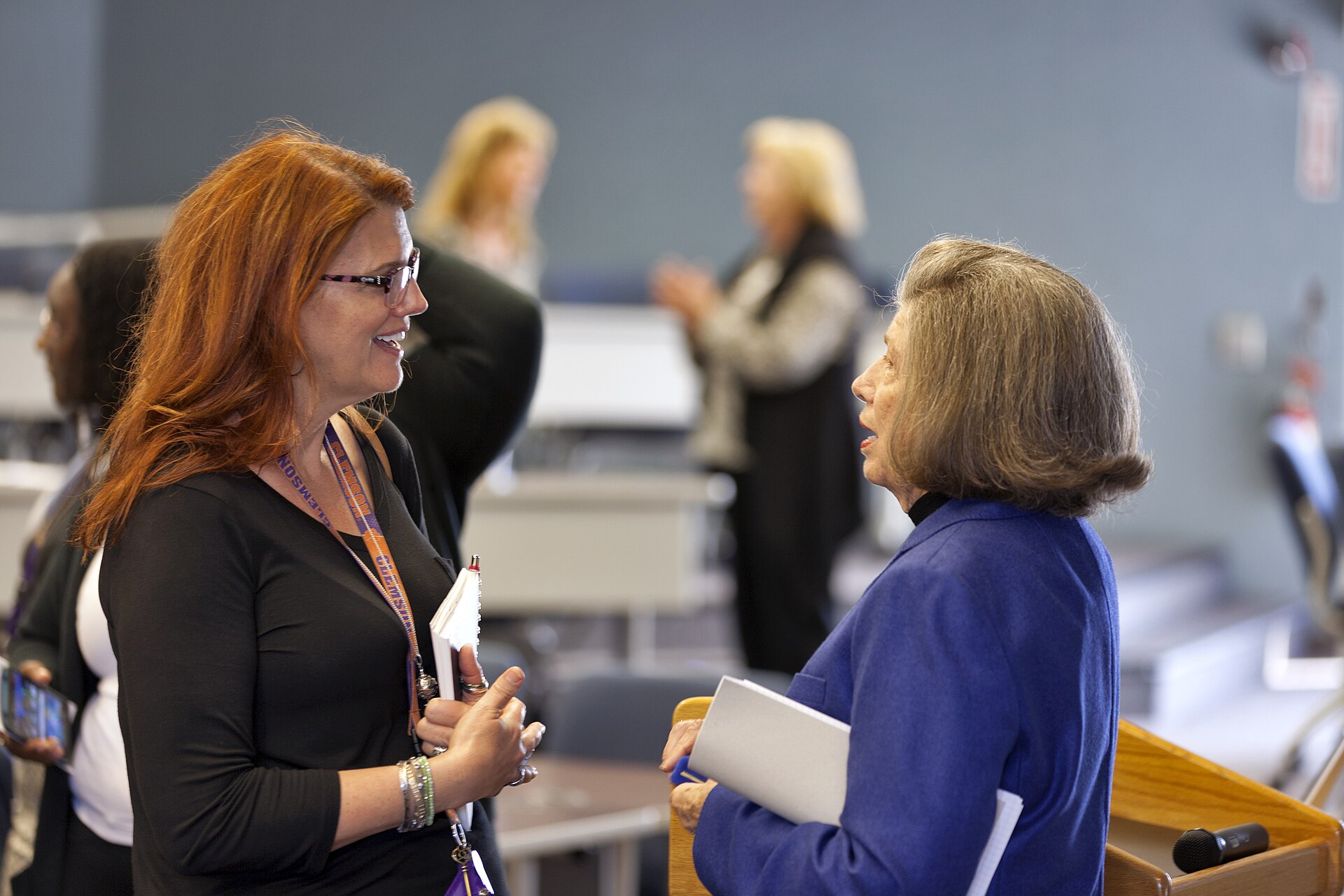
Morgan in 2024 with Charlie Blackwell-Thompson — NASA's first female Launch Director — in the same Firing Room 1, now staffed by a launch team that is about a third women. NASA photo (public domain).
The Last Word
"I look at that picture of the firing room where I'm the only woman.
And I hope all the pictures now that show people working on the
missions to the Moon and onto Mars, in rooms like Mission Control or
Launch Control or wherever — that there will always be several women.
I hope that photos like the ones I'm in don't exist anymore."
Why She's Among the Giants
Hamilton wrote the code that flew the spacecraft; Morgan read the
instruments that launched it. Same morning, same discipline — truth
from the machine, trusted under pressure. She earned her seat the hard
way, was told the room wasn't for her, and answered with forty-five
years of doing the work and then holding the door open behind her. The
Giants are the people who made it possible to ask a machine for the
truth and trust the answer; Morgan spent her career on exactly that
console.