
History of Learning
The history of learning is older than the history of education by about three and a half billion years. Education is an institution — schools, curricula, examinations — invented a few thousand years ago. Learning is a property of living matter: a cell changes its behavior because something happened to it. A neuron is stimulated — whether by chaos, novelty, pain, or pleasure — and it responds. When that response persists, the organism has learned.
Every school, book, and tutorial in the companion article exists to harness this one biological fact. This article traces learning itself: how nervous systems discovered it, how science measured it, and how machines were eventually taught to do it.
Before brains: learning without neurons
Learning did not wait for brains. A single-celled organism placed in a changing environment alters its behavior — the paramecium that recoils from a chemical at first, then ignores it, has performed habituation: the simplest form of learning on record. It has no nervous system at all. It simply changed.
The definitive laboratory proof came from an unlikely subject: the sea slug Aplysia californica, whose nervous system contains only about 20,000 neurons — large enough to see under a microscope. Beginning in the 1960s, Eric Kandel and his colleagues showed that the slug's gill-withdrawal reflex could be strengthened, weakened, and conditioned — and, crucially, they located the changes at identified synapses. A touch that preceded a shock produced a stronger response later. The slug had formed an association, and the association lived in measurable changes to synaptic strength. Kandel's work, honored with the Nobel Prize in 2000, answered the question that had stood since antiquity: learning is not metaphor. It is matter rearranged.
The neuron doctrine: electricity meets anatomy
That nerves carried something electrical became undeniable in 1791, when Luigi Galvani made dead frogs' legs twitch with dissimilar metals — animal electricity, demonstrated on a laboratory bench. The nerve impulse was real, measurable, and physical.
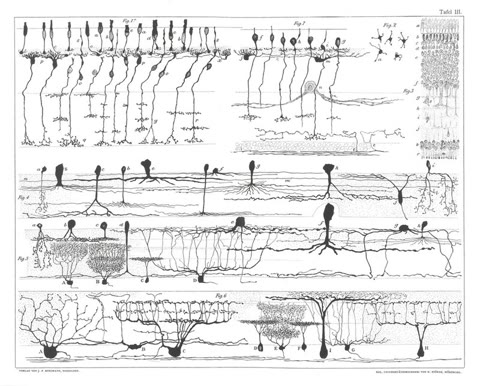
The anatomy took another century. Camillo Golgi's silver-chromate stain (1873) finally made whole neurons visible — but Golgi himself believed they fused into one continuous net. Santiago Ramón y Cajal, staining the same tissue, drew what Golgi's method actually showed: discrete cells, each a tree of branching fibers ending in terminals that touched — but did not merge with — their neighbors. The two men shared the Nobel Prize in 1906 and used their lectures to argue opposite conclusions; Cajal's neuron doctrine won. A decade earlier, Charles Sherrington had already named the junction where one neuron hands its signal to the next: the synapse (1897) — the precise site where learning would later be found to live.
The cell that learns
If neurons are discrete cells meeting at synapses, then learning must be something synapses do. In 1949, the psychologist Donald Hebb stated the rule in one sentence: neurons that fire together, wire together. When cell A repeatedly helps fire cell B, their connection strengthens. It was a hypothesis without direct evidence — and the most consequential conjecture in the history of neuroscience.
The evidence arrived in 1973, when Timothy Bliss and Terje Lømo, recording from the rabbit hippocampus, showed that a brief burst of stimulation produced long-lasting potentiation — synapses that stayed stronger for days. Long-term potentiation (LTP) was Hebb's rule, measured. Kandel's Aplysia work then traced the mechanism down to molecules: repeated stimulation alters gene expression, grows new synaptic terminals, and physically rebuilds the cell's wiring. Learning, at last, had a mechanism: the brain stores experience by changing the strength and structure of its connections.
The laws of association: what the behaviorists measured
While anatomists argued about cells, another tradition measured learning's laws — from the outside, treating the brain as a sealed instrument and the animal as a responder to stimuli.
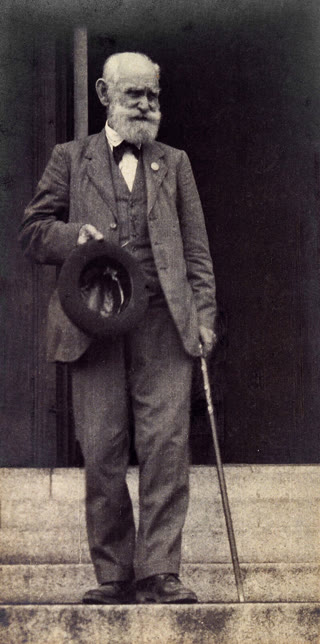
Ivan Pavlov was studying digestion in dogs when he noticed the animals salivated before food arrived — at the sight of the attendant, the sound of footsteps. He spent the rest of his career mapping the conditioned reflex: pair a neutral stimulus (a bell) with food often enough, and the bell alone summons the response. The digestion research had already earned him the 1904 Nobel Prize, and the conditioning work that followed gave science its first rigorous description of associative learning.
Edward Thorndike, placing cats in puzzle boxes at Columbia (1898), found a second law. Cats escaped not by insight but by trial: successful actions were stamped in by their consequences — the law of effect. B. F. Skinner generalized it into operant conditioning: behavior followed by reinforcement recurs; behavior followed by nothing fades. In his chambers, pigeons learned to peck discs, guide missiles, and play table tennis — and the schedules of reinforcement he mapped, from fixed ratios to variable rewards, remain the deepest account ever written of how consequences sculpt behavior.
The pleasure signal: reward as the teacher's currency
In 1954, James Olds and Peter Milner at McGill implanted electrodes in rats' brains and let the animals press a lever that stimulated a region near the septal area. The rats pressed it until exhaustion — thousands of times an hour — choosing stimulation over food and water. They had found the brain's reward system, and with it the second great engine of learning.
Decades of work refined the picture. The neurotransmitter dopamine, mapped by Wolfram Schultz and others in the 1990s, turned out not to signal pleasure itself but reward prediction error — the difference between expected and actual outcomes. Dopamine fires when reality exceeds expectation and falls silent when predictions hold. It is, in effect, the brain's built-in learning signal: it says this was better than predicted — do it again. The mathematically elegant consequence is that the same computation drives habit formation, addiction, curiosity, and play.
What brains keep: the memory systems
Learning writes; memory is what the writing leaves. The modern map of memory begins with a tragedy: in 1953, the patient Henry Molaison (H.M.) had most of both hippocampi removed to treat epilepsy — and lost the ability to form new lasting memories while keeping old ones intact. Brenda Milner's studies of him proved memory is not one thing: H.M. could learn new skills he could not remember learning. Procedural memory (how) survived where declarative memory (what) could not form.
Endel Tulving later split declarative memory into episodic (lived events) and semantic (detached facts); Alan Baddeley mapped working memory, the bench where thought assembles; and research on consolidation showed that memory is not written once but replayed — during sleep, the day's learning is rehearsed, sorted, and filed. The brain is not a recording device but an editor, keeping what proved useful.
The cognitive turn: learning as construction
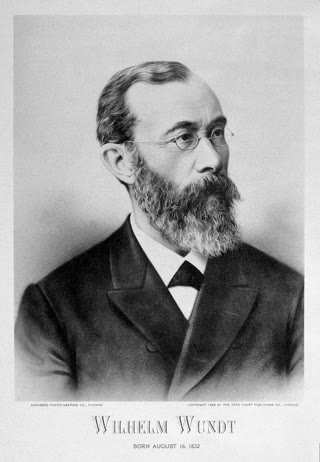
The behaviorists' sealed-box era ended when experimenters opened the box and found structure inside. Wilhelm Wundt had already founded experimental psychology at Leipzig in 1879 — the first laboratory devoted to the mind. But the decisive reframings came from three thinkers who watched learning happen rather than merely tally it.
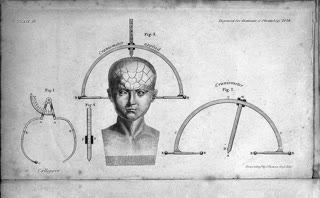
Jean Piaget observed that children do not absorb smaller copies of adult knowledge — they construct it, in stages: the infant's object permanence, the child's conservation, the adolescent's abstraction. Each stage is a reorganized mind, not an expanded one. Lev Vygotsky, working in the Soviet Union, added the social dimension: children first perform every capacity with more capable partners, then internalize it — the zone of proximal development, the space where guided learning outpaces solo discovery. Albert Bandura completed the triad: children learn aggression, skills, and norms simply by watching — observational learning, no reinforcement required.
Learning without instruction
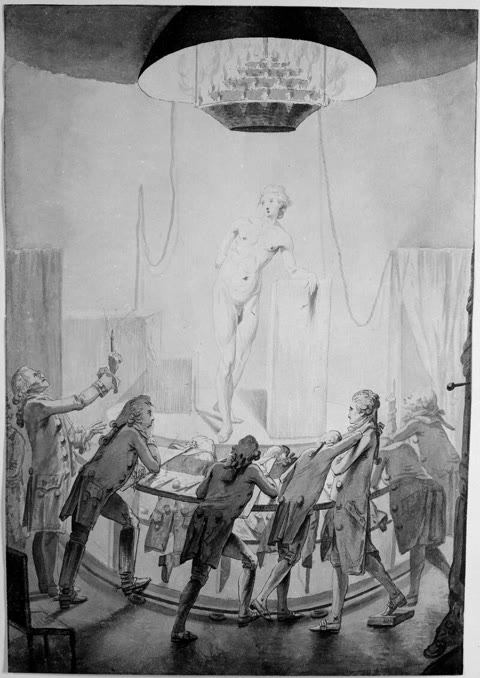
The deepest surprise of the twentieth-century research was how much learning needs no teacher. Karl Groos's The Play of Animals (1898) argued that play is practice — the wolf cub stalking leaves is rehearsing the hunt. Konrad Lorenz documented imprinting: a gosling locks onto the first moving object it sees, a learning window that opens and shuts on schedule. And J. Mark Baldwin had shown, as early as 1896, that learning evolves: behaviors acquired in a lifetime can, over generations, become innate — the Baldwin effect, learning as evolution's shortcut. The organism that could learn faster evolved; the brains that could learn anything — that could treat every signal as a lesson — inherited the Earth.
The learning machine
The final chapter belongs to learning's mirror: the machine built to do it. Frank Rosenblatt's perceptron (1958) was a physical device that learned to classify patterns by adjusting connection strengths — Hebb's rule in hardware. When early enthusiasm collapsed into the first AI winter, the idea survived underground as connectionism, resurfacing in 1986 when Rumelhart, Hinton, and Williams published backpropagation: a way to assign credit through layers, turning Hebb's local rule into a global gradient.
The payoff came in 2012, when a deep network trained on GPUs halved the error rate on image recognition and launched the modern era. Transformers (2017) then showed that attention — a mechanism for weighting what matters — could learn language at scale. The machines now learning to translate, prove, and tutor run on the same principle the sea slug proved on a microscope slide: stimulate, respond, adjust the weight, repeat. Learning's mechanism, once the exclusive property of cells, became a property of any system that can adjust.
AdaLogic BASIC stands at this intersection: a language designed so that its compiler itself contains learning systems — neural inference, Markov prediction, adaptive engines — while remaining readable enough to teach the human on the other side of the screen. The synapse's rule, written in BASIC.
Threads that never changed
Across three billion years and every system examined:
- The stimulus precedes the change — chaos, novelty, pain, or pleasure: something must happen before anything can be learned. The neuron that is never stimulated never rewires.
- Response becomes structure — LTP, imprinting, conditioning, backpropagation: in every substrate, a response that repeats becomes the system's new shape.
- Two currencies pay for the change — surprise (the signal that the model was wrong) and reward (the signal that the action worked). Prediction error and pleasure are the twin ledgers of learning, from dopamine to gradient descent.
- The learner always outgrows the lesson — every system studied, from the paramecium to the transformer, extracts more from stimulation than the stimulation specified. That is what makes it learning rather than storage.
See also
- History of Education — the institutions built on this biology
- History of Science · History of Mathematics · History of Language · History of Electricity · History of Programming — the companion volumes
- AdaLogic BASIC — a language with learning systems in its own compiler
- Alan Turing — who asked whether machines could learn, and meant it
References
- Cajal, S. R., Textura del sistema nervioso — the neuron doctrine, drawn by hand
- Hebb, D. O., The Organization of Behavior (1949) — "fire together, wire together"
- Kandel, E. R., In Search of Memory (2006) — the molecular biology of learning
- Pavlov, I. P., Conditioned Reflexes (1927) — the laws of association
- Skinner, B. F., The Behavior of Organisms (1938) — operant conditioning
- Olds, J. & Milner, P., "Positive reinforcement produced by electrical stimulation" (1954) — the reward system
- Tulving, E., Elements of Episodic Memory (1983) — the memory systems
- Rumelhart, D., Hinton, G., & Williams, R., "Learning representations by back-propagating errors" (1986) — the learning machine
- Wellcome Collection — all images in this article (Public Domain Mark / CC BY)