
Hygrocybe WV02
Hygrocybe sp. ‘WV02’ is the provisional research name of an apparently undescribed species of waxcap mushroom discovered in June 2026 near Cross Lanes, West Virginia, by amateur mycologist Drew Palmer. DNA sequencing of the specimen's ITS barcode region — performed by Mycota Lab — found its closest known relative to be Hygrocybe flavifolia, a yellow waxcap of the Pacific coast, while confirming that the West Virginia fungus matches no formally named species.[1] The discovery broke in regional news in late September 2026 and stands as a neat modern parable: a new species found not on an expedition, but on a walk near home.[2]
The discovery
Palmer had planned a mid-June 2026 trip to a state park to look for late-spring fungi. When the trip fell through, he took a walk in the woods near his home in Cross Lanes instead — and there, on the forest floor, found mushrooms unlike anything he had encountered.[2]
Palmer is an avid identifier of mushrooms — he would lead a mushroom walk at Kanawha State Forest that September — and he recognized immediately that these were not merely unusual. He told the Charleston Gazette-Mail:
"I knew right away they were something special. I identify a lot of mushrooms, but I had never seen anything remotely like this in my entire life. I dropped to my knees and spent the next 45 minutes taking pictures."[3]
The identification
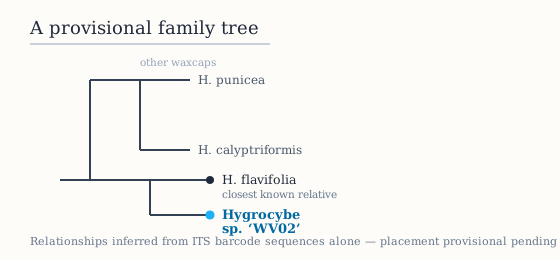
The specimen was analyzed by Mycota Lab, which sequenced the fungus's ITS region — the Internal Transcribed Spacer, the standard DNA barcode for fungi. The result was double-edged in the best way: the sequence showed the mushroom clearly belonged in Hygrocybe, the waxcap genus, with H. flavifolia as its sister taxon — its closest named relative — yet diverged enough to stand as a species of its own.[4]
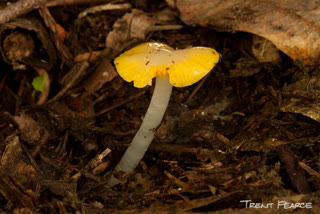
Notably, the determination rests on ITS sequences alone — the molecular first pass of modern mycology, which identifies candidates for novelty before morphology, microscopy, and formal description catch up. Until a formal species description is published, the fungus carries the provisional handle ‘WV02’ — the West Virginia specimen, provisional number two.[5]
The genus: waxcaps
Hygrocybe — the waxcaps — are a genus of often vividly colored mushrooms, named for caps and stems with a distinctly waxy texture. Reds, yellows, oranges and greens recur across the genus; several species, such as the pink H. calyptriformis and the crimson H. punicea pictured above, are grassland indicators prized by field mycologists. That a new waxcap could surface unnoticed in a well-trodden Appalachian county is characteristic of the genus — colorful, conspicuous, and still capable of hiding in plain sight.[6]
Documentation and coverage
The species now holds an official research entry on iNaturalist, the citizen-science platform, under Hygrocybe sp. 'WV02', and Mycota Lab publicly distributed a link containing Palmer's original photographs and field descriptions (bit.ly/NewMushroom).[7]
The story was broken by journalist Rick Steelhammer in the Charleston Gazette-Mail on September 29, 2026, under the headline "Something special: New mushroom species discovered in Kanawha County" — coverage that took the find from a sequencing report to a statewide story.[8]
See also
- Science-adjacent: the role of citizen-science platforms like iNaturalist in modern taxonomy
- iNaturalist — Hygrocybe sp. 'WV02' — the species' research entry
- Mycota Lab — the sequencing laboratory
Footnotes
- ↑ Rick Steelhammer, "Something special: New mushroom species discovered in Kanawha County," Charleston Gazette-Mail, September 29, 2026
- ↑ Charleston Gazette-Mail, September 29, 2026
- ↑ Drew Palmer, quoted in the Charleston Gazette-Mail, September 29, 2026
- ↑ Mycota Lab analysis per Charleston Gazette-Mail reporting; iNaturalist research entry for Hygrocybe sp. 'WV02'
- ↑ iNaturalist — Hygrocybe sp. 'WV02' research entry
- ↑ Charleston Gazette-Mail, September 29, 2026; genus morphology per standard mycological references
- ↑ iNaturalist research entry; Mycota Lab public release, bit.ly/NewMushroom
- ↑ Steelhammer, Charleston Gazette-Mail, September 29, 2026