
History of Language
The history of language is the history of humanity's first technology — older than fire's mastery, older than the wheel, older than anything else on this wiki by a hundred millennia. Speech made us us; writing made us cumulative; the alphabet made it all cheap enough for everyone. And then, in the last sliver of the story, we taught the trick to the machines. This page is the parent of every other history here: mathematics, science, electricity, and programming are all chapters it wrote later.
Before writing — the invention with no date
Somewhere between roughly 100,000 years ago and the dawn of everything else, our ancestors began producing structured, learned, combinatorial sound — not calls, not songs, but grammar: a finite kit of sounds assembling into unlimited meaning. How it began is the field's great unsolved problem — gradual accretion or relatively sudden emergence — because the evidence is indirect: a descent of the larynx, a reshaped hyoid, the FOXP2 gene, and the simple fact that every normal human everywhere acquires language effortlessly while no other species does.
What we know for certain: by the time the first cities rose, languages had already been diverging for tens of thousands of years — thousands of them, none written, almost all now vanished without leaving a single word behind.
Writing begins — and it's accounting
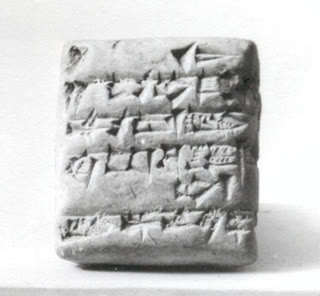
The first writing was not poetry, prayer, or proclamation. It was receipts. In Sumer around 3300 BCE, temple accountants pressed wedges into clay to record grain, beer, and livestock — cuneiform, the oldest substantial writing system. Egypt's hieroglyphs followed, China's oracle-bone inscriptions (Shang dynasty, ~1250 BCE) emerged on the other side of the world, and Mesoamerica invented writing a fourth time entirely on its own — the Maya glyphs.
Writing was invented independently at least three or four times — and every time, the trigger was the same pressure that later produced Zuse's machines: administration outgrew memory.
Three or four inventions, one pattern
| Place | First writing | When | First content |
|---|---|---|---|
| Sumer | cuneiform | ~3300 BCE | receipts, rations |
| Egypt | hieroglyphs | ~3200 BCE | labels, accounts, ritual |
| China | oracle bones | ~1250 BCE | divination records |
| Mesoamerica | glyphs | ~600 BCE | dynastic dates |
Civilizations keep inventing writing for the same reason they keep inventing computers: the bookkeeping outruns the brain.
The alphabet trick — history's best hack
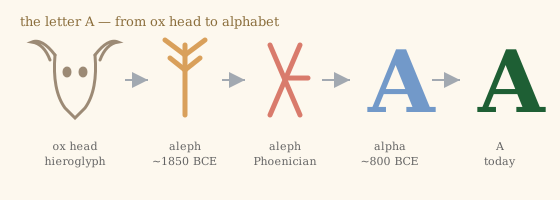
Early scripts were huge: hundreds or thousands of signs, one per word or syllable — a priestly technology requiring years of training. Then, around 1850 BCE, workers — probably Semitic laborers in the Egyptian turquoise mines of Serabit el-Khadim — pulled off the greatest hack in the history of writing: they borrowed a few hieroglyphs but kept only the first sound of each word's name. The ox-head glyph ('āleph) stopped meaning "ox" and started meaning "the sound that starts 'āleph." A few dozen signs could now write anything — no school, no scribe, no permission.
Phoenician merchants spread it across the Mediterranean; the Greeks added the masterstroke — vowels — around 800 BCE, producing the ancestor of nearly every alphabet alive: Latin to the west, Cyrillic to the north, and through Aramaic's other branch, the scripts of Hebrew, Arabic, and the entire Indic family. Your A is a four-thousand-year-old ox.
Panini — the first formal grammar
In Gandhara, around 500 BCE, a grammarian named Pāṇini produced the Aṣṭādhyāyī — roughly 4,000 compact rules that generate, mechanically, the whole of Sanskrit. It is not a grammar in the schoolbook sense; it is a formal system — ordered rules, metarules, exceptions to exceptions — so rigorous that modern linguists compare it to a generative grammar, and programmers recognize something else in it entirely.
The classical world followed: Dionysius Thrax's Greek grammar, Varro and Priscian for Latin — and grammar itself became a technology, exported with every empire and monastery school.
The families — reconstructing the unrecorded
In 1786 William Jones told the Asiatic Society that Sanskrit, Greek, and Latin shared a kinship "stronger than could possibly have been produced by accident" — and linguistics became a science. The comparative method that followed (Grimm's law, 1822, and the Neogrammarians) could do something startling: reconstruct a language that was never written down, Proto-Indo-European, the ~5,500-year-old grandmother of Hindi and English alike, from regular sound-correspondences in her daughters. We have no PIE inscriptions — and linguists can still tell you its word for wolf.
Print, dictionaries, and the standard tongue
Gutenberg's press (~1450) froze language into a mass medium: spelling froze with it, dialects began their long retreat before standard forms, and the dictionary was invented (Johnson's, 1755) to legislate the result. Mass literacy turned a priestly skill into a citizen's right — the same democratization arc, four hundred years earlier, that BASIC would run for code in 1964.
The nineteenth and twentieth centuries made linguistics a science of the mind: Saussure split the sign into signifier and signified (1916); Chomsky argued (1957) that grammar is generated by an innate human faculty — that every child arrives already knowing the shape of language. Then Zamenhof's Esperanto (1887) and hundreds of fellow constructed languages tried to engineer what evolution had done — the first deliberately designed tongues.
Language meets machine
In 1956–59 Chomsky defined the hierarchy of formal grammars — classifying rule-systems by power, from simple regular patterns to full recursive grammars. Computer scientists looked up and realized the hierarchy described their problem exactly: a programming language is a formal language, and a parser is a grammar with a job. Backus–Naur form (1959, for ALGOL) gave syntax a notation; every compiler since lives inside the Chomsky hierarchy, usually at "context-free," one rung above regular expressions.
Natural language and machine language had met on the same ground — the grammar formalism. Every LET and IF you write sits on a branch of Pāṇini's tree.
The living map — and the endangered half
Today there are roughly 7,000 living languages — but the distribution is brutal: the top twenty are spoken by half of humanity, while the bottom half of the list is endangered; a language is lost on the order of every two weeks, and Papua New Guinea alone holds ~840. Against the trend stand the revival stories: Hebrew, resurrected from liturgy into a living mother tongue — the only language ever brought fully back — and Welsh, Hawaiian, Cornish, and Cherokee walking behind it.
See also
- History of Programming — the machine-language sequel
- History of Mathematics · History of Science · History of Electricity — the sibling histories
- Lambda calculus · Alonzo Church — where formal language met computability
- ALGOL · Plankalkül · BASIC · AdaLogic BASIC — designed languages, all
- Punched card — the older writing machines read
References
- Deutscher, Guy. The Unfolding of Language: An Evolutionary Tour of Mankind's Greatest Invention (Metropolitan, 2005).
- Pinker, Steven. The Language Instinct (William Morrow, 1994).