
History of Electricity
The history of electricity runs from a rubbed lump of amber to the largest machine ever built — the planetary power grid — and then to something stranger: electricity taught to compute. It is one of history's tidier arcs: phenomenon, instrument, theory, industry, and finally intelligence, each stage impossible until the one before it existed.
The amber spark
For two thousand years, the amber effect was a parlor curiosity. Then William Gilbert — physician to Elizabeth I — published De Magnete (1600), the first true experimental science book in English, distinguishing magnetism from the attraction of rubbed objects he called electrics. The word stuck to the phenomenon.
The eighteenth century made it a spectacle: von Guericke's sulfur-globe generator, Gray conducting charge through hemp threads and a suspended boy, and finally the Leyden jar (1745) — the first way to store charge — which could knock a man off his feet and did, routinely, in salons across Europe.
Benjamin Franklin did what Franklin did: he made it rigorous. His experiments established the single-fluid theory and gave the world the + and − conventions still on your batteries. The 1752 kite experiment — proving lightning is electricity — made him the most famous scientist alive; it also killed the next man to try it, Georg Richmann of St. Petersburg, struck dead in 1753. Franklin's practical return: the lightning rod, arguably the first time a science directly and measurably saved lives and buildings.
The frog and the pile
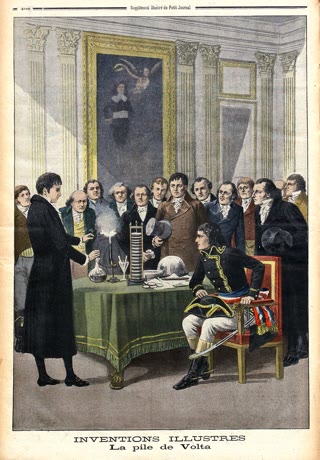
In the 1780s Luigi Galvani noticed dead frog legs twitching when touched by dissimilar metals and announced "animal electricity" — life, literally sparking. Alessandro Volta disagreed: the electricity wasn't in the frog; it was in the metals, with the moist tissue as conductor. The argument produced the century's greatest consolation prize: trying to prove Galvani wrong, Volta stacked alternating zinc and copper discs separated by brine-soaked cloth and, in 1800, announced the voltaic pile — the first battery, the first source of continuous electric current, and the device that opened the laboratory era of electricity. He demonstrated it to Napoleon in 1801; the unit we all use is his name.
Electricity and magnetism become one thing
For centuries the two forces were filed separately — amber attraction here, lodestone attraction there. Ørsted fused them by accident in 1820: a current-carrying wire twitched a compass needle. Within weeks Ampère had turned it into mathematics; within a decade Faraday had turned it into machines.
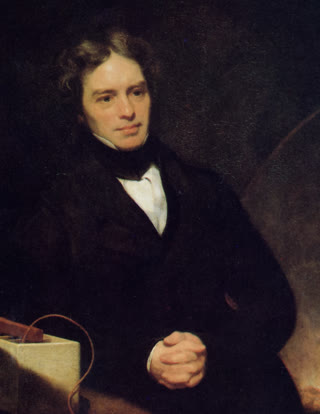
Michael Faraday is the patron saint of this history: no university, no mathematics beyond arithmetic, the son of a blacksmith — and the greatest experimentalist who ever lived. In 1821 he made the first electric motor (a wire spinning around a magnet); in 1831, electromagnetic induction — motion making current — the generator, and with it every power station since. He invented the very idea of a field: force as something existing in the space itself, invisible but real.
In 1865 Maxwell closed the loop mathematically: his equations showed electricity, magnetism, and light are one phenomenon — electromagnetic waves traveling at a calculable speed that turned out to be light's own. Optics had been electricity all along.
The Victorian internet
The telegraph was electricity's first consumer product: Wheatstone and Cooke (1837) wired British railways; Morse (1844) sent "What hath God wrought" from Washington to Baltimore and — equally important — invented the code that made his system the standard. By 1866 a working transatlantic cable put London and New York a few minutes apart. Stock prices, news, wars, and love letters began moving at light speed. The nineteenth century built the internet twice.
Power and light
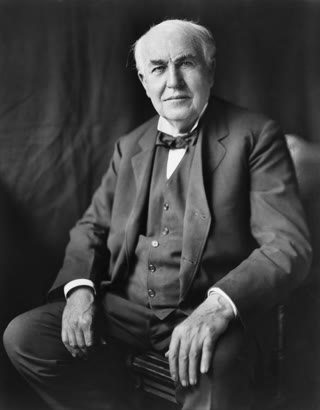
Arc lamps lit lighthouses from the 1860s; the streetlight version was blinding, buzzy, and perfect for public squares. The real prize was a lamp for the home: Joseph Swan demonstrated a working incandescent bulb in England — and Thomas Edison, developing independently, produced a practical bulb and the entire system around it in 1879: the lamp, the socket, the meter, the dynamo, the parallel wiring. Edison's real invention was the electric utility. Pearl Street Station (1882), the world's first central power plant, lit a square mile of Manhattan — and Edison's DC architecture was already obsolete.
The war of the currents
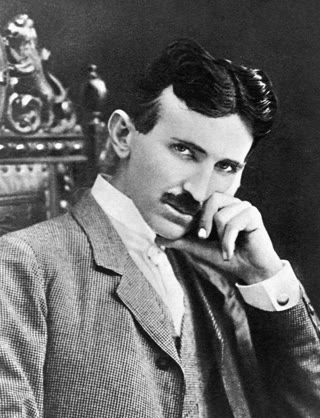
DC's flaw was physics: it couldn't travel — voltage dropped within a mile. Nikola Tesla's alternating-current polyphase system, sold to Westinghouse, could transform to high voltage, cross a continent, and transform back down. Edison defended DC brutally — pamphlets, electrocuted animals, the association of AC with the electric chair. AC won anyway, decisively, at Niagara Falls in 1896, when Tesla's system lit Buffalo from the cataract's power.
The electron and the vacuum
Electricity's last classical gift was discovering its own particle: J.J. Thomson found the electron in 1897 — cathode rays were matter, subatomic, universal. Then Fleming's valve (1904) and de Forest's triode (1906) turned the evacuated tube into something unprecedented: a device that could switch and amplify an electric signal. Radio followed, then telephony across oceans, then television — and somewhere in that lineage, quietly, the switch that would become the computer.
Solid state — the transistor century
Vacuum tubes were hot, fragile, and power-hungry — the relays' only heir, until 1947, when Bardeen, Brattain, and Shockley at Bell Labs built the transistor: a switch of pure crystal, no vacuum, no heat, no filament. Kilby and Noyce put whole circuits on one chip (1958–59); Federico Faggin's team at Intel put a whole computer on one (the 4004, 1971). From there it's Moore's law all the way down to the device you are reading this on — billions of switches, each one Faraday's descendant.
The priority table — who "invented" it, honestly
| Invention | Credited | The fuller story |
|---|---|---|
| Incandescent bulb | Edison | Swan the same year, a dozen experimenters earlier — Edison's real invention was the utility |
| Radio | Marconi | Tesla's patents, Lodge's demonstrations, Popov's receiver |
| Telephone | Bell | Gray filed the same day; Meucci showed a working phone years earlier |
| AC induction motor | Tesla | Ferraris invented it independently the same year |
| Telegraph | Morse | Wheatstone–Cooke was first; Morse won with the code |
| Transistor | Shockley | Bardeen & Brattain built the point-contact first; Shockley wrote himself into the center |
The grid — the largest machine
Electrification redrew civilization's outline: Niagara's power, national grids, rural electrification, elevators and steel frames making cities vertical, refrigeration remaking food, the telephone and the tube remaking time itself. Today the grid is arguably humanity's single largest artifact — a machine spanning continents, kept in balance second by second — and it is the reason the rest of this wiki exists.
See also
- History of Science · History of Mathematics — the twin timelines
- Z3 · Konrad Zuse — the relay machine
- Manchester Baby · EDSAC — the electronic machines
- History of Programming · AdaLogic BASIC
- Punched card · Jacquard Loom — the pre-electric technologies of control
- History of Language