
Grace Hopper
Grace Brewster Murray Hopper (9 December 1906 – 1 January 1992) was a mathematician, a Navy rear admiral, and the person who proved a computer could write its own program. She built the first compiler, popularized the word "debugging," championed COBOL into existence as a standard, and spent forty years telling anyone who would listen that computers belonged to people, not priesthoods. The fleet named a destroyer for her.
Before the Navy
Grace Murray earned her doctorate in mathematics from Yale in 1934 — one of the few women then holding a math PhD — and taught at Vassar, her alma mater. When the United States entered the Second World War she tried to enlist and was rejected on every technicality available: too old at 37, fifteen pounds under the Navy's minimum weight, and — officially — too valuable as a mathematics professor to release. She obtained waivers for all of it and joined the WAVES in December 1943, graduating first in her class at Smith College.
Harvard and the Mark I
Her first assignment was luck disguised as an order: the Bureau of Ordnance Computation Project at Harvard, under Commander Howard Aiken, running the Mark I — IBM's Automatic Sequence Controlled Calculator, a fifty-one-foot relay machine of switches, gears, and five hundred miles of wire, driven by punched paper tape.
Hopper became one of its first three programmers and wrote its operating manual. The Mark I's programmers coded long arithmetic sequences in a notation somewhere between mathematics and machine code — problems like the rocket-trajectory and implosion-modeling calculations the Navy needed. It was punishing, glorious work; Aiken was famously hard to please, and Hopper famously unafraid of him. She stayed at Harvard's Computation Laboratory after the war as a research fellow — until private industry offered something Harvard couldn't: a machine you could buy.
The moth — told honestly
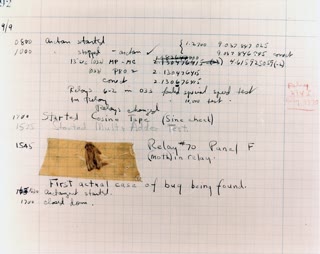
In September 1947, operators of Harvard's Mark II traced a malfunction to a moth trapped in relay #70 and taped the insect into the logbook: "First actual case of bug being found." Hopper didn't find the moth, didn't log it — but she told the story for the rest of her life, and through her the engineering term bug (which Edison had used in the 1870s) became debugging: the word programming still uses. The logbook page sits in the Smithsonian, moth and all.
The compiler nobody believed
In 1949 Hopper joined the Eckert–Mauchly Computer Corporation — soon part of Remington Rand — home of UNIVAC, the first commercial American computer. There, in 1952, she did the thing people said couldn't be done.
Programmers then wrote raw machine code: numeric opcodes, absolute addresses, and hours of copying errors. Hopper's insight was that the machine could do the tedious part. Her A-0 system read a program written as symbolic calls — "get subroutine number 217 from the tape library, put it here, wire it up thus" — and produced runnable machine code. A program writing a program. She called it a compiler.
The reaction was disbelief and worse: colleagues argued a computer couldn't write programs, that code had to be hand-crafted, that her approach would produce inefficient machine instructions. She later said, plainly: "Nobody believed that. I had a running compiler and nobody would touch it. They told me computers could only do arithmetic." A-0 became A-2, then MATH-MATIC and FLOW-MATIC — the first English-like business language, and the direct ancestor of COBOL. Every compiler, interpreter, and transpiler since — including the one that builds AdaLogic BASIC — stands on her A-0.
COBOL and the standards war
COBOL itself was designed by the CODASYL committee in 1959–60 (its own page tells that story), but Hopper's fingerprints are everywhere: FLOW-MATIC proved English-like syntax could work, she advised the committee, and then she did the unglamorous part that made COBOL real — enforcement. The Navy ran validation tests for COBOL compilers, refusing to certify non-conforming ones, which is a large part of why "COBOL" meant the same language on every vendor's machine. Languages die by dialect; Hopper strangled the dialects.
She collected an actual tombstone engraved "COBOL" — a gift joking about the language's predicted demise — and kept it in her office, pointing at it every time someone declared COBOL dead. It outlived every eulogist.
Amazing Grace
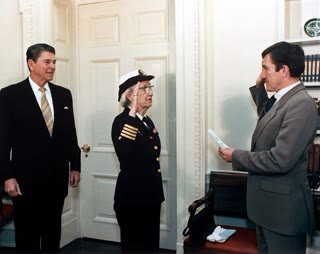
Hopper's second career was teaching the future to people who didn't believe in it yet. Her props were famous:
- She handed out "nanoseconds" — foot-long wires, the distance light travels in a billionth of a second — to executives who asked why satellite communication took so long. (For a "picosecond," she offered a packet of pepper: the space between the flakes.)
- Her office clock ran backwards. Asked why, she'd say it was a reminder that arbitrary conventions can be changed.
- Her standing orders to young officers: "It's easier to ask forgiveness than it is to get permission" — and "the most dangerous phrase in the language is 'we've always done it this way.'"
She retired from the Navy in 1966 — and was recalled within the year, "temporarily," for what became nineteen more years of service. When she finally retired in 1986, aboard the USS Constitution — the Navy's oldest commissioned ship — she was, at seventy-nine, its oldest active-duty commissioned officer.
Her private life was quiet: a marriage ended in 1945, she kept her husband's name, never remarried, had no children, and gave the Navy and its sailors the devotion a family might have gotten. The lecture circuit made her, in her seventies, an improbable celebrity — the admiral in dress whites explaining computers to rooms full of people who feared them.
Legacy
- **USS Hopper (DDG-70)** — the guided-missile destroyer commissioned in 1997, the second Navy ship named for a woman
- Presidential Medal of Freedom, awarded posthumously in 2016
- The Grace Hopper Celebration — the world's largest gathering of women in computing, running since 1994
- Hopper College, Yale — renamed for her in 2017
- And the word debugging, used by every programmer who ever lived, whether they know her name or not
Her real epitaph is the compiler: the idea that humans write intent and machines write instructions. Everything in the language era — FORTRAN, COBOL, ALB — descends from it.
See also
- COBOL · History of Programming
- The first programmers — her ENIAC contemporary, Betty Holberton, co-edited COBOL's spec
- Alan Turing · Bletchley Park
- Compilers — she invented the concept
- IBM · Punched card