
Getac B300-X
This is the story of my Getac B300-X — a fully rugged laptop that spent its first career with the Chattanooga sheriff's department, its second as my first real computer after the fire, and its third as the machine the entire AdaLogic BASIC language was written on. It has 29,314 documented powered-on hours. Somewhere north of seventeen thousand of those are mine.
It is the most important object I own, and this is its biography.
Getac — the rugged specialists
Getac is a Taiwanese manufacturer that has spent decades in a strange niche of the laptop market: machines built not for desks but for disasters. The B300 line is their flagship class of "fully rugged" notebook — magnesium-alloy chassis, sealed port doors, MIL-STD-810G environmental ratings, IP65 dust-and-water sealing, and a display engineered to stay readable in direct sunlight. These are the laptops you find bolted into police cruisers, field-service trucks, ambulances, and military vehicles — the machines that get rained on, dropped on asphalt, and left running in a hot car for a shift.[1]
Getac itself grew out of a 1989 joint venture between Taiwan's MiTAC and GE Aerospace — a defense-electronics supplier that moved into rugged portables as that market formed. Its permanent rival has always been Panasonic's Toughbook line, and the two have spent decades one-upping each other on drop ratings, sealing, and screen brightness. Where Toughbook sells brand recognition, Getac sells spec sheets: brighter screens, more sealing, lower prices for agencies buying in volume.[2]
This particular unit carries an extra line in its pedigree: it was supplied to the sheriff's department through NCS Technologies, a government-focused systems integrator — the kind of company that takes a rugged machine, images it for an agency, and puts it to work. When its service ended, it went where a lot of government iron goes: online surplus auction.
I didn't know any of that history when I bid on it. I knew it looked like a laptop that could survive me — and at that point in my life, surviving things was the only feature that mattered.
The B300 line
Getac launched the original B300 in early 2008 as a compact, fully rugged answer to the Panasonic Toughbook CF-30 and the GD-Itronix XR-1 — magnesium-alloy case, shock-mounted drive, sealed port doors, and a display rated at up to 1,200 nits in an era when a bright laptop managed 300. It found exactly the audience it was built for, and Getac kept iterating: seven generations of B300 shipped between 2008 and 2018, tracking Intel's mobile roadmap from Core 2 Duo through eighth-generation Core while the chassis stayed recognizably itself.[3]
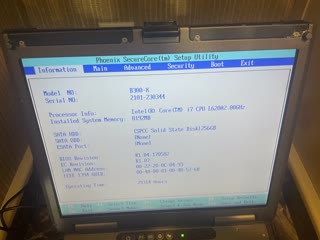
By serial and silicon, mine is a second-generation machine — the ~2010 update that moved the line to Intel's first-generation Core i7. The chip on the BIOS tab reads i7-L620: that's the Core i7-620LM, a 2.0 GHz low-voltage dual-core from Intel's Arrandale family — the 32 nm mobile silicon that merged CPU, memory controller and GPU on one package — turbos to 2.8 GHz at a 25 W TDP. Twenty-five watts doesn't sound like much until you remember this machine sinks it through copper heat pipes with no external exhaust at all — the chassis itself is the heatsink, which is why a working B300 is a warm B300. (Hold that thought for the winter chapter.) It's a serious processor for its era, wrapped in 8.5 pounds of armor and rated to operate from −4 °F to 140 °F. When RuggedPCReview benchmarked this generation they measured roughly a 30% overall gain over the 2008 original — the rugged notebook keeping pace instead of standing still.[4]
The -X suffix on my unit's badge is NCS Technologies' configuration — the integrator's own designation for the B300s it built out for government deployment. Same chassis, same screen, same armor; different label on the contract.
The auction — $183 for a second life
I was sixteen, and I had nothing. The house fire of 2014 had taken everything — the machines, the code on them, my first compiler project, all of it (that story is on the AdaLogic BASIC page).
For $183 you did not get a complete laptop. It was missing the hard-drive caddy and the battery — a cruiser machine, probably, that had lived most of its life docked and powered off the vehicle. What you got was a magnesium-alloy chassis in genuinely good shape (minor scuffs, the honest wear of a working machine), that extraordinary screen, a sealed rubber keyboard, and a provenance most laptops never get: a documented past life spent in service.
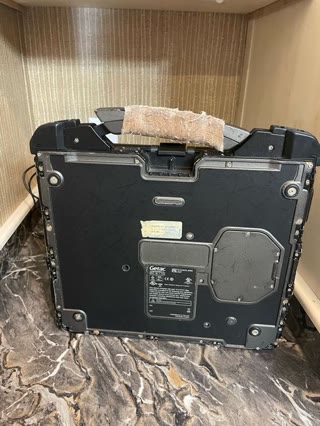
I bought it anyway. You don't need a hard-drive caddy when you have a plan.
The Cruzer years
The plan was a 32 GB SanDisk Cruzer — a $10 USB stick from Walmart — with Slackware installed on it. For roughly three years, that was the entire storage system: the whole operating system, my files, my tools, my compilers, everything, living on a thumb drive plugged into a rugged ex-police laptop.
And it was enough. I still think about that sometimes — an entire computing life on ten dollars of flash memory. Slackware first, running whatever fit in 32 GB — I put Slackware 12.2 on it early and stayed in the family through 14.2 — and the machine just worked. Eventually I sourced a hard-drive caddy and a battery, then a second battery in place of the optical drive, and the B300 went from tethered oddity to a machine that could genuinely go anywhere. But those Cruzer years taught me something no tutorial could: you do not need much machine to do serious work. You need a machine that won't die and a toolchain you understand.
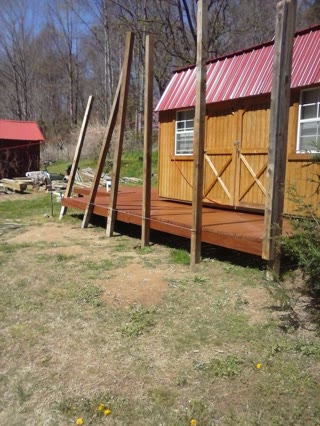
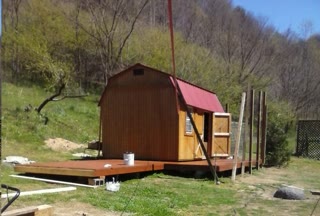
It did more than compute, though. The winters after the fire were cold in a way I'd never felt before — we were living in a 12×16 shed — me, my mom, and my dad, all three of us in that one small building for almost three years. The power would go out all the time, and I'd sit there freezing.
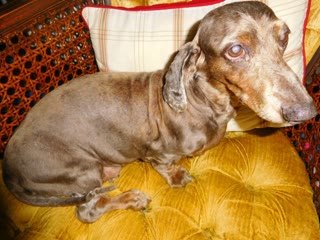
And I wasn't alone in that cold. I had Smudge — my dachshund, who I'd had since I was about four years old, who stayed with me through most of my life. He was there through the fire's aftermath, there in the camper, there while the Cruzer spun up and the B300 burned warm against my side. A boy, his dog, and a laptop that wouldn't die. That's what the rebuild actually looked like.
The hardware tour
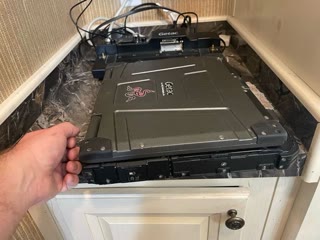
The screen is the machine's first argument for existing. Gorilla Glass, sunlight-readable, genuinely usable outdoors in full daylight — the feature that turned my programming sessions into fieldwork. It also has an NVG-compatible mode: press the right function and the backlight drops to a level designed to be viewed through night-vision goggles rather than blinding them. I have — I've tested the mode through actual night-vision goggles, and it works as advertised. And a screen that can go dark enough for NVGs is a screen that can go dark enough for 3 AM in a dark room — which is to say, perfect.[5]
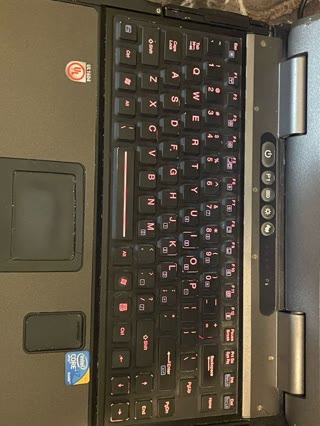
The keyboard is the second argument. It's a sealed rubber membrane unit, red-backlit — and it is, honestly, the greatest keyboard I have ever programmed on. There's a split worn into the rubber now, where the coating peeled back far enough to let the red glow bleed through. It didn't ship that way. That split is my years on it, written into the machine itself.
The ports tell you the era and the intent: under sealed rubber doors live USB, audio, and SD on the sides; VGA, serial, USB and power on the rear; a FireWire/IEEE 1394 GUID on the BIOS tab; and on the bottom, the gold-plated dock connector the machine spent its cruiser years married to. Serial ports don't ship on laptops anymore — but for anyone who talks to embedded hardware, a real DB-9 with a door over it is a gift that keeps giving.
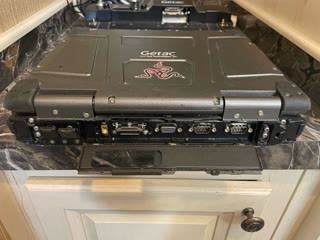
The radios are the part nobody photographs: behind the sealed doors and the magnesium, the B300 carries a retractable 3G mobile antenna — a telescoping aerial built into the chassis for the GPS/3G cellular modem, so a cruiser could phone home from the field. It's the kind of hardware that justifies the whole platform: a laptop with its own pull-out antenna mast. I actually got 3G working on it once — but 3G was already dated by the time I was using the machine, so it went back to being what it mostly is now: a fascinating piece of the machine's first career, retracted but still there.[6]
The powertrain is rugged the way trucks are rugged: a Delta-branded brick, a barrel connector that locks, a hard power switch, and — my favorite detail — a programmable P1 button whose BIOS options include blackout: a hardware key that can kill the screen instantly, presumably for officers who need light discipline. There's a TPM, virtualization (VT-x/VT-d), DVMT graphics-memory tuning, and Intel AMT — disabled, on mine, the way it should be.
Outside
A rugged laptop is a promise: take me anywhere, I'll keep up. The B300 kept it. I sat in the grass and programmed. I took it to lakes, creeks, and rivers and wrote code with the screen fully readable in daylight. I've browsed and programmed on it in the snow and in the forest — places no ordinary laptop survives, let alone invites.
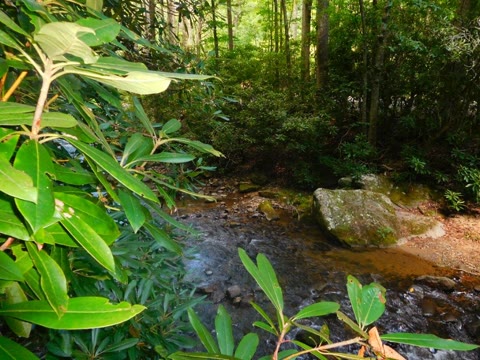
That screen in daylight, the sealed keyboard against damp grass, the chassis that doesn't care about a bump against a rock — this is what the B300 was built for, and it turns out it's also what a sixteen-year-old teaching himself to build languages needed. The machine didn't just survive my education; its design encouraged it. Why would you write code indoors when your computer goes outside?
That creek is up Roan Mountain — the high ridge on the Tennessee–North Carolina line, famous for its rhododendron and its six-thousand-foot balds. The streams up there run cold and green exactly like that photograph, and the B300 went with me, because a rugged laptop doesn't get to sit home when you go to the mountains. That's why the picture belongs in this timeline: the outside years aren't a claim, they're a place — and this is one of them.
Docked
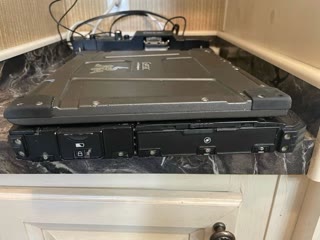
Once I had a real home again, the B300 settled into its second mode: docked, basically permanently, on the caddy — 99% of its life since then, running steady off the Delta brick. Rugged machines make excellent docked machines; they're overbuilt, they cool well under load, and they don't die. And honestly, by then the machine and I had the same arrangement anyway — it stayed where I stayed, running while I worked. The laptop that survived a sheriff's department and three years of thumb-drive college became the quiet workstation where the real work happened.
What was written on it
This is the part of the article that matters most, so I'll say it plainly: the entire AdaLogic BASIC language was written on this machine.
Not prototyped on it — written on it, nearly from scratch: on Slackware, in a mix of native Linux tools and Windows tooling run through Wine. Before ALB existed, the machine carried my earlier work too — programming in GLBasic and PureBasic, in C, in the game engines that came before the language.
And inside that work was the chain that produced everything: gamedeck, my game engine — originally C/C++, ported completely to Ada — with about thirty games written in it, small arcade titles and larger unreleased ones. Gamedeck needed a scripting language for its game logic, and the DSL I wrote for it was AdaLog — the Prolog-style logic engine that gave AdaLogic its name — written, like so much of that era, in the shed. The path runs straight through this laptop's serial number: gamedeck → AdaLog → ALB, all of it compiled on this machine.
Today
The B300 isn't retired — it changed jobs, same as I did. It now runs Rocky Linux 9.3, and it's the dev/test machine for the ecosystem it helped create. I still power it on, I still write code on that keyboard, and every time the backlight bleeds through that split rubber I remember exactly where all of this started.
The operating system deserves its own paragraph. Rocky Linux is the community enterprise distribution founded after Red Hat discontinued CentOS in 2020 — started by CentOS co-founder Gregory Kurtzer and named for Rocky McGaugh, the other co-founder, who had died. Release 9.3 'Blue Onyx' shipped in November 2023, tracking RHEL source-for-source with support promised to 2032.[7]
And yes — a man named Rocky runs a distro named Rocky. I didn't pick it for the name; I picked it because a machine that outlived a fire and a sheriff's department deserved an operating system engineered to be boring for a decade. Enterprise-grade, rebuilt-from-source stable, free forever — the software equivalent of a magnesium-alloy chassis. But the name doesn't hurt.
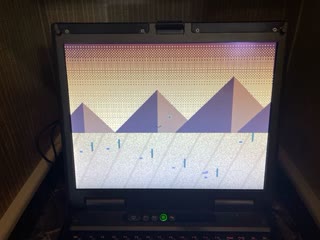
On it, live: TitaniumWM — my SPARK-annotated tiling window manager, running its master-and-stack layout on the sunlight screen; TitaniumRun, the contract-checked launcher; TitaniumBG, drawing its animated procedural wallpapers — the desert scene's buzzard still circles on this display. AdaLog itself runs here, the little Prolog doing its proofs on the machine where it was born. ALB runs through Wine — the language compiled on this laptop still executes on it, now as the finished toolchain rather than the work-in-progress. And gamedeck lives here too, the engine it all started for, still running its thirty games.
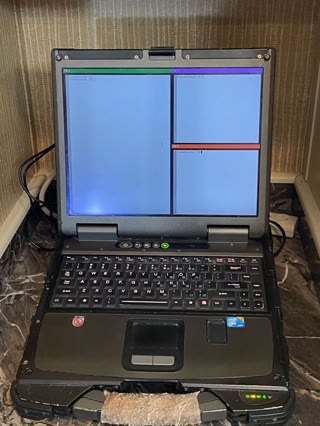
My own utilities round it out — safeScale, a bash tool I wrote that wraps xrandr display scaling and redshift-style cool/warm temperature control in simple syntax (a screen that does night-vision mode deserves a tool that does gentle scaling and gentle color), plus the usual suspects: htop running in a pane, Firefox in a tab, the kernel log scrolling at boot.
The numbers
- $183 — the surplus-auction price, missing caddy and battery included
- 11,986 → 29,314 — operating hours at purchase versus today; seventeen-thousand-plus of the difference is mine
- 32 GB — the SanDisk Cruzer that was its entire disk for three years
- 7 — generations of B300 Getac shipped between 2008 and 2018; mine is the second
- ~30 — games written in gamedeck, the engine AdaLog was built for
- 9 — the BIOS tabs I photographed for this article — Information, Main, Advanced, Security, Boot — a setup utility from an era when firmware still showed you everything
Notes
- This article is first-person testimony: the machine is mine, the photographs are mine, and the history sections (auction, Cruzer years, usage) are my own account.
- My memory says the early Slackware install was "12.3" — Slackware never shipped a 12.3 (the line ran 12.2 → 13.x → 14.x). Recorded as remembered; 14.2 is certain.
- The operating-time figure is the Phoenix SecureCore BIOS's own counter, photographed for this article.
- The i7-L620 on the BIOS tab is Intel's Core i7-620LM — the CPU that identifies this as the second-generation (~2010) B300, not the 2008 original.
- "NVG-compatible" and "blackout" describe manufacturer features; the P1 button's blackout option is documented on the BIOS Advanced tab.
- The full photo set — including the complete BIOS tour, dock connector close-ups, and the boot-log series — is archived; a video walkthrough (IMG_8949) exists alongside the stills.
References
- Author's photographs of the unit — hardware tour, BIOS screens, and live TitaniumWM/TitaniumBG captures (this article's figures).
- Phoenix SecureCore Setup Utility, Information tab — model, serial, and operating-time counter.
- Getac B300 manufacturer specifications — MIL-STD-810G, IP65, sunlight-readable/NVG display.
- RuggedPCReview — B300 launch coverage (2008) and generation reviews; B300 G2 benchmarks vs the original.
- Rocky Linux 9.3 release announcement (rockylinux.org, November 2023); RESF project history.
- AdaLogic BASIC — the language this machine wrote; AdaLog — the DSL that ran for it first.
- NCS Technologies — government integrator of record for the original deployment.
Footnotes
- ↑ Getac's B300 specifications — fully rugged class, MIL-STD-810G, IP65, sunlight-readable display; marketed to law enforcement, field service, and defense.
- ↑ Getac corporate history — the company originated as a 1989 MiTAC/GE Aerospace joint venture; the Toughbook rivalry is the standard industry framing.
- ↑ RuggedPCReview's B300 generation coverage — 2008 launch positioning against the CF-30 and XR-1; seven generations through 2018.
- ↑ The i7-620LM identifies the unit as a B300 G2; the generation review measured ~30% PassMark improvement over the 2008 original.
- ↑ The B300's sunlight-readable/NVG display modes are manufacturer features; the 3 AM utility is the author's.
- ↑ The retractable 3G/GPS antenna is a documented B300 option; the working-3G test is the author's own account.
- ↑ Rocky Linux 9.3 GA announcement, November 2023; the CentOS succession and McGaugh dedication are the project's own account.