
FORTRAN
FORTRAN — originally FORmula TRANslation — is the first high-level programming language to see widespread practical use, and the oldest still in production anywhere. Released by IBM in 1957, designed by John Backus and his team, it taught the world that a program could be written in something resembling mathematics and that a machine could do the translation. Every language since — including AdaLogic BASIC — stands on the foundation FORTRAN poured.
Before it: the operator objection
In the early 1950s, programming meant assembly: one cryptic instruction at a time, matched to a specific machine, error-prone and slow to write. The dominant belief in the field was that this could not be improved — that a machine translating human formulas into machine code would produce something so slow and bloated that no serious programmer would accept it. The objection was not entirely foolish: the first "automatic programming" systems did produce terrible code.
John Backus — an IBM programmer who had hand-built the Speedcoding system for the IBM 701 — decided the objection was wrong. Not wrong in principle, but wrong in engineering: a sufficiently smart translator could generate machine code comparable to hand-written assembly. That was the claim FORTRAN had to prove, and it is why the name matters: FORTRAN was sold not as a new language but as a translation service. The language was the wrapper; the product was a compiler good enough that people would actually use it.
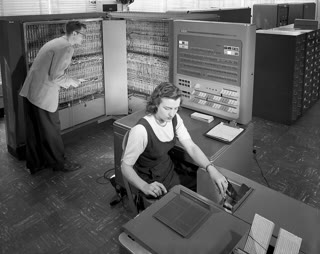
The machine it ran on
FORTRAN was designed around the IBM 704 — the first mass-produced computer with hardware floating-point arithmetic, delivered from 1955. Its 4,096 words of core memory and 36-bit word shaped the language: the DO loop maps onto the 704's index registers, and the three-way arithmetic IF mirrors its compare instruction. NASA's predecessor NACA ran aeronautics calculations on the 704 pictured above — the exact class of work FORTRAN was built to serve.
The language
FORTRAN's first manual (1956) described a language of startling ambition for its era:
C      A SIMPLE FORTRAN PROGRAM
       READ 100, A, B
       SUM = A + B
       PRINT 200, SUM
  100  FORMAT (2F8.2)
  200  FORMAT (F10.2)
       STOP
       END
Readable at a glance — SUM = A + B looked like mathematics because it was mathematics. Variables had names, expressions had operators, DO loops existed for iteration, and GO TO handled control flow. The fixed-column layout — comment in column 1, statement labels in 1–5, continuation in 6, code in 7–72 — was a fossil of the punched card and remained FORTRAN's signature for forty years.
FORTRAN I shipped in 1957 with 18 person-years of development behind it and one iconic promise in its manual: "the FORTRAN translator will produce programs that run nearly as fast as those written by hand." It mostly kept the promise — the compiler's optimization was genuinely clever — and the "objection" collapsed almost immediately.
The versions that made it permanent
- FORTRAN I (1957) — the first release; DO loops, arithmetic IF, FORMAT statements.
- FORTRAN II (1958) — added
SUBROUTINEandFUNCTION— modular programming, the idea that you could write a routine once and call it, is encoded here. - FORTRAN IV (1962) — machine-independent; the version that made FORTRAN the lingua franca of scientific computing.
- FORTRAN 77 — structured
IF/ELSE/ENDIF,CHARACTERtype — the standard that ran the world for a decade and a half. - Fortran 90 (lost the all-caps) — free-form source at last, modules, dynamic arrays, array operations.
- Modern Fortran (2003/2008/2018/2023) — object-oriented features, coarrays for parallelism, C interop — a living language, not a museum piece.
What it is used for — still
FORTRAN never went away. It remains the language of the heaviest numerical computing on Earth:
- Numerical weather prediction — the world's forecasting models are mostly Fortran
- Physics — climate models, nuclear simulation, quantum chemistry, particle physics
- Engineering — structural analysis, CFD, finite-element methods
- BLAS and LAPACK — the linear-algebra libraries underneath virtually all numerical software, including most of machine learning's foundations (NumPy calls Fortran routines), are Fortran
The reason is not sentimentality: Fortran's array semantics, decades of compiler optimization, and strict numerical determinism make it the fastest language ever built for math — and seventy years of accumulated scientific code is not a codebase anyone rewrites.
The compilers that taught compilers
FORTRAN did more than introduce a language: it invented compiler optimization as a discipline. The Backus team's optimizer — register allocation, common subexpression elimination, strength reduction — was so sophisticated that it was decades before other compilers caught up. And Frances Allen, who joined the team in 1957, built the theoretical framework for program analysis that all modern optimizing compilers rest on — work that won her the Turing Award in 2006, the first woman to receive it.
The modern implementations carry that inheritance forward: gfortran, the Fortran front end inside GCC, implements Fortran 77 through Fortran 2023 on every platform GCC touches — it is the reason Fortran never died — and flang, the LLVM-native front end that entered the LLVM tree in 2020, runs Fortran through the same optimizer that powers Rust and Swift.
Legacy
- It killed the "automatic programming will never work" objection permanently — after FORTRAN, the question was not whether to use a language but which one. See the age of languages it opened.
- It made software portable in principle for the first time — a FORTRAN program could, with care, run on machines from different vendors, an idea that had not existed before.
- It named things we still use: the term "compiler" stabilized around FORTRAN, and its conventions (variables, loops, libraries, comments) are the generic vocabulary of all programming.
- Sixty-nine years old and shipping in production, on every continent, every day — no other language can claim that.
See also
- IBM
- LISP — the other founding language, built for a different question
- ALGOL — the structured-language answer
- History of Programming
- Compilers — the toolchains FORTRAN taught to optimize
- Ada Lovelace
- Punched card
- AdaLogic BASIC
- Forth — the stack machine that went the other way: postfix, untyped, infinitely extensible
- Scientific notation — FORTRAN’s E and D exponents made it typeable
References
- Backus, John, et al. "The FORTRAN Automatic Coding System." Proceedings of the Western Joint Computer Conference (1957).
- IBM. Programmer's Reference Manual: The FORTRAN Automatic Coding System for the IBM 704 EDPM (1956).
- Sammet, Jean E. Programming Languages: History and Fundamentals (Prentice-Hall, 1969).