
Donna Strickland
Donna Theo Strickland (born 27 May 1959) is a Canadian physicist who won the 2018 Nobel Prize in Physics for a technique she invented as a graduate student: chirped pulse amplification, the trick that lets lasers reach ferocious intensity without blowing themselves apart. She was the third woman ever to win the physics prize — after Marie Curie in 1903 and Maria Goeppert Mayer in 1963 — and the first in fifty-five years. Months before the Nobel announcement, a volunteer-written draft about her was declined on Wikipedia for insufficient notability, making her the unexpected face of a debate about who encyclopedias remember. This one remembered her.
From Guelph to the lasers
Strickland was born in Guelph, Ontario, and grew up interested in how things worked. She studied engineering physics at McMaster University, graduating in 1981 — one of few women in her program — and found the subject she would spend a life on: lasers. For graduate school she went to the Institute of Optics at the University of Rochester in New York, the oldest optics program in the United States, where she joined the group of a young French laser scientist named Gérard Mourou at the Laboratory for Laser Energetics.
The lab's problem was a beautiful paradox: ultrashort laser pulses were the future — pulses lasting femtoseconds, quadrillionths of a second, could probe matter at its fastest timescales — but amplifying one was self-defeating. Cram that much energy into that little time and the peak intensity destroys the very optics meant to amplify it. The glass melts, the mirrors burn, the beam dies. Short pulses couldn't get stronger the ordinary way.
Chirped pulse amplification
The solution Strickland and Mourou published in 1985 borrows a move from radar. A chirped pulse has its frequencies spread through time like a bird's sliding whistle — and a pulse stretched thin carries its energy gently. CPA works in three stages:
  short pulse
      |
      v
 [ STRETCHER ]  spreads the pulse in time — peak power drops thousands of times
      |
      v
 [ AMPLIFIER ]  now harmless to the optics — pump it full of energy
      |
      v
 [ COMPRESSOR ] squeezes it back to femtoseconds — peak intensity explodes
      |
      v
  a pulse far more powerful than the glass could ever have held directly
Stretch, amplify, compress. The amplified pulse never exists in dangerous form until it's past the gain medium and into matched compression optics — typically diffraction gratings — that squeeze it back into a pulse of staggering peak power. Radar engineers had used the same stretch-and-compress idea for decades; Strickland and Mourou carried it into optics.
Their paper, "Compression of amplified chirped optical pulses," appeared in Optics Communications in December 1985 and became one of the most-cited papers in laser science — it was the heart of Strickland's doctoral dissertation, and she completed her PhD in 1989. The technique did not stay in the lab. CPA is the enabling technology behind petawatt lasers, laser wakefield particle acceleration, attosecond pulse generation, precision micromachining, and the femtosecond lasers used in LASIK eye surgery — every procedure that reshapes a cornea with light rides on the 1985 idea.
From Rochester to Waterloo
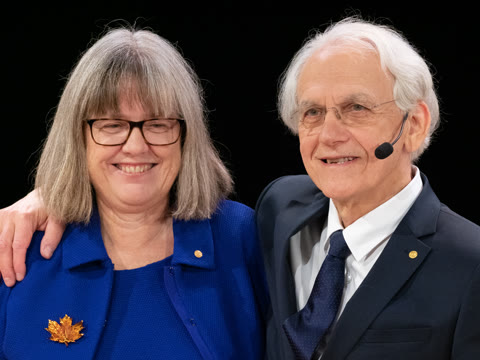
After Rochester, Strickland worked where the ultrafast frontier was: as a researcher at Princeton, then at the Lawrence Livermore National Laboratory, and at Canada's National Research Council in Ottawa in Paul Corkum's ultrafast phenomena group. In 1997 she joined the physics faculty of the University of Waterloo, back home in Ontario, where she built and ran the Ultrafast Laser Group.
She served as president of the Optical Society of America — now Optica — in 2013. What she did not do was chase rank: when the Nobel call came she was still, famously, an associate professor, having never filed the paperwork for promotion. Asked about it afterward, she shrugged that titles were never the point. The lasers were the point.
The Nobel Prize
On 2 October 2018 the Royal Swedish Academy of Sciences awarded half the physics prize to Arthur Ashkin for optical tweezers — light used as fingers to grip cells and viruses — and the other half jointly to Mourou and Strickland for chirped pulse amplification. The shared half was an unusually specific honor: a prize, in effect, for one paper, and the paper was her dissertation work.
Strickland learned she'd won in the middle of the night. She became the third woman in the prize's 117-year history, ending a gap so long that reporters had to explain who the second one was — Maria Goeppert Mayer, honored in 1963 for the nuclear shell model. Strickland received the medal in Stockholm that December, was appointed an Officer of the Order of Canada the following year, and returned to Waterloo, where she kept doing what associate professors do: running a lab, training students, and making light do harder things.
The article that wasn't
Here is the part of her story that belongs on a wiki like this one.
In early 2018, a volunteer tried to create a Wikipedia article about Donna Strickland. The draft was declined: a reviewer judged there weren't enough independent sources establishing her notability. It was a routine call — academic scientists rarely make headlines, and standards require coverage about a subject, not just papers by them. By the letter of the rules, it wasn't absurd. By the autumn, it looked like the year's worst editorial decision.
When the Nobel was announced that October, the world's press went to profile the third woman ever to win physics and found the encyclopedia had nothing. Within hours an article existed; within days the story itself was news — The Guardian and others covered it as a flashpoint in the long-running debate over Wikipedia's gender gap, where roughly one biography in six is of a woman. The episode cut two ways at once: evidence that encyclopedic rules can systematically undervalue scientists who don't court publicity, and a reminder that "notability" is a mirror that reflects whatever the world bothers to write down. Strickland had spent three decades publishing; the world just hadn't been taking notes.
Her own response was characteristically unbothered — she pointed out she'd simply never been famous, and that the Nobel changed that faster than any article could. But the lesson stuck, and it's one worth writing down on a page about her in a wiki anyone can edit: write the article anyway. The obscure scientist, the forgotten programmer, the engineer nobody profiled — notability is earned in the lab, but it is only recorded by people who bother to record it.
Still in the lab
Strickland continues to lead her group at Waterloo and to advocate for physics education. She is careful with the "woman physicist" framing — she has said she never felt her gender was the story of her career, and has gently resisted being made a symbol — but the numbers she changed are stubborn facts: third woman physics laureate, first in fifty-five years, and a living rebuke to the idea that only full professors, loud self-promoters, or encyclopedia-approved subjects make history.
She won the Nobel Prize for work she did as a student. The lesson for students is better than the prize itself: the thing you're building right now might be the thing.
See also
References
- Strickland, Donna, and Gérard Mourou. "Compression of Amplified Chirped Optical Pulses." Optics Communications 56(3), 1985 — the CPA paper.
- Nobel Prize. "The Nobel Prize in Physics 2018 — Donna Strickland," nobelprize.org.
- National Academies / University of Waterloo — Strickland biography and CPA history.