
Corel Linux
Corel Linux — officially Corel LINUX OS — was the strangest bid of the boxed-set era: a desktop operating system built not by a Linux company, but by the maker of WordPerfect and CorelDRAW, one of the few software firms on Earth with both real desktop applications and a corporate reason to want Windows to lose.
It lasted less than two years. It is still one of the most instructive failures in desktop history — because the product was genuinely good, and it died anyway.[1]
Why a word-processor company built an OS
Corel's founder Michael Cowpland spent the late 1990s as one of the few CEOs willing to say the quiet part: Microsoft Windows had a monopoly problem, and somebody ought to ship an alternative. Corel had motives no pure-play Linux vendor could match. WordPerfect — the office suite that once outsold Word — needed a platform Microsoft didn't control. CorelDRAW needed a future that wasn't hostage to a competitor's OS roadmap.
So Corel went Linux-first years before it shipped a distro. WordPerfect 8 arrived for Linux in 1998 — a full commercial office suite on a free OS, a genuine event. Corel contracted CodeWeavers to push Wine forward so its applications could run without Microsoft underneath, sending improvements upstream — one of the earliest sustained corporate investments in Wine. It even bought a hardware play, the Netwinder ARM network computer, in 1999. The LinuxOS was simply the keystone of a strategy already underway.[2]
Corel LinuxOS
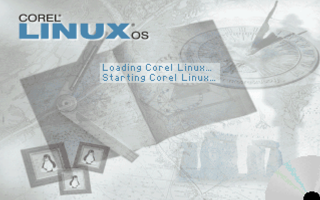
Corel launched LinuxOS at Comdex in November 1999 to an audience primed by the Red Hat IPO three months earlier. ZDNet covered it under the headline "Corel puts a penguin on the desktop" and called it "the first end-user Linux" — the phrase "Linux for the rest of us" attached itself immediately.[3]
Underneath the polish it was honestly built: a Debian base, a customized KDE 1.x desktop, apt package management behind a friendlier Corel Update tool, the Corel File Manager standing in for KFM. It competed explicitly against Windows 98 and 2000 — and also against Mandrake and Red Hat, who were fighting for the same shelf space.
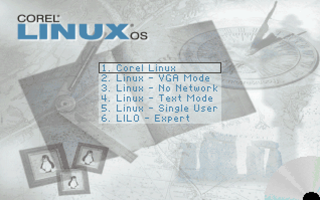
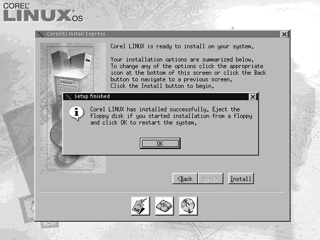
Second Edition arrived August 15, 2000 in three flavors: a free download, a regular box, and a Deluxe edition bundling WordPerfect Office for Linux — the full "alternative stack" vision in one SKU: free OS, commercial office suite, one vendor.[4]
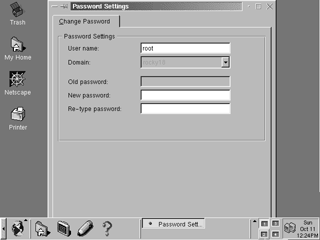
It reviewed well. It sold, by Corel's own numbers, almost nothing: LinuxOS revenue was about $2.7 million in fiscal 2000 — roughly 1.5% of the company — and falling.[5]
The $135 million handshake
On October 2, 2000 — seven weeks after Second Edition shipped, weeks after Cowpland resigned as CEO — Microsoft announced a "strategic alliance" with Corel: $135 million for 24 million non-voting convertible preferred shares, joint .NET work, and a settlement of legal disputes between the two companies.[6]
Buried in the SEC filing is the clause that tells the real story: on Microsoft's request, Corel was obligated to provide thirty full-time engineers — twenty developers and ten testers — to port the .NET platform to Linux. The company that built a Linux OS to escape Microsoft was now contractually available to port Microsoft's framework onto it.[7]
Whether the investment directly killed the distro or merely made the decision easy is argued about to this day. Wired's reporting was blunt: Corel had decided "not to enter into a head-to-head battle with Microsoft." What is not argued is the sequence — Cowpland out in August, Microsoft in October, and the Linux division gone by the following summer.
The Xandros afterlife
In August 2001, Corel sold the majority of its Linux division — code, team, and roadmap — to Xandros, a startup assembled by Linux Global Partners largely from the same engineers, for a reported ~$2 million plus a 5% equity stake. The strangest bid of the boxed-set era ended where many such stories do: the people kept the torch after the company dropped it.[8]
And the code kept working for years. Xandros Desktop shipped in 2002 on the Corel foundation — and in 2007, a version of Xandros came preinstalled on the ASUS Eee PC 701, the little netbook that sold out worldwide and briefly made "a mainstream Linux laptop for normal people" a shipping fact rather than a prophecy. The four-click installer's DNA made it onto more ordinary desktops than Corel itself ever did.
What it proved
Corel Linux demonstrated, early and at real expense, three things the desktop fight kept relearning:
- Polish was possible. A real company could ship a friendly, working, four-click Linux desktop in 1999. The technical problem was never the blocker everyone assumed.
- Motive was the blocker. The product died not of bugs but of incentives — a struggling application company could not sustain an OS war against its largest investor. Every later attempt (Linspire, Ubuntu's Unity push, the netbook wave) re-discovered some version of this.
- The code outlives the company. Debian underneath, KDE on top, Wine upstreamed, the team absorbed into Xandros, and Xandros onto the Eee PC — nothing Corel built was wasted, even though Corel itself kept almost none of it.
The Year of the Linux Desktop never came. But the boxed sets still exist, the screenshots survive, and somewhere out there the installs still boot.
Quiz
- Corel LinuxOS was built on Debian with a customized KDE desktop.
- Corel's WordPerfect and CorelDRAW work helped fund early Wine development.
- Microsoft's 2000 investment included an obligation for Corel to port .NET away from Linux.
- The Corel Linux codebase survived as Xandros, which later shipped on the Eee PC.
- Corel LinuxOS was discontinued because its installer was too difficult.
Show answers — click to check yourself
1. True — Debian base, customized KDE 1.x, apt behind the Corel Update tool. 2. True — Corel contracted CodeWeavers and upstreamed the improvements. 3. False — it was the reverse: Corel was obligated to port .NET to Linux on Microsoft's request — 30 engineers' worth. 4. True — sold August 2001; Xandros shipped 2002 and landed on the Eee PC 701 in 2007. 5. False — the four-click Install Express was the friendliest installer of its era; the distro died of incentives, not usability.
Notes
- All screenshots by Rocky L. Oliver.
- Whether Microsoft's investment directly killed the distro is contested; this article reports the sequence (Cowpland's resignation, the October 2000 alliance, the August 2001 sale) and the SEC-documented .NET-port obligation, and lets the reader weigh causation.
- "Linux for the rest of us" was the era's framing (ZDNet's launch coverage); exact box copy varied by edition.
- The Netwinder, WordPerfect 8, and Wine sponsorship are covered as motive context; each deserves its own article.
References
- ZDNet — "Comdex '99: Corel puts a penguin on the desktop," November 17, 1999.
- Corel Corporation FY2000 10-K (SEC) — Microsoft share purchase terms; the 30-FTE .NET-to-Linux port obligation; LinuxOS revenue ~$2.7M.
- Microsoft press release — "Corel and Microsoft Announce Strategic Alliance," October 2, 2000.
- Wired — "Xandros Buys Corel's Linux," August 2001.
- Corel LinuxOS Second Edition release, August 15, 2000 — download, regular, and Deluxe (WordPerfect Office bundle) editions.
- Screenshots by Rocky L. Oliver — LILO, boot splash, Install Express, and the KDE desktop of Corel LinuxOS 1.2.
Footnotes
- ↑ Corel LinuxOS entered public beta September 21, 1999 and released November 15, 1999; the Linux division was sold to Xandros in August 2001.
- ↑ WordPerfect 8 for Linux released 1998; Corel's Wine work via CodeWeavers was upstreamed; Corel acquired the Netwinder line in 1999.
- ↑ ZDNet, "Comdex '99: Corel puts a penguin on the desktop," November 17, 1999 — "the first end-user Linux."
- ↑ Corel LinuxOS Second Edition released August 15, 2000 in download, regular, and Deluxe editions; Deluxe bundled WordPerfect Office for Linux.
- ↑ Corel FY2000 SEC filing (10-K MD&A): LinuxOS-related revenue ~$2.7M, down 24% year over year.
- ↑ Microsoft press release, October 2, 2000 — $135M for 24M preferred shares at $5.625; .NET alliance and legal settlement.
- ↑ Corel FY2000 10-K: obligation to provide 30 FTEs (20 developers, 10 testers) to port .NET from Windows to Linux on Microsoft's request, through October 2003.
- ↑ Wired, "Xandros Buys Corel's Linux," August 2001 — majority of the division sold; reported ~$2M price; Xandros staffed by the same team.